The Pakistan-China Boundary Joint Commission
#GS-2 #Current Events #International #National #India-China Relations #Border Management
Key takeaways
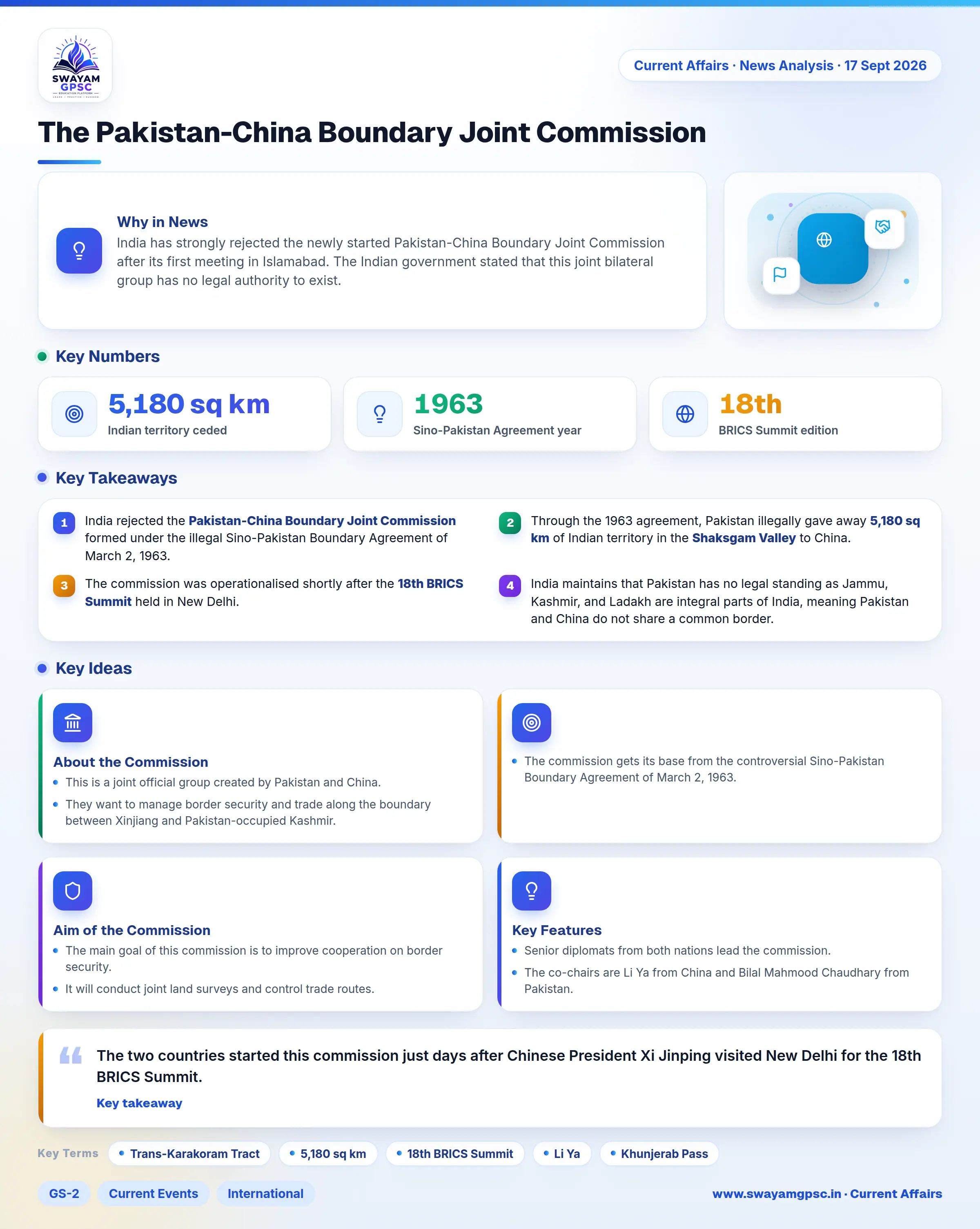
- India rejected the Pakistan-China Boundary Joint Commission formed under the illegal Sino-Pakistan Boundary Agreement of March 2, 1963.
- Through the 1963 agreement, Pakistan illegally gave away 5,180 sq km of Indian territory in the Shaksgam Valley to China.
- The commission was operationalised shortly after the 18th BRICS Summit held in New Delhi.
- India maintains that Pakistan has no legal standing as Jammu, Kashmir, and Ladakh are integral parts of India, meaning Pakistan and China do not share a common border.
Why in News
- India has strongly rejected the newly started Pakistan-China Boundary Joint Commission after its first meeting in Islamabad.
- The Indian government stated that this joint bilateral group has no legal authority to exist.
About the Commission
- This is a joint official group created by Pakistan and China.
- They want to manage border security and trade along the boundary between Xinjiang and Pakistan-occupied Kashmir.
- This area includes Gilgit-Baltistan and the Trans-Karakoram Tract which Pakistan gave to China.
Background
- The commission gets its base from the controversial Sino-Pakistan Boundary Agreement of March 2, 1963.
- Under this illegal pact, Pakistan gave away about 5,180 sq km of Indian land in the Shaksgam Valley to China.
- The two countries started this commission just days after Chinese President Xi Jinping visited New Delhi for the 18th BRICS Summit.
- During that summit, India and China had agreed to keep peace along the Line of Actual Control.
Aim of the Commission
- The main goal of this commission is to improve cooperation on border security.
- It will conduct joint land surveys and control trade routes.
- The group also aims to build better roads and transport links in the border areas.
Key Features
- Senior diplomats from both nations lead the commission.
- The co-chairs are Li Ya from China and Bilal Mahmood Chaudhary from Pakistan.
- The team has the power to carry out regular physical checks of the border.
- They will mark boundary lines and verify border pillars near the Karakoram passes.
- The group aims to improve customs rules and check-posts like the Khunjerab Pass.
- This will help secure trade routes connected to the China-Pakistan Economic Corridor (CPEC).
- It plans to simplify travel permits for local people and manage seasonal trade.
- It will also handle emergencies along the shared border area.
India's Stand
- India maintains that Pakistan and China do not share any direct international border.
- The Indian territories of Jammu, Kashmir, and Ladakh actually separate the two nations.
- The government strongly states that the entire region of Jammu, Kashmir, and Ladakh is an inseparable part of India.
- This has always been the case and will not change.
- India asserts that Pakistan has no legal right or standing to make border deals.
- Pakistan cannot sign agreements about Indian lands that it occupies illegally.
- India completely rejects the Sino-Pakistan Boundary Agreement of 1963.
- The government declares that neither this old pact nor any new joint commission can affect India's legal ownership of these lands.