Optimising Artificial Intelligence for Healthcare in India
#GS-2 #GS-3 #Governance & Social Justice #Health #Science & Technology #Artificial Intelligence #Infrastructure #Current Events #National
Key takeaways
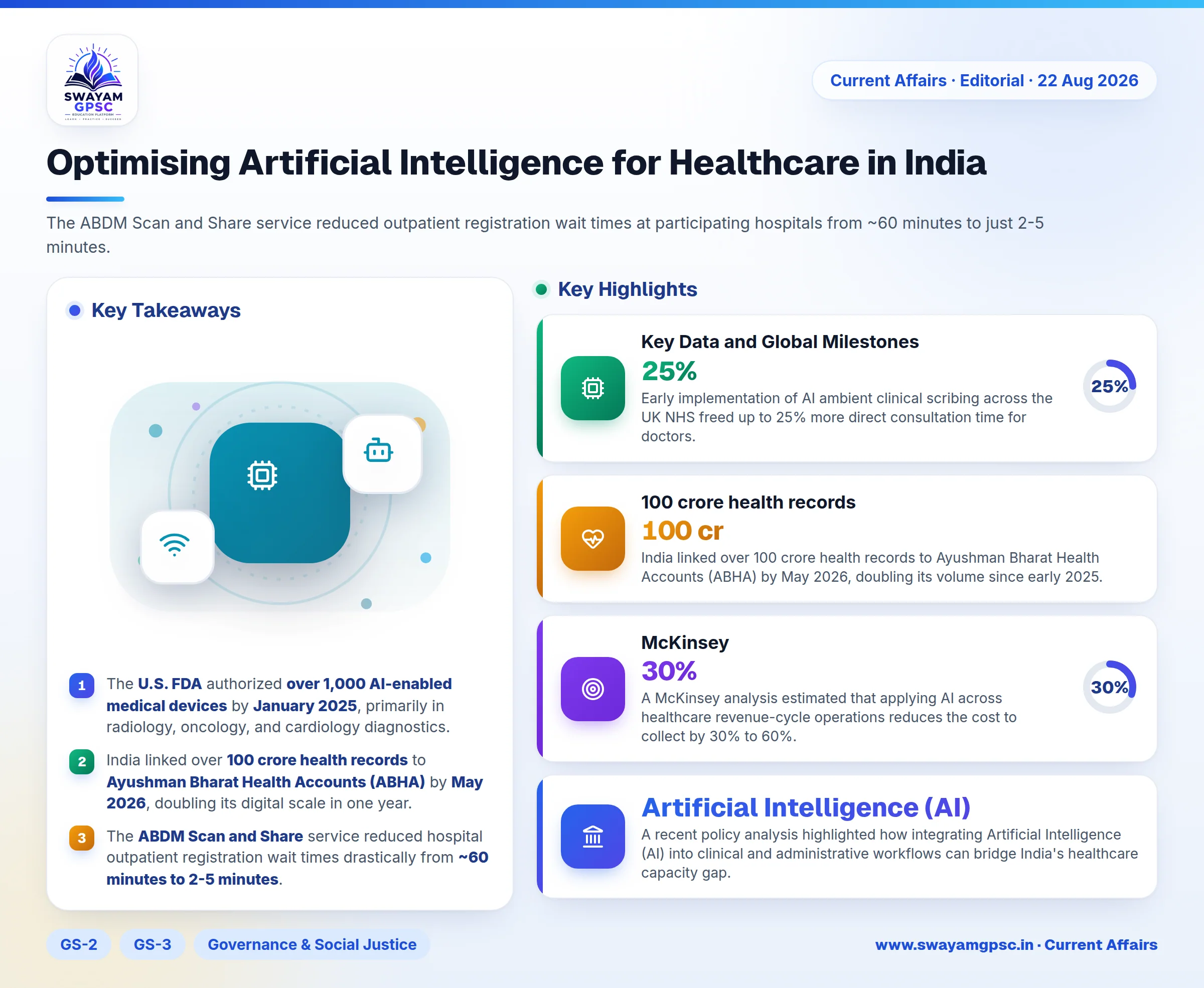
- The U.S. FDA authorized over 1,000 AI-enabled medical devices by January 2025, primarily in radiology, oncology, and cardiology diagnostics.
- India linked over 100 crore health records to Ayushman Bharat Health Accounts (ABHA) by May 2026, doubling its digital scale in one year.
- The ABDM Scan and Share service reduced hospital outpatient registration wait times drastically from ~60 minutes to 2-5 minutes.
- Applying AI models across healthcare revenue-cycle operations can lower administrative collection costs by 30% to 60%.
Why in News
- A recent policy analysis highlighted how integrating Artificial Intelligence (AI) into clinical and administrative workflows can bridge India's healthcare capacity gap.
Understanding AI Optimization in Healthcare
- Optimizing AI in healthcare involves deploying machine learning, natural language processing, and computer vision models. These tools enhance diagnostic accuracy, reduce administrative burden on clinicians, streamline hospital operations, and expand specialist care to underserved regions.
- Rather than replacing medical practitioners, clinical AI functions as a decision-support tool. It makes existing healthcare infrastructure more efficient, accessible, and preventive.
Key Data and Global Milestones
- By January 2025, the U.S. FDA authorized over 1,000 AI-enabled medical devices, primarily across radiology, oncology, and cardiology diagnostics.
- Early implementation of AI ambient clinical scribing across the UK NHS freed up to 25% more direct consultation time for doctors.
- India linked over 100 crore health records to Ayushman Bharat Health Accounts (ABHA) by May 2026, doubling its volume since early 2025.
- The ABDM Scan and Share service reduced outpatient registration wait times at participating hospitals from ~60 minutes to just 2-5 minutes.
- A McKinsey analysis estimated that applying AI across healthcare revenue-cycle operations reduces the cost to collect by 30% to 60%.
Key Applications and Strategic Benefits
- AI tools pre-screen and triage radiology scans like CT, MRI, and X-rays. They alert radiologists immediately to critical emergencies like intracranial hemorrhages or early-stage tumors.
- Automated voice-to-text NLP systems generate structured clinical documentation during patient visits, reducing physician burnout and paperwork fatigue.
- Tele-AI diagnostic suites allow local physicians in primary and secondary healthcare centers to access centralized specialist expertise in Tier-2 and Tier-3 hubs.
- Real-time analysis of electronic health records and ICU telemetry tracks vital signs to predict septic shock, cardiac arrest, or clinical deterioration hours in advance.
- Continuous remote monitoring enables risk-stratified intervention for chronic conditions like diabetes and hypertension before acute hospitalizations occur.
Challenges in AI Healthcare Deployment
- AI models trained on Western datasets may underperform across India's diverse demographic, genetic, socioeconomic, and regional disease patterns.
- Clinicians may hesitate to rely on complex deep-learning diagnostic outputs if the underlying algorithmic reasoning remains unexplainable.
- Centralizing and processing sensitive clinical records exposes hospital networks to potential data breaches and privacy risks without robust encryption.
- AI models verified in controlled clinical trials often experience accuracy degradation over time due to variations in local hardware and operator skills.
- Legal frameworks remain unclear regarding accountability when an AI-assisted recommendation contributes to a misdiagnosis or adverse clinical event.
Way Forward
- Authorities must mandate localized, multicentric clinical validation studies to ensure AI models perform accurately across diverse Indian populations.
- Healthcare systems must establish clear clinical protocols ensuring AI outputs remain strictly assistive, keeping ultimate accountability with licensed physicians.
- Policymakers should leverage the unified Ayushman Bharat Digital Mission (ABDM) health data exchange to feed standardized, anonymized records into certified clinical AI models.
- Governments need to enact statutory regulations defining medical device software liabilities, data privacy standards, and algorithmic transparency mandates.
- Deployments should prioritize high-impact friction points where clinical delays are most acute, such as emergency triage and rural point-of-care screening.
Conclusion
- Integrating Artificial Intelligence into healthcare offers a major opportunity to democratize medical expertise and optimize hospital capacity across India.
- Realizing this potential requires prioritizing clinical safety, population-specific representative datasets, and robust ethical oversight over rapid technological expansion.