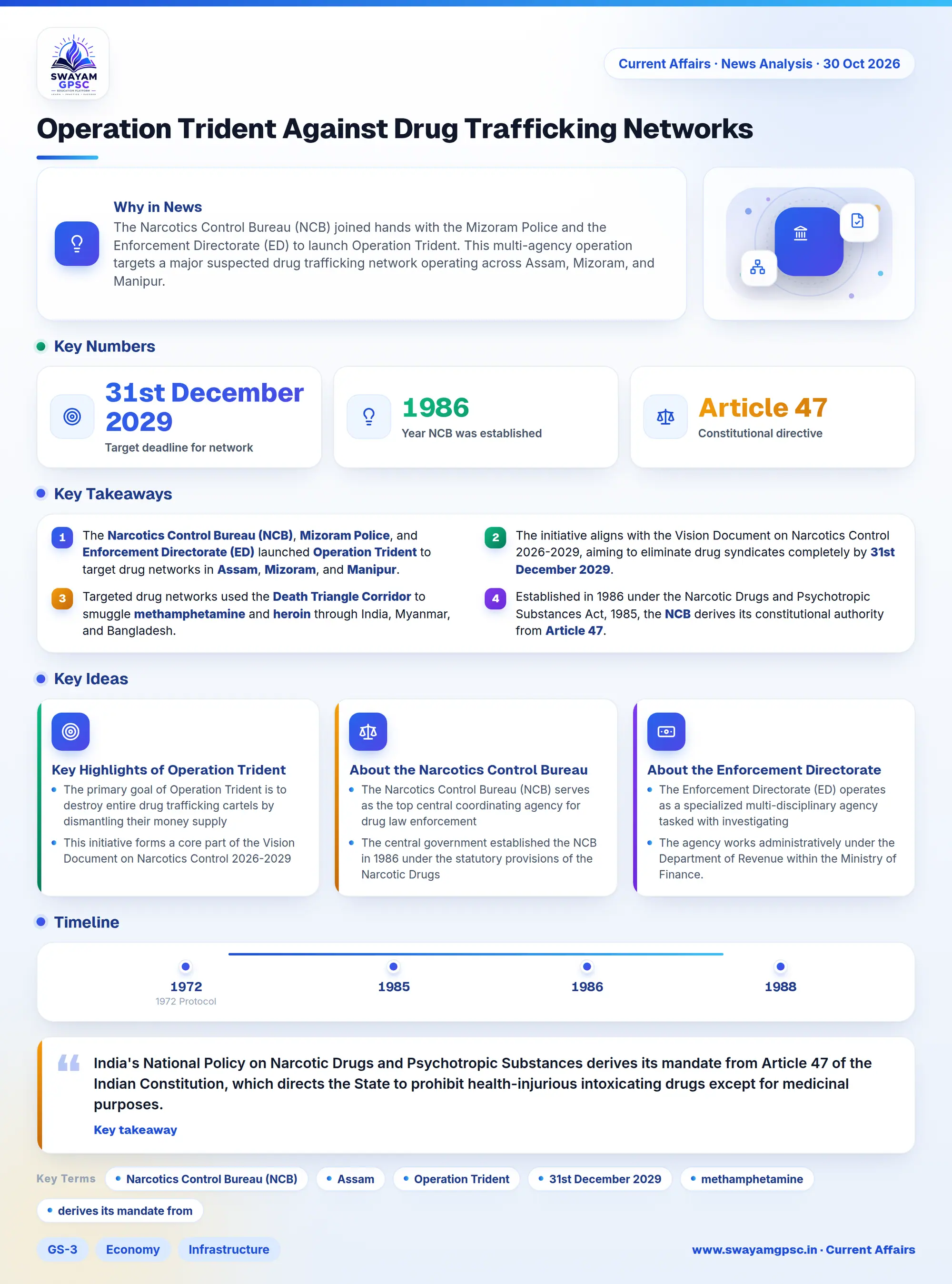
Operation Trident Against Drug Trafficking Networks
#GS-3 #Economy #Infrastructure #GS-2 #Governance & Social Justice #Regulatory Bodies #Current Events #National #Rapid Fire CA #Quick Facts For Prelims #Government Policies & Interventions
Key takeaways
- The Narcotics Control Bureau (NCB), Mizoram Police, and Enforcement Directorate (ED) launched Operation Trident to target drug networks in Assam, Mizoram, and Manipur.
- The initiative aligns with the Vision Document on Narcotics Control 2026-2029, aiming to eliminate drug syndicates completely by 31st December 2029.
- Targeted drug networks used the Death Triangle Corridor to smuggle methamphetamine and heroin through India, Myanmar, and Bangladesh.
- Established in 1986 under the Narcotic Drugs and Psychotropic Substances Act, 1985, the NCB derives its constitutional authority from Article 47.
Why in News
- The Narcotics Control Bureau (NCB) joined hands with the Mizoram Police and the Enforcement Directorate (ED) to launch Operation Trident.
- This multi-agency operation targets a major suspected drug trafficking network operating across Assam, Mizoram, and Manipur.
Key Highlights of Operation Trident
- The primary goal of Operation Trident is to destroy entire drug trafficking cartels by dismantling their money supply and supply chains rather than focusing only on individual drug seizures.
- This initiative forms a core part of the Vision Document on Narcotics Control 2026-2029, which sets a firm target to eliminate drug networks by 31st December 2029.
- The mission marks a strategic shift toward crippling the financial and corporate-style organizational structures of drug cartels.
- The targeted criminal network reportedly moved methamphetamine and heroin across India, Myanmar, and Bangladesh using the route known as the Death Triangle Corridor.
About the Narcotics Control Bureau
- The Narcotics Control Bureau (NCB) serves as the top central coordinating agency for drug law enforcement across India.
- The central government established the NCB in 1986 under the statutory provisions of the Narcotic Drugs and Psychotropic Substances Act, 1985.
- India's National Policy on Narcotic Drugs and Psychotropic Substances derives its mandate from Article 47 of the Indian Constitution, which directs the State to prohibit health-injurious intoxicating drugs except for medicinal purposes.
- The agency functions administratively under the Ministry of Home Affairs.
- India supports international anti-drug efforts as a signatory to key agreements including the Single Convention on Narcotic Drugs, 1961 (amended by the 1972 Protocol), the Convention on Psychotropic Substances, 1971, and the UN Convention against Illicit Traffic in Narcotic Drugs and Psychotropic Substances, 1988.
About the Enforcement Directorate
- The Enforcement Directorate (ED) operates as a specialized multi-disciplinary agency tasked with investigating financial crimes like money laundering and violations of foreign exchange regulations.
- The agency works administratively under the Department of Revenue within the Ministry of Finance.
- The central headquarters of the agency is located in New Delhi.