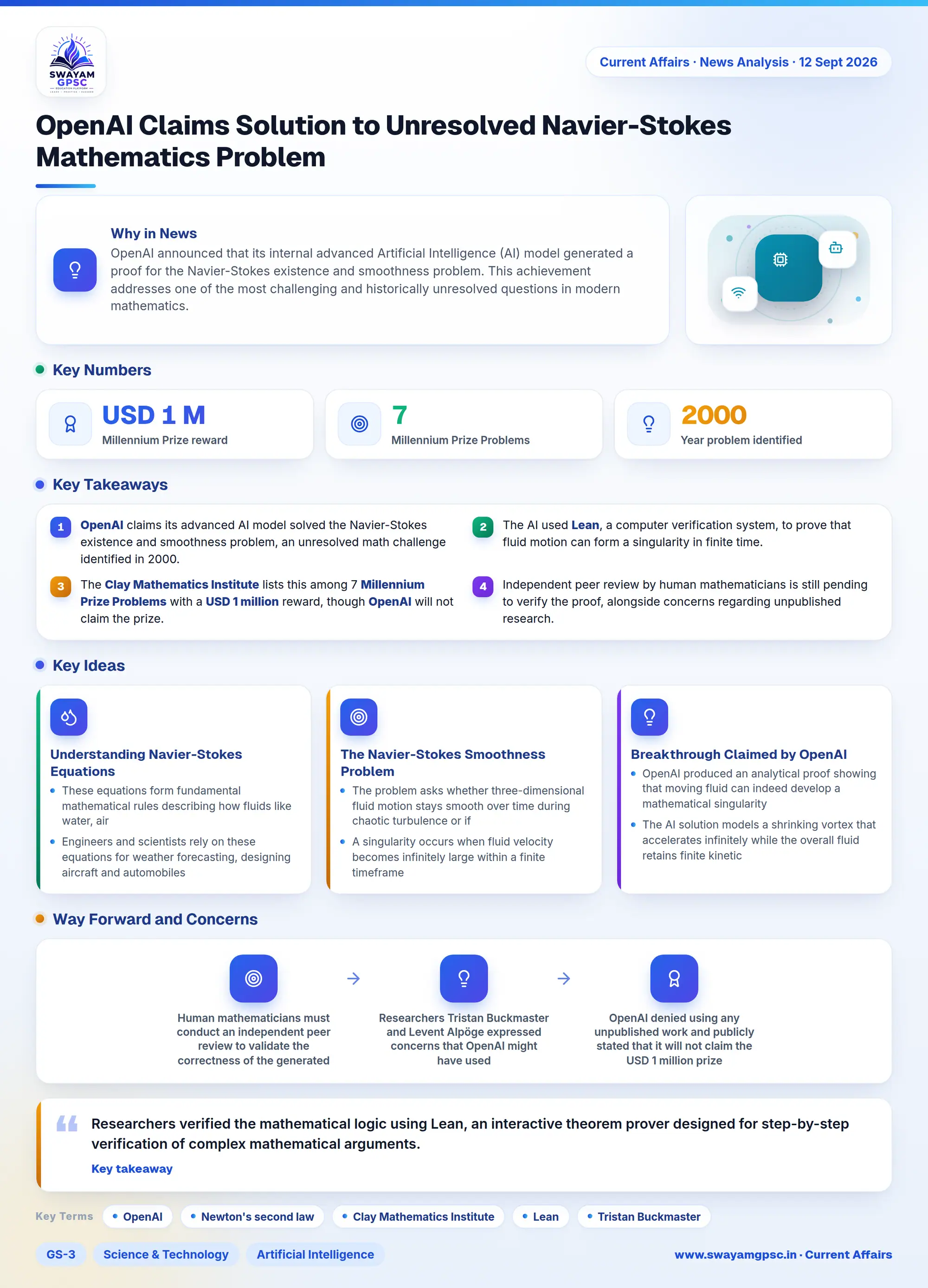
OpenAI Claims Solution to Unresolved Navier-Stokes Mathematics Problem
#GS-3 #Science & Technology #Artificial Intelligence #Rapid Fire CA #Quick Facts For Prelims #Mathematics
Key takeaways
- OpenAI claims its advanced AI model solved the Navier-Stokes existence and smoothness problem, an unresolved math challenge identified in 2000.
- The AI used Lean, a computer verification system, to prove that fluid motion can form a singularity in finite time.
- The Clay Mathematics Institute lists this among 7 Millennium Prize Problems with a USD 1 million reward, though OpenAI will not claim the prize.
- Independent peer review by human mathematicians is still pending to verify the proof, alongside concerns regarding unpublished research.
Why in News
- OpenAI announced that its internal advanced Artificial Intelligence (AI) model generated a proof for the Navier-Stokes existence and smoothness problem.
- This achievement addresses one of the most challenging and historically unresolved questions in modern mathematics.
Understanding Navier-Stokes Equations
- These equations form fundamental mathematical rules describing how fluids like water, air, and honey move based on mass conservation and Newton's second law.
- Engineers and scientists rely on these equations for weather forecasting, designing aircraft and automobiles, and predicting ocean currents.
The Navier-Stokes Smoothness Problem
- The problem asks whether three-dimensional fluid motion stays smooth over time during chaotic turbulence or if equations develop a breakdown point called a singularity.
- A singularity occurs when fluid velocity becomes infinitely large within a finite timeframe, causing the standard mathematical equations to fail.
- The Clay Mathematics Institute named this issue one of the seven Millennium Prize Problems in 2000, offering a USD 1 million reward for its solution.
Breakthrough Claimed by OpenAI
- OpenAI produced an analytical proof showing that moving fluid can indeed develop a mathematical singularity within a finite period.
- The AI solution models a shrinking vortex that accelerates infinitely while the overall fluid retains finite kinetic energy.
- Researchers verified the mathematical logic using Lean, an interactive theorem prover designed for step-by-step verification of complex mathematical arguments.
Way Forward and Concerns
- Human mathematicians must conduct an independent peer review to validate the correctness of the generated proof.
- Researchers Tristan Buckmaster and Levent Alpöge expressed concerns that OpenAI might have used their unpublished research without authorization.
- OpenAI denied using any unpublished work and publicly stated that it will not claim the USD 1 million prize money.