Oil Spills and Their Impacts
#GS-3 #Environment #Environmental Pollution & Degradation #Environmental Impact Assessment (EIA) #Water Resources #Conservation #Quick Facts For Prelims
Key takeaways
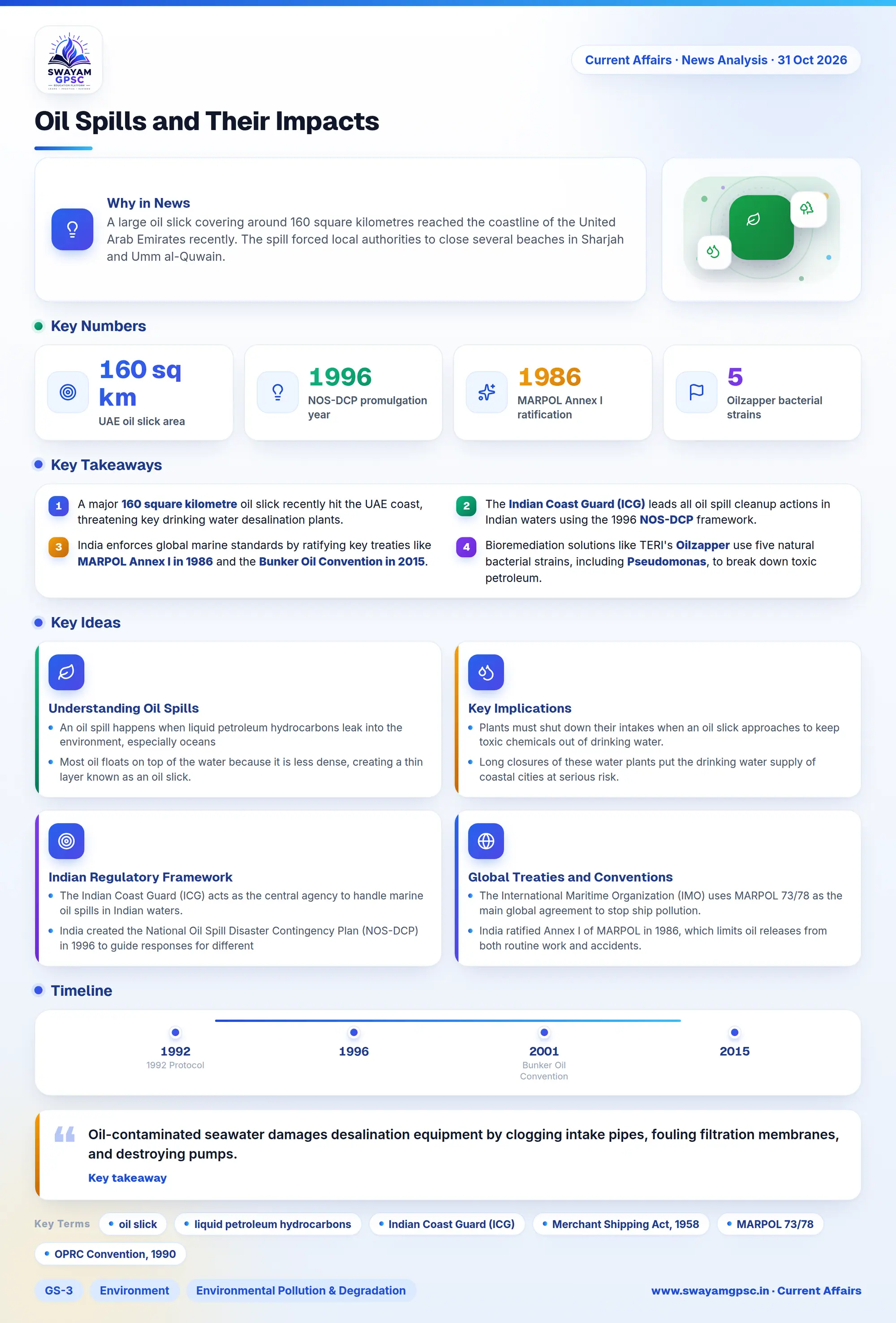
- A major 160 square kilometre oil slick recently hit the UAE coast, threatening key drinking water desalination plants.
- The Indian Coast Guard (ICG) leads all oil spill cleanup actions in Indian waters using the 1996 NOS-DCP framework.
- India enforces global marine standards by ratifying key treaties like MARPOL Annex I in 1986 and the Bunker Oil Convention in 2015.
- Bioremediation solutions like TERI's Oilzapper use five natural bacterial strains, including Pseudomonas, to break down toxic petroleum.
Why in News
- A large oil slick covering around 160 square kilometres reached the coastline of the United Arab Emirates recently.
- The spill forced local authorities to close several beaches in Sharjah and Umm al-Quwain.
- This incident threatens the region's desalination plants, which supply most of the local drinking water.
Understanding Oil Spills
- An oil spill happens when liquid petroleum hydrocarbons leak into the environment, especially oceans, due to human actions.
- Most oil floats on top of the water because it is less dense, creating a thin layer known as an oil slick.
- This floating layer spreads out and can form a thin, shiny layer on the surface.
- Heavier oil types or oil mixed with sand can sink and harm the seabed floor.
Key Implications
- Oil-contaminated seawater damages desalination equipment by clogging intake pipes, fouling filtration membranes, and destroying pumps.
- Plants must shut down their intakes when an oil slick approaches to keep toxic chemicals out of drinking water.
- Long closures of these water plants put the drinking water supply of coastal cities at serious risk.
- Oil layers block sunlight and stop oxygen exchange, while oil-eating bacteria consume dissolved oxygen and create dead zones.
- Oil smothers coastal creatures directly, causing severe harm to marine life like coral reefs.
- Toxic chemicals in crude oil lower the breeding success of ocean animals like fish, sea turtles, and seabirds.
- Spills harm coastal economies by stopping local fishing, scaring away tourists, and requiring expensive cleanup efforts.
Indian Regulatory Framework
- The Indian Coast Guard (ICG) acts as the central agency to handle marine oil spills in Indian waters.
- India created the National Oil Spill Disaster Contingency Plan (NOS-DCP) in 1996 to guide responses for different levels of spill emergencies.
- The Merchant Shipping Act, 1958 includes rules from the MARPOL agreement to control vessel pollution.
Global Treaties and Conventions
- The International Maritime Organization (IMO) uses MARPOL 73/78 as the main global agreement to stop ship pollution.
- India ratified Annex I of MARPOL in 1986, which limits oil releases from both routine work and accidents.
- India joined the OPRC Convention, 1990 to work with other countries during major ocean pollution emergencies.
- India follows the Civil Liability Convention (CLC) 1992 Protocol, which forces oil tanker owners to pay for spill damages.
- The Bunker Oil Convention (2001) covers fuel spills from all ocean ships, and India ratified it in 2015.
Measures to Clean Oil Spills
- Rescuers place floating fences called booms around the slick to stop it from spreading to sensitive areas.
- Special boats use skimmers to physically skim, scoop, and separate floating crude oil off the water surface.
- Cleaners spread absorbents like polyurethane foam, peat moss, or straw to soak up remaining oil.
- Workers spray chemical disperants like Corexit 9500 and Corexit 9527 to break slicks into tiny drops that natural microbes can eat.
- Teams release specific bacteria to eat and break down petroleum pollutants through bioremediation.
- Scientists use modified Pseudomonas bacteria strains to degrade complex oil compounds.
- The Energy and Resources Institute developed Oilzapper, a mix of five natural bacteria strains that break down petroleum.
- Rescuers sometimes set fire to floating oil through in-situ burning, though this releases black carbon and toxic smoke into the air.