Odisha Coastal Erosion: Status, Causes, and Solutions
#GS-3 #Environment #Climate Change #Geography #Coastal Erosion #Disaster Management
Key takeaways
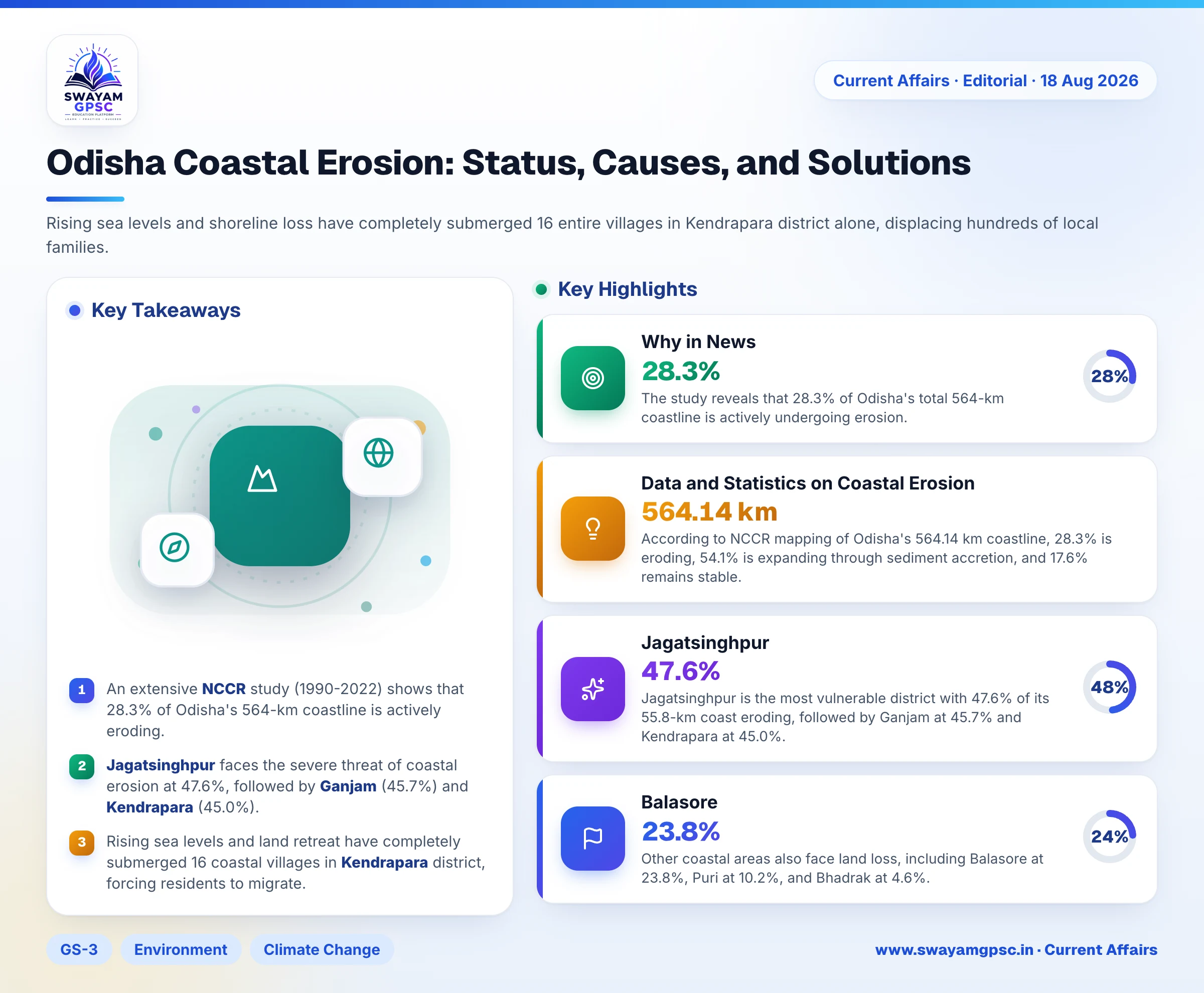
- An extensive NCCR study (1990-2022) shows that 28.3% of Odisha's 564-km coastline is actively eroding.
- Jagatsinghpur faces the severe threat of coastal erosion at 47.6%, followed by Ganjam (45.7%) and Kendrapara (45.0%).
- Rising sea levels and land retreat have completely submerged 16 coastal villages in Kendrapara district, forcing residents to migrate.
- Erosion damages key ecological habitats like Gahirmatha, which hosts the world's largest Arribada mass nesting grounds for endangered Olive Ridley sea turtles.
Why in News
- The Union Minister for Ports, Shipping and Waterways recently briefed the Rajya Sabha about coastal erosion along Odisha's shoreline.
- This update relies on a long-term scientific assessment conducted from 1990 to 2022 by the National Centre for Coastal Research (NCCR).
- The study reveals that 28.3% of Odisha's total 564-km coastline is actively undergoing erosion.
Understanding Coastal Erosion
- Coastal erosion is the continuous wearing away and landward movement of beach sand and dunes caused by waves, tidal currents, storm surges, and sand drift.
- In Odisha, severe tropical storms in the Bay of Bengal interact with artificial coastal structures to disrupt natural sand movement, resulting in shoreline retreat and land loss.
Data and Statistics on Coastal Erosion
- According to NCCR mapping of Odisha's 564.14 km coastline, 28.3% is eroding, 54.1% is expanding through sediment accretion, and 17.6% remains stable.
- Jagatsinghpur is the most vulnerable district with 47.6% of its 55.8-km coast eroding, followed by Ganjam at 45.7% and Kendrapara at 45.0%.
- Other coastal areas also face land loss, including Balasore at 23.8%, Puri at 10.2%, and Bhadrak at 4.6%.
- Rising sea levels and shoreline loss have completely submerged 16 entire villages in Kendrapara district alone, displacing hundreds of local families.
Causes of Coastal Erosion in Odisha
- Frequent high-intensity cyclones in the Bay of Bengal generate powerful storm surges that rapidly wash away sandy beaches.
- Global climate change causes seawater expansion and glacier melt, driving sea-level rise and pushing high tides further inland.
- Hard concrete marine structures like breakwaters, groynes, and sea walls for ports block the natural longshore movement of sand, causing severe downstream erosion.
- The historical destruction of coastal mangrove forests and sand dunes removes natural bio-shields that absorb wave energy.
- Unregulated beach sand mining combined with upstream river dams traps sediment, cutting off the natural sand supply to coastal deltas.
Implications of Coastal Erosion
- Complete land submergence forces coastal families into permanent migration, turning them into climate refugees without land titles or homes.
- Erosion damages fish landing centers, breaks artisanal fishing gear, and floods nearby farmland with saltwater, destroying rural incomes.
- Retracting shorelines undermine critical port facilities, coastal highways, and tourism infrastructure along popular beach corridors.
- Severe shoreline retreat at sites like Gahirmatha and the Devi river mouth damages mass nesting sites (Arribada) of endangered Olive Ridley sea turtles.
- Advancing seawater contaminates freshwater underground aquifers, creating severe drinking water shortages for nearby residents.
Way Forward
- Authorities should prioritize soft nature-based solutions, such as restoring mangrove forests and casuarina shelterbelts to absorb wave impact naturally.
- Engineers should use non-invasive hybrid structures like submerged geotextile tubes and sand replenishment, expanding on trial projects like the Pentha embankment.
- The state must enforce Coastal Regulation Zone (CRZ) norms and spatial plans using NCCR hazard mapping to stop unsafe construction in vulnerable areas.
- Government bodies need to establish a statutory climate resettlement policy to give displaced coastal refugees legal land rights, housing, and livelihood options.
- Authorities should deploy satellite remote sensing and local community surveillance to track seasonal beach changes and stop illegal sand mining.
Conclusion
- Odisha's eroding shoreline underscores the urgent threat of climate-driven land loss and environmental degradation along eastern India.
- Solving this crisis requires shifting away from temporary concrete sea walls toward integrated, nature-based management and fair climate resettlement policies.