An Ocean of Opportunity in Indian Ocean Region
#GS-2 #International Relations #Current Events #National #Economy #Infrastructure #Environment #Climate Change
Key takeaways
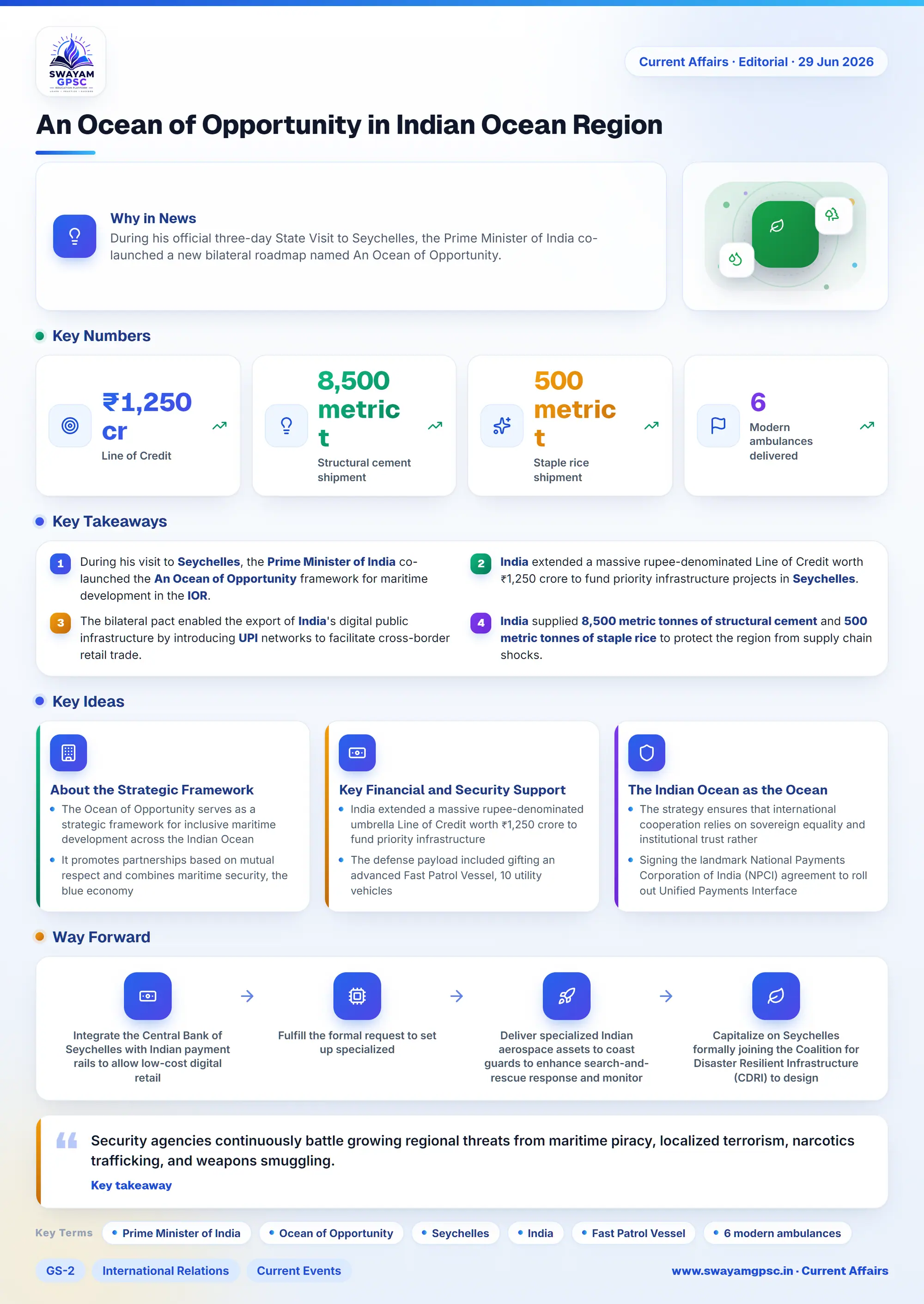
- During his visit to Seychelles, the Prime Minister of India co-launched the An Ocean of Opportunity framework for maritime development in the IOR.
- India extended a massive rupee-denominated Line of Credit worth ₹1,250 crore to fund priority infrastructure projects in Seychelles.
- The bilateral pact enabled the export of India's digital public infrastructure by introducing UPI networks to facilitate cross-border retail trade.
- India supplied 8,500 metric tonnes of structural cement and 500 metric tonnes of staple rice to protect the region from supply chain shocks.
- The maritime strategy addresses regional vulnerabilities like illegal fishing in exclusive economic zones (EEZ) and enhances search-and-rescue operations.
Why in News
- During his official three-day State Visit to Seychelles, the Prime Minister of India co-launched a new bilateral roadmap named An Ocean of Opportunity.
About the Strategic Framework
- The Ocean of Opportunity serves as a strategic framework for inclusive maritime development across the Indian Ocean Region (IOR).
- It promotes partnerships based on mutual respect and combines maritime security, the blue economy, digital connectivity, and climate resilience.
- The framework focuses particularly on Small Island Developing States such as Seychelles, Mauritius, Maldives, and Sri Lanka.
Key Financial and Security Support
- India extended a massive rupee-denominated umbrella Line of Credit worth ₹1,250 crore to fund priority infrastructure development projects in Seychelles.
- The defense payload included gifting an advanced Fast Patrol Vessel, 10 utility vehicles, and 5 Laser Radial class tactical boats to the Seychelles Defence Force.
- To protect the island from supply chain shocks, India shipped 8,500 metric tonnes of structural cement and 500 metric tonnes of staple rice as direct humanitarian subsidies.
- The medical package delivered the first batch of 6 modern ambulances along with a team of specialized Indian paramedics to train local technicians.
The Indian Ocean as the Ocean of Opportunities
- The strategy ensures that international cooperation relies on sovereign equality and institutional trust rather than military or economic size.
- Signing the landmark National Payments Corporation of India (NPCI) agreement to roll out Unified Payments Interface (UPI) networks makes cross-border retail trade very easy.
- The joint SESEL blueprint opens up new business pathways in healthcare, commercial space observation, and sustainable agriculture.
- The framework builds regional capacity by setting up decentralized vocational centers, such as the newly launched Seychelles Professional and Technical Education Centre.
- Joint marine science exploration allows member states to tap into underwater resources safely while protecting local ecosystems.
Challenges Associated with the IOR
- Security agencies continuously battle growing regional threats from maritime piracy, localized terrorism, narcotics trafficking, and weapons smuggling.
- Foreign deep-sea trawlers routinely breach exclusive economic zones (EEZ), destroying fragile marine ecosystems and threatening local fishing communities.
- Small island nations face severe vulnerabilities from rising sea levels and extreme weather anomalies.
- The entire region remains vulnerable to disruptions at maritime trade gates, where localized conflicts send logistics costs and insurance premiums soaring.
- The entry of non-regional powers trying to build deep-water dual-use naval assets creates high-stakes competition that threatens India as the primary net security provider.
Way Forward
- Integrate the Central Bank of Seychelles with Indian payment rails to allow low-cost digital retail transactions for tourists and businesses.
- Fulfill the formal request to set up specialized, Indian-backed defensive command hubs to safeguard local digital networks against cyber warfare.
- Deliver specialized Indian aerospace assets to coast guards to enhance search-and-rescue response and monitor economic zones.
- Capitalize on Seychelles formally joining the Coalition for Disaster Resilient Infrastructure (CDRI) to design climate-proof coastal installations and ports.
- Expand continuous joint naval patrols and satellite data sharing to protect vulnerable chokepoints against illegal fishing fleets.
Conclusion
- By matching ₹1,250 crore in financial assistance with cutting-edge upgrades like UPI integration and space technology pacts, India successfully aligned its MAHASAGAR doctrine with the needs of the Global South.
- Executing specialized AI cyber centers and scaling up patrol assets will remain vital to protect critical trade corridors and secure a peaceful maritime horizon.