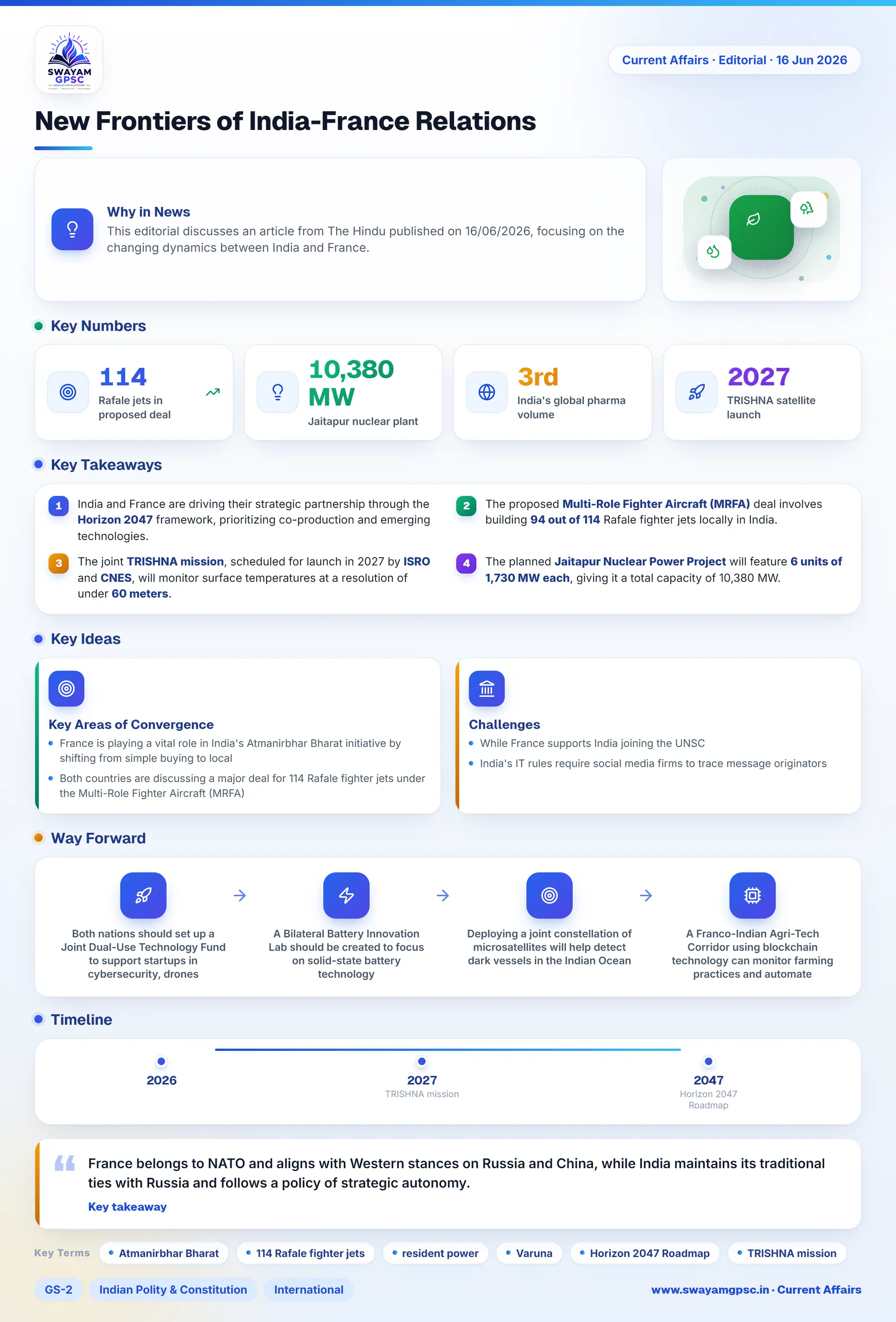
New Frontiers of India-France Relations
#GS-2 #Indian Polity & Constitution #International #Current Events #Economy #Infrastructure #Science & Technology #Environment #Sustainable Development #Effect of Policies & Politics of Countries on India's Interests
Key takeaways
- India and France are driving their strategic partnership through the Horizon 2047 framework, prioritizing co-production and emerging technologies.
- The proposed Multi-Role Fighter Aircraft (MRFA) deal involves building 94 out of 114 Rafale fighter jets locally in India.
- The joint TRISHNA mission, scheduled for launch in 2027 by ISRO and CNES, will monitor surface temperatures at a resolution of under 60 meters.
- The planned Jaitapur Nuclear Power Project will feature 6 units of 1,730 MW each, giving it a total capacity of 10,380 MW.
Why in News
- This editorial discusses an article from The Hindu published on 16/06/2026, focusing on the changing dynamics between India and France.
- Traditional security ties are now taking a back seat as innovation, digital cooperation, and joint technological research become the core pillars of this partnership.
Key Areas of Convergence
- France is playing a vital role in India's Atmanirbhar Bharat initiative by shifting from simple buying to local manufacturing and co-production.
- Both countries are discussing a major deal for 114 Rafale fighter jets under the Multi-Role Fighter Aircraft (MRFA) framework, where 94 of these 114 jets would be built locally.
- In the Indo-Pacific, India and France want to maintain a rules-based and open order, with France acting as a resident power through territories like La Réunion.
- The two militaries hold regular drills such as Varuna, Shakti, and Garuda, while logistics agreements let the Indian Navy use French bases in the Western Indian Ocean.
- Under the Horizon 2047 Roadmap, both governments are pushing joint research in advanced fields like Artificial Intelligence (AI) and quantum computing.
- The TRISHNA mission, a joint project between ISRO and CNES launching in 2027, will provide thermal images with a resolution better than 60 meters for better water management.
- India and France co-founded the International Solar Alliance (ISA) to promote clean energy, and France serves as co-chair for the Coalition for Disaster Resilient Infrastructure (CDRI).
- Through the Indo-Pacific Triangular Development Cooperation Fund, both countries help smaller nations in Africa and Asia achieve Sustainable Development Goals (SDGs).
- Both nations support a multipolar world and reject binary global blocs, allowing India to maintain strategic autonomy while France acts as a bridge with the European Union.
- Energy cooperation features the Jaitapur Nuclear Power Project, planned with a total capacity of 10,380 MW across 6 units of 1,730 MW each.
- The Reserve Bank of India (RBI) and Banque de France signed a memorandum in March 2026, and plans were made in June 2026 to expand UPI to Paris and Nice airports.
Challenges
- France belongs to NATO and aligns with Western stances on Russia and China, while India maintains its traditional ties with Russia and follows a policy of strategic autonomy.
- While France supports India joining the UNSC, India wants a complete restructuring of global bodies like the IMF and World Bank to reflect modern realities.
- India's IT rules require social media firms to trace message originators, which clashes with the GDPR standard of end-to-end encryption supported by the European Union.
- India's civil nuclear liability laws stalled the Jaitapur Nuclear Power Project (10,380 MW) for over a decade due to differing risk appetites compared to French operator EDF.
- India ranks third globally in drug production by volume, but strict intellectual property rules favored by French pharmaceutical firms create constant trade friction.
- France strongly defends the Common Agricultural Policy (CAP) and applies strict Sanitary and Phytosanitary (SPS) measures, which often leads to the rejection of Indian food exports.
- France prefers a transactional approach to climate finance, whereas India insists on the principle of Common But Differentiated Responsibilities (CBDR) for unconditional funding.
Way Forward
- Both nations should set up a Joint Dual-Use Technology Fund to support startups in cybersecurity, drones, and anti-satellite defense under the Bharat Innovates 2026 initiative.
- A Bilateral Battery Innovation Lab should be created to focus on solid-state battery technology and lithium-ion recycling to secure the renewable energy supply chain.
- Deploying a joint constellation of microsatellites will help detect dark vessels in the Indian Ocean and improve maritime awareness alongside the Information Fusion Centre-Indian Ocean Region (IFC-IOR).
- A Franco-Indian Agri-Tech Corridor using blockchain technology can monitor farming practices and automate compliance with strict EU food safety standards.
- Setting up urban living labs in smart cities will allow French firms to help test climate-resilient construction and water-recycling systems.
- An Economic Security Dialogue will help both countries protect their supply chains in critical sectors like semiconductors and green minerals.
- The Joint India-France AI Working Group should create unified standards by combining India's data protection architecture with the GDPR.
- Following the passage of the SHANTI Act, 2026, both countries should shift their nuclear focus toward Small Modular Reactors (SMRs) for safer energy deployment.