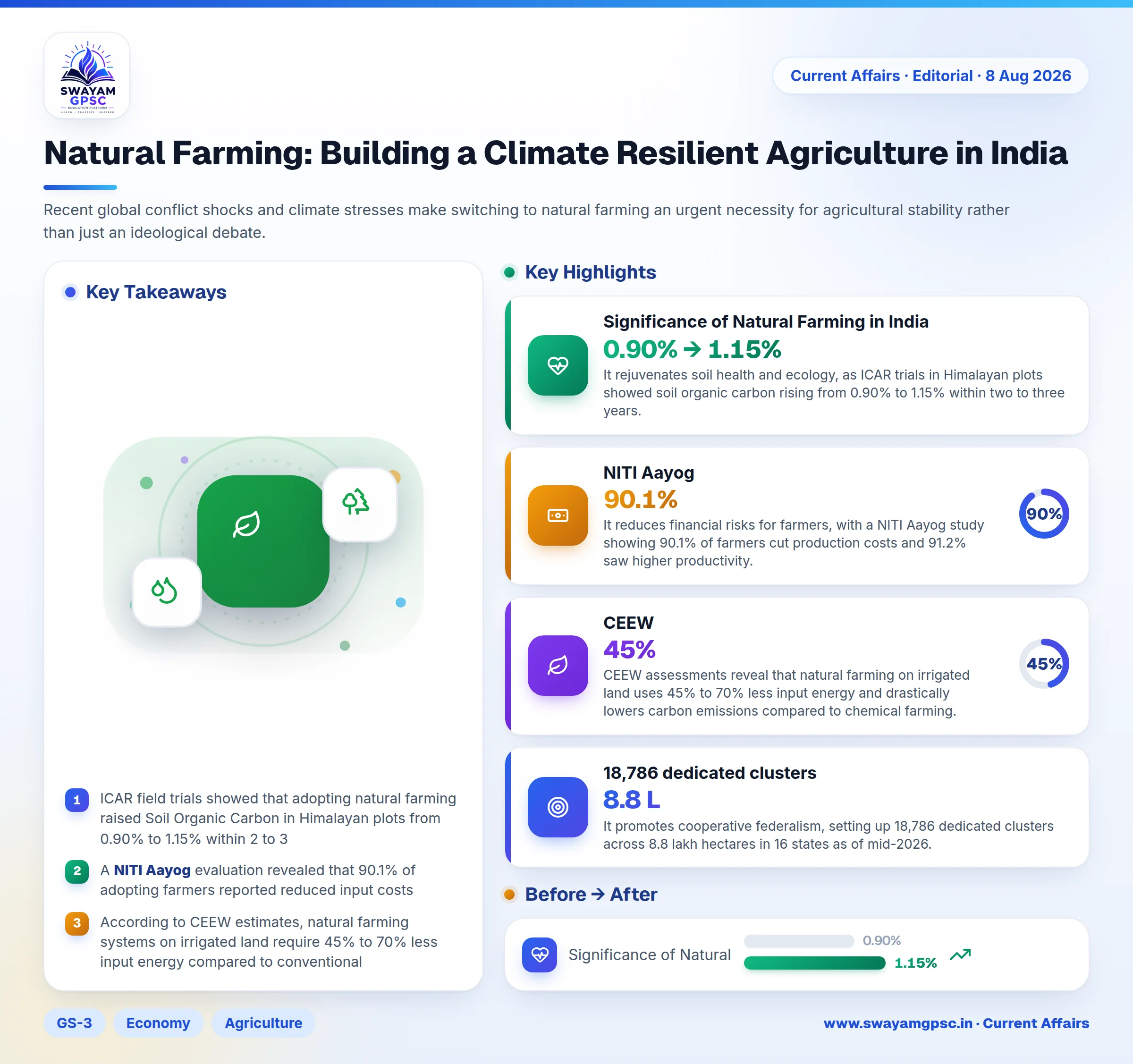
Natural Farming: Building a Climate Resilient Agriculture in India
#GS-3 #Economy #Agriculture #Environment #Sustainable Development #Climate Change #Environmental Pollution & Degradation #Food Security #Agricultural Marketing
Key takeaways
- ICAR field trials showed that adopting natural farming raised Soil Organic Carbon in Himalayan plots from 0.90% to 1.15% within 2 to 3 years.
- A NITI Aayog evaluation revealed that 90.1% of adopting farmers reported reduced input costs, while 91.2% experienced higher crop productivity.
- According to CEEW estimates, natural farming systems on irrigated land require 45% to 70% less input energy compared to conventional chemical farming.
- The National Mission on Natural Farming (NMNF) supports farmers with an incentive of Rs 4,000 per acre per year for two years during the transition phase.
- Under central-state cooperation, 18,786 dedicated clusters covering 8.8 lakh hectares have been established across 16 states as of mid-2026.
Why in News
- Recent global conflict shocks and climate stresses make switching to natural farming an urgent necessity for agricultural stability rather than just an ideological debate.
- Based on an editorial in The Hindu Businessline, scaling up natural farming successfully requires structured government support, phased transition plans, and local bio-input networks to protect crop yields.
What is Natural Farming?
- Natural Farming, also known in India as Prakritik Kheti, is an eco-friendly and chemical-free system that relies entirely on local biodiversity, farm waste, and natural processes.
- Unlike conventional farming that depends heavily on synthetic fertilizers, pesticides, deep tilling, and modified seeds, natural farming treats farmland as a living and self-sustaining ecosystem.
- The system operates on five core principles: zero synthetic chemicals, minimal soil tilling to protect earthworms, growing multiple crops together, keeping topsoil covered with organic mulching, and integrating local livestock.
- In India, this system is largely practiced through Zero Budget Natural Farming (ZBNF) using traditional preparations such as Jeevamrutha, Bijamrutha, Acchadana, and Waaphasa.
- Jeevamrutha is a fermented microbial mixture of cow dung, cow urine, jaggery, pulse flour, soil, and water that revives soil microbes and unlocks root nutrients.
- Bijamrutha is a seed treatment made of cow dung, urine, lime, and soil that protects sprouting seeds from fungal and soil-borne diseases.
- Acchadana uses dried straw or cover crops for mulching to conserve moisture, while Waaphasa maintains an air-moisture balance in the soil to reduce irrigation needs.
- Compared to organic farming, natural farming strictly minimizes external purchased inputs, avoids heavy tillage, and strongly relies on native livestock for preparing on-farm inputs.
Significance of Natural Farming in India
- It rejuvenates soil health and ecology, as ICAR trials in Himalayan plots showed soil organic carbon rising from 0.90% to 1.15% within two to three years.
- It reduces financial risks for farmers, with a NITI Aayog study showing 90.1% of farmers cut production costs and 91.2% saw higher productivity.
- CEEW assessments reveal that natural farming on irrigated land uses 45% to 70% less input energy and drastically lowers carbon emissions compared to chemical farming.
- Eliminating toxic agrochemicals improves nutrition, protects public health, and shields farm workers, consumers, and ecosystems from harmful chemicals under the National Mission on Natural Farming (NMNF).
- It empowers rural women by training over 33,676 Community Resource Persons and Krishi Sakhis as agricultural experts and leaders.
- It strengthens national input sovereignty by cutting dependence on foreign fertilizer imports from countries like Russia, Saudi Arabia, Jordan, and Morocco.
- It promotes cooperative federalism, setting up 18,786 dedicated clusters across 8.8 lakh hectares in 16 states as of mid-2026.
- It preserves agro-biodiversity, restores indigenous agricultural knowledge, prevents stubble burning, and treats farmers as responsible custodians of natural resources.
Challenges
- Yield outcomes remain uncertain across crops, as a CSTEP study in Andhra Pradesh noted yield declines of 0.3 to 0.7 tonnes per acre for groundnut, maize, and cotton under natural farming.
- The transition period carries financial risks, and the NMNF incentive of Rs 4,000 per acre per year for two years may not fully cover yield losses for large farms.
- Rigid application of standard formulas without soil testing can create nutrient imbalances across different crop types.
- Preparing bio-inputs and managing weeds requires heavy physical labor, which can increase the unpaid workload on rural women.
- Weak market linkages and low certification numbers exist, as only 4.73 lakh certificates were issued out of 11.86 lakh farmers registered under PGS-India Natural by February 2026.
- Completely removing chemical fertilizers without organic substitutes risks depleting soil nutrients, which could harm national food security.
- Landless farmers and non-livestock owners face difficulty accessing native cow dung and urine, making them dependent on unregulated bio-input sellers.
Way Forward
- The government should create a Natural Farming Suitability Atlas to map regional crop suitability, soil nutrient needs, and climate-specific protocols.
- Policy makers must design a 3 to 5 year transition package providing financial support, low-interest credit, and crop insurance against initial yield losses.
- Extension services should employ practicing natural farmers as paid trainers alongside support from Krishi Vigyan Kendras and agricultural universities.
- Decentralized Bio-input Resource Centres (BRCs) should be established through FPOs and women's self-help groups to provide quality-tested bio-inputs.
- Farmers should adopt diversified farming practices like crop rotation, intercropping, green manuring, and agroforestry rather than relying on simple input substitution.
- Authorities should establish a transparent certification system using QR codes, residue testing, and clear labels distinguishing natural, organic, and residue-free produce.
Conclusion
- Natural farming provides a sustainable pathway for India to restore soil health, protect the environment, and secure farmer livelihoods.
- Scaling this system nationwide requires scientific planning, structured financial support, and strong local institutions to ensure long-term food security.