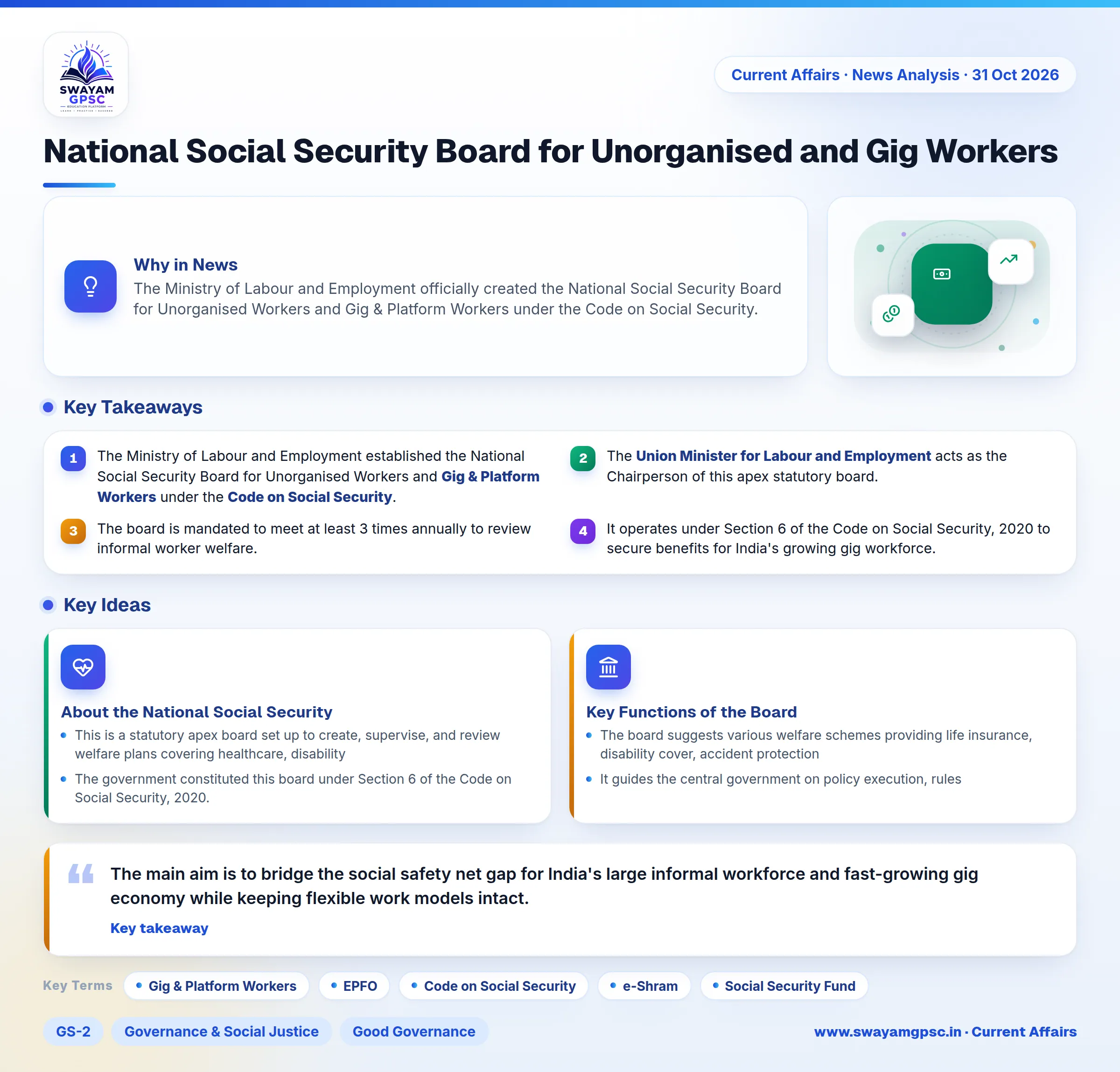
National Social Security Board for Unorganised and Gig Workers
#GS-2 #Governance & Social Justice #Good Governance #Economy #Employment #Labour #Social Security
Key takeaways
- The Ministry of Labour and Employment established the National Social Security Board for Unorganised Workers and Gig & Platform Workers under the Code on Social Security.
- The Union Minister for Labour and Employment acts as the Chairperson of this apex statutory board.
- The board is mandated to meet at least 3 times annually to review informal worker welfare.
- It operates under Section 6 of the Code on Social Security, 2020 to secure benefits for India's growing gig workforce.
Why in News
- The Ministry of Labour and Employment officially created the National Social Security Board for Unorganised Workers and Gig & Platform Workers under the Code on Social Security.
About the National Social Security Board
- This is a statutory apex board set up to create, supervise, and review welfare plans covering healthcare, disability, accidents, and pensions for informal and platform workers across India.
- The government constituted this board under Section 6 of the Code on Social Security, 2020.
- The main aim is to bridge the social safety net gap for India's large informal workforce and fast-growing gig economy while keeping flexible work models intact.
- The Union Minister for Labour and Employment serves as the Chairperson of this board.
- The board includes government officials from central and state departments, representatives from EPFO and ESIC, and members from digital platform companies.
- It also features representatives from trade unions, gig worker groups, and civil society organisations.
- The board must hold meetings at least 3 times every year.
Key Functions of the Board
- The board suggests various welfare schemes providing life insurance, disability cover, accident protection, health care, maternity support, and old-age benefits.
- It guides the central government on policy execution, rules, and administrative hurdles related to the Code on Social Security.
- The members review how well central social security schemes run and how easily workers can access them.
- The board checks worker registration databases, e-Shram links, and digital records kept by states and union territories.
- It monitors money spent from the Social Security Fund, checking government grants and aggregator fees.