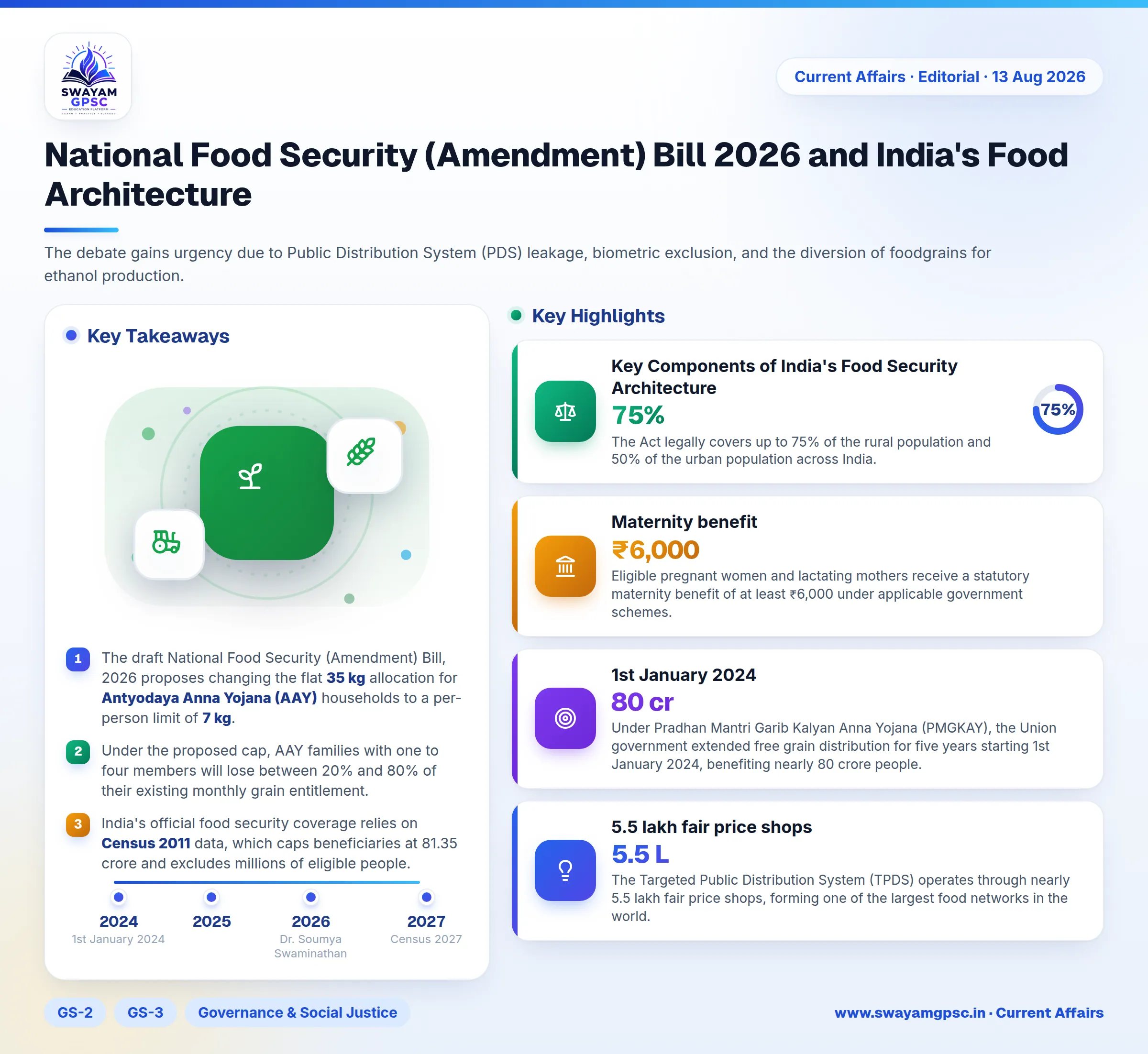
National Food Security (Amendment) Bill 2026 and India's Food Architecture
#GS-2 #GS-3 #Governance & Social Justice #Economy #Food Security #Poverty & Hunger #Government Policies & Interventions
Key takeaways
- The draft National Food Security (Amendment) Bill, 2026 proposes changing the flat 35 kg allocation for Antyodaya Anna Yojana (AAY) households to a per-person limit of 7 kg.
- Under the proposed cap, AAY families with one to four members will lose between 20% and 80% of their existing monthly grain entitlement.
- India's official food security coverage relies on Census 2011 data, which caps beneficiaries at 81.35 crore and excludes millions of eligible people.
- In 2025-26, the government allocated roughly 44 lakh tonnes of FCI rice and 68 lakh tonnes of maize for ethanol production, creating a food-versus-fuel conflict.
- Child stunting in India declined from 35.5% in NFHS-5 to 29.3% in NFHS-6, but severe malnutrition and dietary deficiencies persist across states.
Why in News
- Leading public health experts, including Dr. Soumya Swaminathan and Dr. V. Mohan, recently highlighted the policy impacts of the draft National Food Security (Amendment) Bill, 2026.
- The proposed draft replaces the fixed monthly quota of 35 kg per Antyodaya Anna Yojana (AAY) household with a size-linked limit of 7 kg per person.
- This cap renews intense debate over whether welfare reforms should reduce grain quotas or preserve minimum entitlements while adding pulses, protein foods, and edible oils.
- The debate gains urgency due to Public Distribution System (PDS) leakage, biometric exclusion, and the diversion of foodgrains for ethanol production.
What is Food Security?
- Food security exists when all individuals have physical, social, and economic access to safe and nutritious food at all times for an active life.
- The first dimension, Availability, requires adequate food production, imports, and buffer stocks managed through Minimum Support Price (MSP) procurement by the Food Corporation of India (FCI).
- The second dimension, Access, ensures that families possess physical and economic means to obtain food through the National Food Security Act (NFSA), PDS, and PMGKAY.
- The third dimension, Utilisation, focuses on proper nutrition, health, and sanitation through initiatives like Anganwadi Services and PM POSHAN.
- The fourth dimension, Stability, guarantees continuous access during economic or environmental shocks using buffer norms and portable ration cards.
- A country can hold massive grain reserves and still suffer from malnutrition if families cannot afford diverse foods or lack clean water and sanitation.
Key Components of India's Food Security Architecture
- The National Food Security Act, 2013 transformed discretionary food aid into a legal entitlement to ensure nutritional security and human dignity.
- The Act legally covers up to 75% of the rural population and 50% of the urban population across India.
- Under NFSA, Priority Household members receive 5 kg of foodgrains per person every month at subsidized prices.
- Present provisions grant each AAY family a fixed quota of 35 kg of foodgrains per month regardless of family size.
- The law guarantees free meals and nutritional support for pregnant women, lactating mothers, and children through local Anganwadi centres.
- Eligible pregnant women and lactating mothers receive a statutory maternity benefit of at least ₹6,000 under applicable government schemes.
- The Act mandates a food-security allowance if the government fails to supply entitlement foodgrains or meals to beneficiaries.
- Administrative mechanisms include State Food Commissions, District Grievance Redressal Officers, social audits, and mandatory local vigilance committees.
- The Act empowers women by designating the eldest woman aged 18 years or above as the official head of the household for ration cards.
- The Antyodaya Anna Yojana specifically targets the poorest families, protecting small vulnerable households like single elderly citizens, widows, and persons with disabilities.
- Under Pradhan Mantri Garib Kalyan Anna Yojana (PMGKAY), the Union government extended free grain distribution for five years starting 1st January 2024, benefiting nearly 80 crore people.
- The Targeted Public Distribution System (TPDS) operates through nearly 5.5 lakh fair price shops, forming one of the largest food networks in the world.
- The One Nation One Ration Card (ONORC) scheme allows migrant workers to buy foodgrains from any electronic Point of Sale (e-PoS) shop across the country.
Draft National Food Security (Amendment) Bill, 2026
- The draft bill amends the first proviso to Section 3(1) of the National Food Security Act, 2013.
- It proposes giving each AAY beneficiary 7 kg of foodgrains per month, subject to a maximum ceiling of 35 kg per household.
- Under this new formula, only households with five or more members will receive the full allocation of 35 kg.
- Small families with one to four members will lose between 20% and 80% of their current monthly ration entitlement.
- Families with five or more members receive no additional grain because of the rigid 35 kg upper ceiling.
- Proponents argue that the amendment corrects per-person inequity where a seven-member AAY family receives only 5 kg per person, while a single-member family gets 35 kg.
- The government aims to improve fiscal discipline and optimize public grain management by reducing excess food subsidies.
- Demographic shifts such as urbanization, nuclear families, and population ageing require updating entitlement structures to reflect actual household needs.
- Critics highlight that the bill reduces grain access for small families without providing compensatory benefits to larger families, making it a retrenchment measure.
- The reduction heavily impacts vulnerable groups like elderly people living alone, widows, disabled citizens, and families affected by migration.
- Data from Tamil Nadu shows that 84.5% of its 18.64 lakh AAY households have fewer than five members, which would cut state grain allocations by 35.6%.
- Women often act as household food buffers by eating last, meaning reduced rations will worsen female malnutrition without showing in average consumption data.
- The Central Government will continue to determine the overall coverage of AAY beneficiaries for each state under the revised law.
Progress Made in Food and Nutrition Security
- Large rights-based food programs protected vulnerable citizens from severe hunger during the Covid-19 pandemic and global price volatility.
- According to NFHS-6 (2023-24), child stunting among children under five dropped from 35.5% in NFHS-5 to 29.3%.
- Severe child wasting also declined from 7.7% in NFHS-5 to 5.2% in NFHS-6.
- The Household Consumption Expenditure Survey showed rural monthly per-capita spending increased from ₹3,773 in 2022-23 to ₹4,122 in 2023-24.
- The proportion of households unable to afford an ICMR-NIN recommended healthy diet dropped from 52% in 2011-12 to 25% in 2023-24.
- By late 2025, approximately 5.50 lakh of 5.51 lakh fair price shops installed electronic devices supporting nationwide portability.
- India maintains strong public procurement and buffer stocks to support farmers and stabilize open market consumer prices.
Challenges
- Beneficiary caps remain anchored to Census 2011 data, covering only 55.6% of the estimated 146 crore population in 2025 instead of the intended 67%.
- Widespread reports from several states expose PDS grain leaks, fake records, under-weighing, and illegal sales for industrial uses.
- Allocating 11 lakh tonnes of FCI rice for ethanol production could have provided full yearly AAY rations to roughly 3.1 lakh poor families.
- Essential nutrient sources like pulses, edible oils, eggs, and vegetables remain excluded from central food security distribution schemes.
- NFHS-6 records child wasting at 19% and underweight prevalence at 31.8%, with only 15% of young children receiving a minimum acceptable diet.
- The 2021 ICMR-INDIAB study found 101 million people living with diabetes and 136 million with prediabetes in India.
- A 2025 ICMR-INDIAB study revealed that Indians derive 62.3% of daily energy from carbohydrates and only 12% from protein, raising type-2 diabetes risks.
- The State of Food Security and Nutrition in the World (SOFI) 2026 report shows that 32.7% of the global population cannot afford a healthy diet.
- In 2025-26, biofuel production consumed 44 lakh tonnes of FCI rice and 68 lakh tonnes of maize, inflating market prices for food and feed.
- Rigid Aadhaar seeding and e-KYC mandates caused states to cancel 2.49 crore ration cards since 2020, excluding elderly citizens and manual labourers.
- High post-harvest costs account for 70-75% of healthy food retail prices due to inadequate cold chains and rural processing infrastructure.
- Large releases under the Open Market Sales Scheme (OMSS), such as 25 lakh tonnes of wheat in 2024-25, deplete critical emergency buffer reserves.
Way Forward
- Parliament must enact a protection clause ensuring that no AAY household receives less than its current 35 kg monthly quota.
- The Union government should update beneficiary ceilings using updated population figures before completing Census 2027.
- States must establish dynamic inclusion mechanisms so that no ration card gets cancelled without written notice, clear reasons, and a formal appeal.
- The government should introduce a nutrition-sensitive PDS offering subsidized pulses, millets, and healthy edible oils alongside standard cereals.
- India must shift biofuel production toward second-generation non-food biomass like crop residues and organic waste.
- Authorities should implement end-to-end digital tracking with GPS logging from FCI depots to fair price shops and industrial buyers.
- Alternative verification options like offline tokens, OTPs, and doorstep delivery must be guaranteed when biometric systems fail.
- Independent State Food Commissions require dedicated budgets, staff, and powers to enforce grievance redressal and conduct social audits.