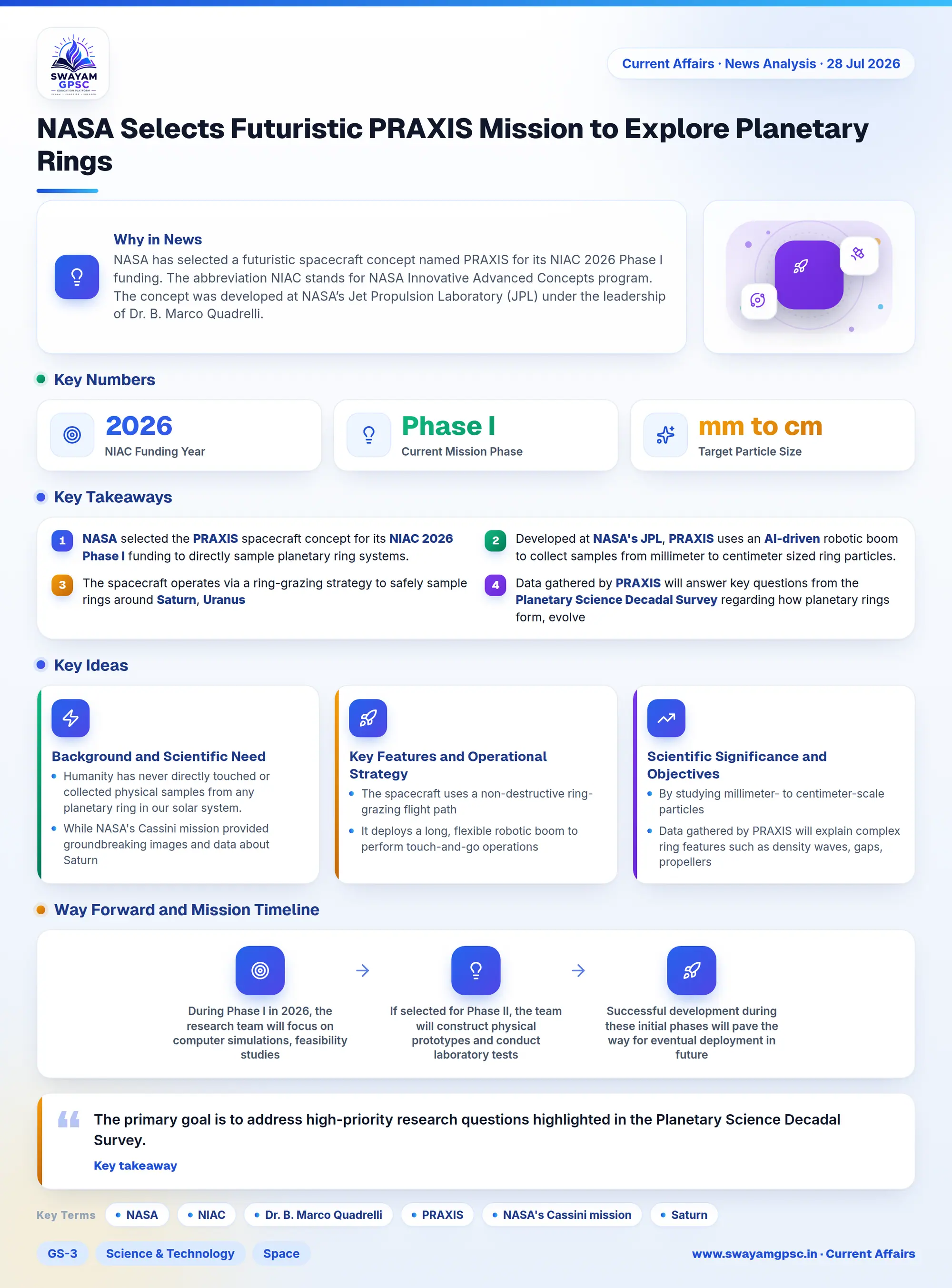
NASA Selects Futuristic PRAXIS Mission to Explore Planetary Rings
#GS-3 #Science & Technology #Space #NASA #Planetary Exploration #Current Events
Why in News
- **NASA** has selected a futuristic spacecraft concept named **PRAXIS** for its **NIAC 2026 Phase I** funding.
- The abbreviation **NIAC** stands for **NASA Innovative Advanced Concepts** program.
- The concept was developed at **NASA’s Jet Propulsion Laboratory (JPL)** under the leadership of **Dr. B. Marco Quadrelli**.
- **PRAXIS** stands for **Planetary Rings Autonomous EXploration with In-situ Sampling**.
- It aims to become the very first space mission to directly touch and collect samples from planetary ring systems in deep space.
Background and Scientific Need
- Humanity has never directly touched or collected physical samples from any planetary ring in our solar system.
- While **NASA's Cassini mission** provided groundbreaking images and data about **Saturn**, fundamental questions about ring formation remain unanswered.
- Scientists still do not fully understand how ring systems originate, evolve over time, and eventually disappear.
- Rings around planets like **Saturn**, **Uranus**, and **Neptune**, as well as smaller bodies like **Chariklo** and **Chiron**, consist mainly of water ice.
- Particle sizes in **Saturn's** rings range from microscopic dust grains to house-sized boulders that constantly collide and break apart.
- Earlier missions lacked the technology to observe millimeter- to centimeter-sized particles at close range, creating a critical gap in planetary science.
Key Features and Operational Strategy
- The spacecraft uses a non-destructive ring-grazing flight path, hovering safely outside the ring plane to avoid dangerous high-velocity debris.
- It deploys a long, flexible robotic boom to perform touch-and-go operations, tapping target particles and snagging free-floating material safely.
- An onboard **AI** system handles autonomous navigation, real-time collision avoidance, and target selection without waiting for commands from Earth.
- Miniaturized onboard instruments will conduct immediate in-situ analysis of particle size, porosity, structure, and chemical composition.
- After sampling one area, the spacecraft can move to another gap or section to compare particles across different ring environments.
Scientific Significance and Objectives
- The primary goal is to address high-priority research questions highlighted in the **Planetary Science Decadal Survey**.
- By studying millimeter- to centimeter-scale particles, scientists hope to unravel the exact origin and dynamic evolution of planetary rings.
- Data gathered by **PRAXIS** will explain complex ring features such as density waves, gaps, propellers, and self-gravity wakes.
- The mission will successfully bridge the observational gap between microscopic dust and massive boulders in ring systems.
Way Forward and Mission Timeline
- During **Phase I** in **2026**, the research team will focus on computer simulations, feasibility studies, and detailed system design.
- If selected for **Phase II**, the team will construct physical prototypes and conduct laboratory tests to demonstrate technical feasibility.
- Successful development during these initial phases will pave the way for eventual deployment in future deep-space exploration missions to outer planets.