Monetization of Homemakers Labour
#GS-1 #Indian Society #Women #Social Justice #Economy #Growth
Key takeaways
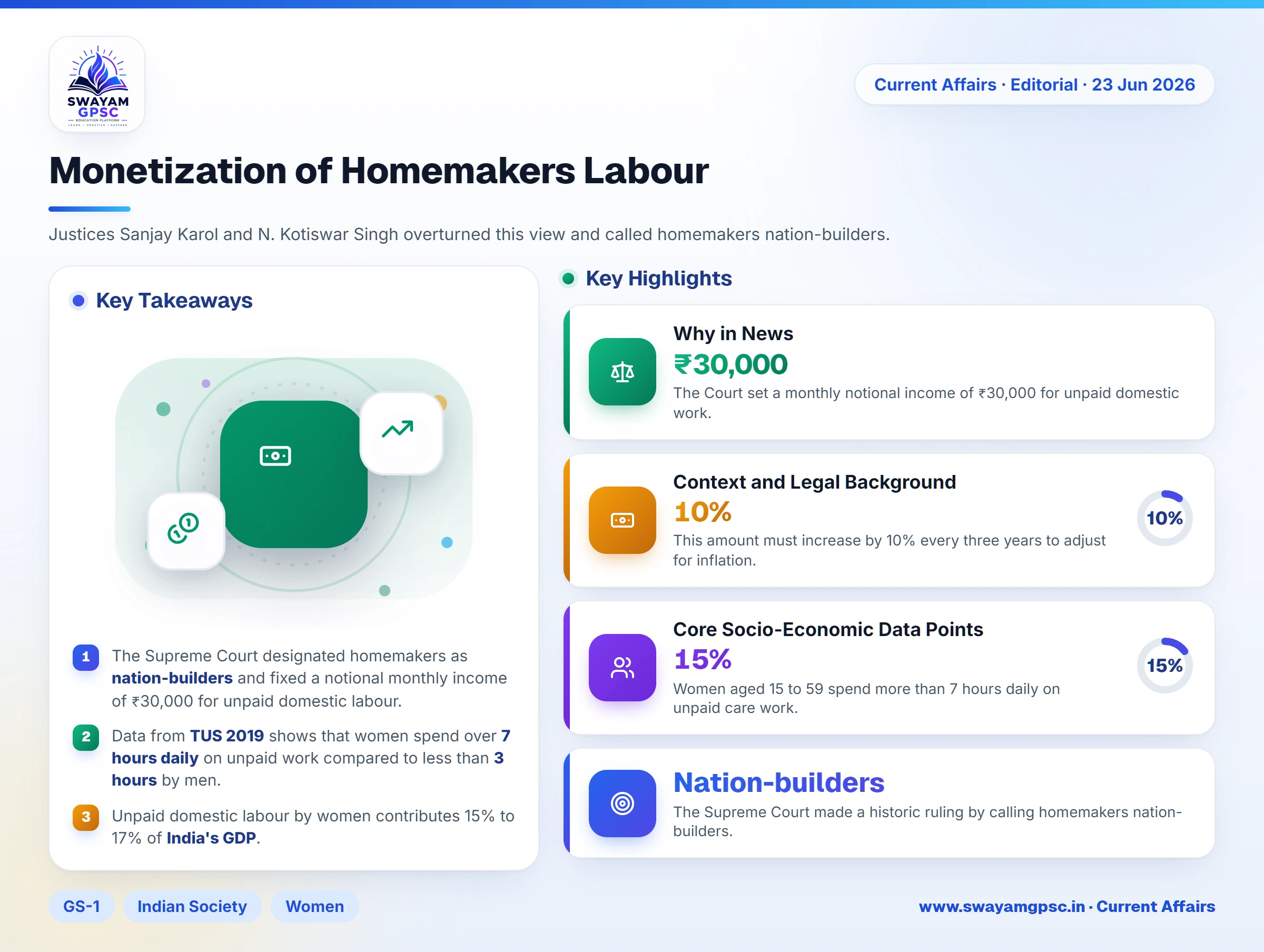
- The Supreme Court designated homemakers as nation-builders and fixed a notional monthly income of ₹30,000 for unpaid domestic labour.
- Data from TUS 2019 shows that women spend over 7 hours daily on unpaid work compared to less than 3 hours by men.
- Unpaid domestic labour by women contributes 15% to 17% of India's GDP.
- The baseline income amount requires a 10% increase every three years to offset inflation.
Why in News
- The Supreme Court made a historic ruling by calling homemakers nation-builders.
- The Court set a monthly notional income of ₹30,000 for unpaid domestic work.
- This judgment fixes a long-standing economic blind spot by legally recognizing the financial value of women at home.
Context and Legal Background
- The case started from a 25-year-old motor accident compensation claim in Punjab.
- A lower tribunal initially treated a dead woman as a mere financial dependent with very little economic worth.
- Justices Sanjay Karol and N. Kotiswar Singh overturned this view and called homemakers nation-builders.
- The apex court fixed a base amount of ₹30,000 per month for unpaid work.
- This amount must increase by 10% every three years to adjust for inflation.
- If a woman earns a salary and also does housework, the ₹30,000 must be added to her salary instead of replacing it.
Core Socio-Economic Data Points
- The Court rejected the old idea that homemakers are mere dependents.
- Data from the Time Use Survey (TUS) 2019 by the National Sample Survey Office (NSSO) shows huge gender gaps.
- Women aged 15 to 59 spend more than 7 hours daily on unpaid care work.
- Men in the same age group spend less than 3 hours a day on these chores.
- Working women do 2.6 times more unpaid care work than men.
- Unpaid domestic work by women adds about 15% to 17% to India's Gross Domestic Product (GDP).
Multi-Dimensional Implications
- This creates a clear standard rule for all future accident and insurance claims across India.
- It changes household work from a pious duty into a legal economic service with real rights.
- It brings the idea of notional value into state economic planning.
- It highlights the hidden burden that stops women from joining formal jobs.
- It challenges old social norms that treat unpaid housework as free labour.
- It gives women strong psychological and legal respect inside their homes.
Challenges
- This rule currently applies only to tort law and accident compensation cases.
- It does not automatically apply to family disputes or divorce alimony cases.
- Praising domestic roles too much might trap women inside the kitchen by reinforcing old stereotypes.
- A flat rate of ₹30,000 does not fit different living costs in villages and big cities.
- It also ignores the extra hard work needed to care for babies, sick people, or old family members.
Way Forward
- Parliament should update family laws so unpaid housework is counted during divorce and property division.
- The Ministry of Statistics and Programme Implementation (MoSPI) should create Satellite Accounts to measure unpaid care work in national budgets.
- The government must invest in public child care centers like the Palna scheme and care units for the elderly.
- Public policy must encourage men to share housework equally by offering proper paternal leave.