Modernizing India's Public Distribution System
#GS-2 #Governance & Social Justice #Poverty #Hunger #Government Policies & Interventions #GS-3 #Economy #Food Security #Agriculture #Infrastructure
Key takeaways
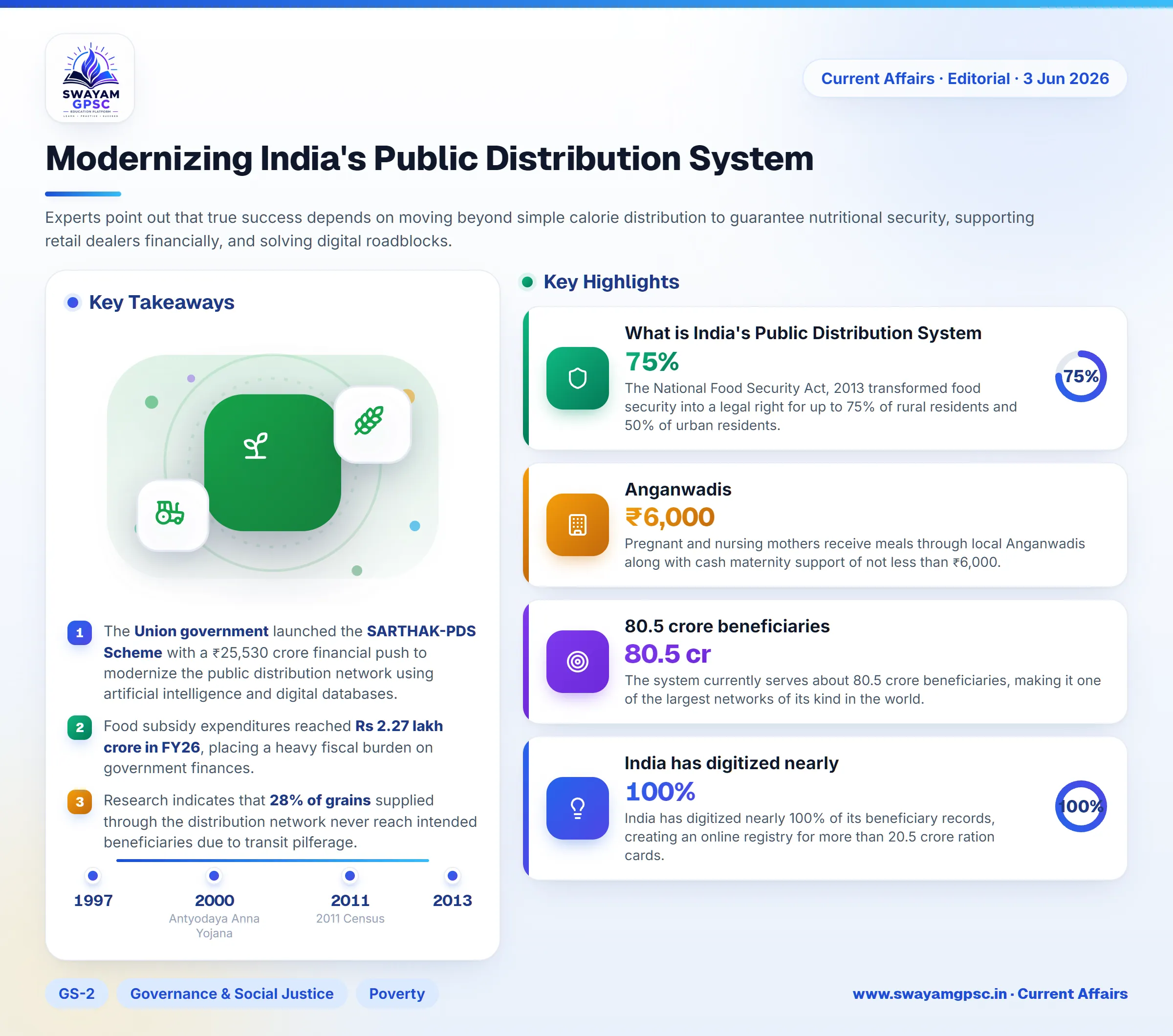
- The Union government launched the SARTHAK-PDS Scheme with a ₹25,530 crore financial push to modernize the public distribution network using artificial intelligence and digital databases.
- Food subsidy expenditures reached Rs 2.27 lakh crore in FY26, placing a heavy fiscal burden on government finances.
- Research indicates that 28% of grains supplied through the distribution network never reach intended beneficiaries due to transit pilferage.
- Around 80.5 crore beneficiaries depend on the country's public distribution network, which achieves nearly 100% digitization across 20.5 crore ration cards.
Why in News
- The Union government recently introduced the SARTHAK-PDS Scheme (Scheme for Assistance in Ration Transport and Handling-Income with Automation in the Public Distribution System) to upgrade India’s Public Distribution System (PDS).
- Experts point out that true success depends on moving beyond simple calorie distribution to guarantee nutritional security, supporting retail dealers financially, and solving digital roadblocks.
What is India's Public Distribution System
- The Public Distribution System (PDS) functions as India’s primary food safety net and operates under the guidance of the Ministry of Consumer Affairs, Food, and Public Distribution.
- The main purpose is to manage food shortages and supply essential items to the public at affordable, subsidized prices.
- The Central government works through the Food Corporation of India - FCI to buy grain from farmers at Minimum Support Price (MSP), manage buffer stocks, and handle bulk shipping.
- State and Union Territory governments handle local tasks like identifying eligible families, issuing Ration Cards, and running Fair Price Shops (FPS) for final delivery.
- During the 1960s, the system started to handle acute food shortages in cities with help from the Food Corporation of India (FCI) and the Commission for Agricultural Costs and Prices (CACP).
- In 1992, the Revamped Public Distribution System expanded its reach into remote and rural areas.
- By 1997, the Targeted Public Distribution System began focusing specifically on Below Poverty Line and Above Poverty Line households.
- The Antyodaya Anna Yojana started in 2000 to deliver heavily subsidized food to the poorest families.
- The National Food Security Act, 2013 transformed food security into a legal right for up to 75% of rural residents and 50% of urban residents.
- Under the National Food Security Act, 2013, the framework changed from a welfare approach to a legal entitlement model.
- Eligible households receive 5 kg of food grains per person per month at low rates.
- To empower women, the eldest female member aged 18 or older is registered as the head of the household on the ration card.
- The law requires setting up State Food Commissions and district officers to handle complaints and maintain accountability.
- Pregnant and nursing mothers receive meals through local Anganwadis along with cash maternity support of not less than ₹6,000.
- Children aged 6 months to 6 years get age-appropriate nutrition through Anganwadis, while those aged 6 to 14 years receive free cooked meals.
- The system currently serves about 80.5 crore beneficiaries, making it one of the largest networks of its kind in the world.
- India has digitized nearly 100% of its beneficiary records, creating an online registry for more than 20.5 crore ration cards.
- Around 99.8% of ration cards are linked with Aadhaar, which helps remove duplicate or fake entries.
- Roughly 99.6% of the 5.43 lakh Fair Price Shops now use electronic Point of Sale (ePoS) machines.
- More than 97% of all transactions are verified using biometric authentication.
- The One Nation One Ration Card (ONORC) project lets migrant workers collect their food rations anywhere across the country.
- The newly launched Sarthak-PDS initiative uses technology built around three main pillars.
- The Nirmal pillar uses artificial intelligence to manage real-time beneficiary lists and stop duplication.
- The ASHA pillar provides a multilingual mobile platform connected to WhatsApp for direct grievance handling.
- The Saksham pillar tracks vehicles using QR codes and forecasts demand to cut transit losses.
Challenges
- Providing free food grains has turned the distribution network into a heavy fiscal commitment, with food subsidy expenses reaching Rs 2.27 lakh crore in FY26.
- This spending crowds out government money that could otherwise build cold-chain storage, fund agricultural research, or improve irrigation.
- Studies from organizations like the Indian Council for Research on International Economic Relations show that 28% of grains sent through the system never reach the intended people due to transit theft.
- Dishonest dealers exploit verification delays to swap nutrient-rich fortified grains with cheaper stocks, cheating consumers while keeping digital registers looking clean.
- The system still relies on population counts from the 2011 Census, ignoring rapid urban growth and migration trends.
- Many urban informal workers remain locked out of benefits because state quotas are already full and do not reflect post-pandemic poverty.
- Mandatory biometric checks at ration shops cause technical errors that block genuine beneficiaries from getting their food.
- Upgrading to smart shops turns traditional grocery outlets into high-tech hubs that require steady electricity and internet connections.
- Many local dealers struggle with tiny profit margins that cannot cover electricity and device upkeep.
- To survive financially, some dealers resort to under-weighing rations, such as giving 4.5kg instead of 5kg, which directly harms families.
- A study across six rural states showed that 80% of surveyed households consumed less protein than recommended, as the distribution network mostly supplies carbohydrates.
- While calorie needs are met, hidden micronutrient deficiencies continue to drive high rates of stunting and anemia.
- An analysis connected to the Asian Development Bank found that only 15% of migrant workers without local ration cards managed to get supplies through the portability scheme.
- A survey by the Centre for Labor Research and Action (CLRA) revealed that 70.8% of workers knew about the portability scheme, but only 50.5% tried to use it, and just 58.6% succeeded.
- Common hurdles include dealers refusing service in 53.5% of cases, stock running out in 47.4% of shops, and biometric failures in 30% of attempts.
- In hilly or remote regions with poor telecom signals, digital devices often fail to connect with central servers.
- When internet connections drop, manual offline modes are used, creating loopholes for fraudulent transactions and fake entries.
Way Forward
- The government should replace outdated static lists with dynamic registries linked to digital platforms like the e-Shram portal.
- Using artificial intelligence and a unified national database will help remove duplicate names and improve migrant coverage.
- Urban and well-connected areas should offer direct cash transfers into bank accounts as an alternative to physical grain.
- Direct cash transfers empower consumers, reduce transport burdens for the Food Corporation of India (FCI), and prevent transit leaks, as tested in Chandigarh and Puducherry.
- Ration supplies must include at least 20% bio-fortified grains, millets, and pulses to tackle hidden hunger.
- States like Karnataka and Odisha have successfully added millets to their public distribution baskets.
- Data from NFHS-5 (2019-21) shows that while calorie targets are met, micronutrient shortages remain a severe health crisis that aligns with the goals of the National Nutrition Mission (POSHAN Abhiyaan).
- Fair Price Shop owners should be allowed to work as Business Correspondents (BCs) to offer banking and insurance services.
- Adding extra financial services improves dealer income and removes the temptation to cheat on weights.
- State command centers should be built to track grain shipments and warehouse inventories in real time.
- Independent agencies and local groups like Gram Sabhas should conduct surprise quality checks at distribution centers.
- Regular audits prevent dealers from swapping good grain with inferior stock after biometric scans.
- The Food Corporation of India (FCI) should replace traditional tent storage with modern steel silos to reduce transit losses.
- While old warehouses suffer storage losses of 1 to 2%, modern silos protect grain from rodents and keep it fresh for longer periods.