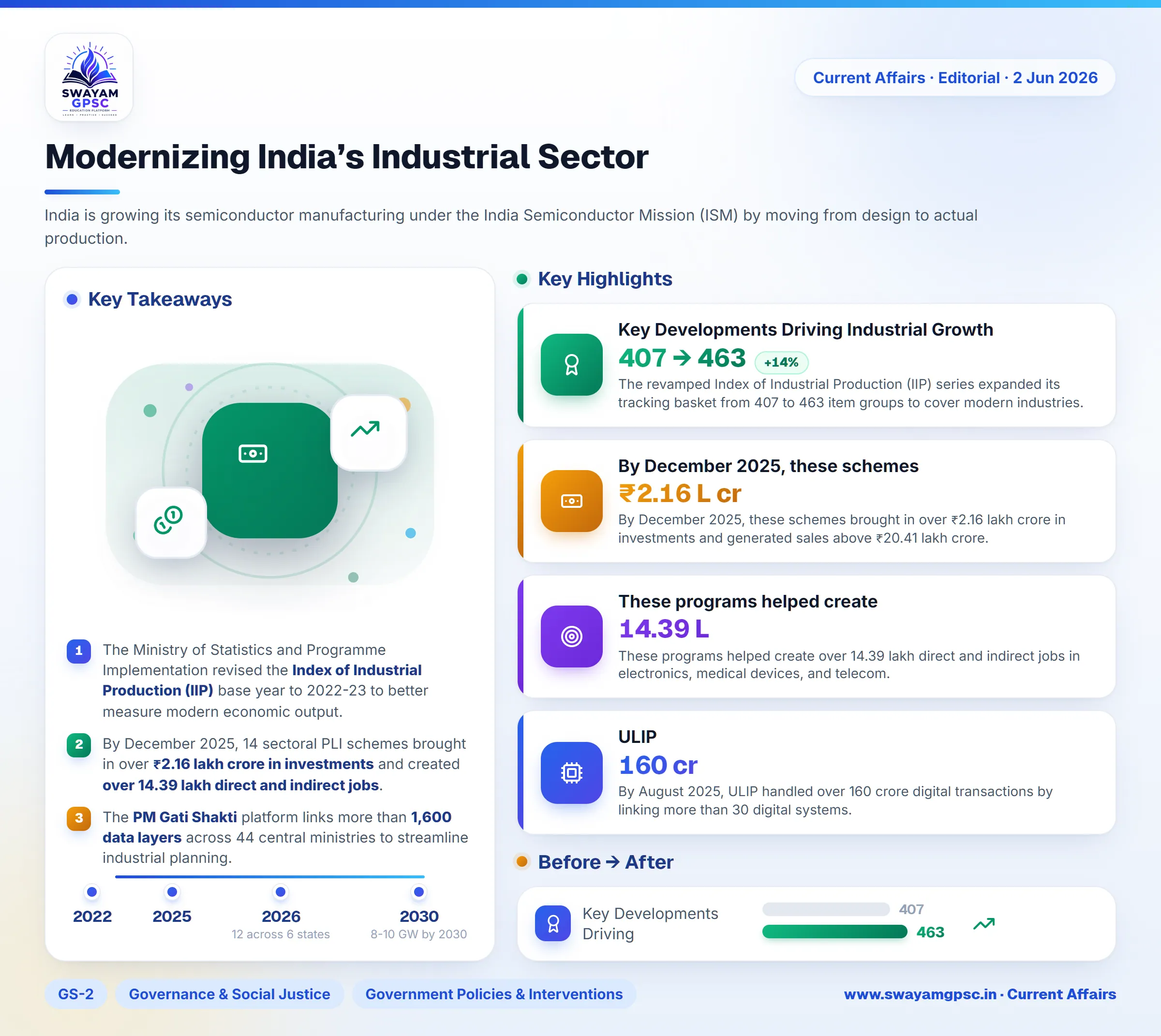
Modernizing India’s Industrial Sector
#GS-2 #Governance & Social Justice #Government Policies & Interventions #GS-3 #Economy #Growth #Infrastructure #Industry
Key takeaways
- The Ministry of Statistics and Programme Implementation revised the Index of Industrial Production (IIP) base year to 2022-23 to better measure modern economic output.
- By December 2025, 14 sectoral PLI schemes brought in over ₹2.16 lakh crore in investments and created over 14.39 lakh direct and indirect jobs.
- The PM Gati Shakti platform links more than 1,600 data layers across 44 central ministries to streamline industrial planning.
- India's defense exports reached a record ₹23,622 crore in FY 2024-25, up from less than ₹1,000 crore a decade ago.
- Private sector R&D spending in India remains low at 0.6%-0.7% of GDP, trailing global leaders like South Korea and Israel.
Why in News
- The Ministry of Statistics and Programme Implementation recently updated the Index of Industrial Production (IIP) base year to 2022-23.
- This update serves as an important structural reset to improve how the country measures its industrial performance.
- Better data allows government leaders to track industrial growth more accurately and support the Make in India initiative.
Key Developments Driving Industrial Growth
- India is growing its semiconductor manufacturing under the India Semiconductor Mission (ISM) by moving from design to actual production.
- By May 2026, the number of approved semiconductor projects reached 12 across 6 states.
- Key projects include the Tata Electronics Dholera fab and work on advanced compound semiconductors like Silicon Carbide and GaN.
- The PLI scheme has driven massive industrial investment across 14 sectors.
- By December 2025, these schemes brought in over ₹2.16 lakh crore in investments and generated sales above ₹20.41 lakh crore.
- These programs helped create over 14.39 lakh direct and indirect jobs in electronics, medical devices, and telecom.
- The PM Gati Shakti National Master Plan has changed how infrastructure is planned by connecting different transport methods.
- This digital platform brings together more than 1,600 data layers from over 44 central ministries to stop approval delays.
- For example, the Amritsar-Kolkata Industrial Corridor (AKIC) uses Gati Shakti mapping to make sure transport links are ready before building starts.
- The National Logistics Policy (NLP) and the Unified Logistics Interface Platform (ULIP) have improved supply chain speed.
- By August 2025, ULIP handled over 160 crore digital transactions by linking more than 30 digital systems.
- India is moving fast toward green energy by supporting projects under the SIGHT scheme and the National Green Hydrogen Mission.
- The government set aside ₹17,490 crore in direct subsidies to build electrolyzers and produce hydrogen.
- Major companies like Reliance Industries are building massive renewable energy storage and green hydrogen plants in Jamnagar, Gujarat.
- The Green Hydrogen Hub at Kandla Port is being built to export Green Ammonia to the European Union.
- Recognizing data centers as essential digital power plants, the government offered tax breaks for cloud providers until 2047.
- India's data center capacity is projected to jump from 1.5 Gigawatt in 2025 to 8-10 GW by 2030.
- Joint ventures like AdaniConnex are building Hyperscale data centers in Noida and Hyderabad to support domestic Large Language Model (LLM) growth.
- Medium and high technology industries made up 46.3% of India's manufacturing value added by early 2026.
- Basic customs duty exemptions on critical materials encourage companies to build high-end products locally instead of importing them.
- Production of high-end Apple iPhones in Chennai and Bangalore now involves advanced Surface Mount Technology (SMT) rather than basic assembly.
- The Union Budget 2026-27 created a ₹10,000 crore SME Growth Fund to help small businesses scale up safely.
- The revamped Index of Industrial Production (IIP) series expanded its tracking basket from 407 to 463 item groups to cover modern industries.
- Driven by Positive Indigenisation Lists, domestic defense production reached around ₹1.51 lakh crore in FY25.
- Over 16,000 MSMEs are helping build local defense items, with 788 industrial licenses issued to 462 companies.
- India's defense exports hit a record ₹23,622 crore in FY 2024-25, up from less than ₹1,000 crore in 2014.
Challenges
- Even with better logistics policies, the Indian transport sector remains divided and inefficient.
- Road transport handles 60-65% of freight, while rail transport accounts for 28-30%.
- Delays in projects like Bharatmala Pariyojana and poorly organized warehouses slow down cargo movement.
- India is great at assembling tech products, but the core intellectual property usually belongs to foreign firms.
- Domestic research spending stays low at 0.6%-0.7% of GDP, compared to over 4% in South Korea and Israel.
- In electronics, high-value parts like display drivers, semiconductor chips, and camera sensors are still imported.
- Small businesses face a missing middle problem where they are too big for micro-loans but too small for normal bank credit.
- Industry reports estimate the MSME credit gap at ₹25-30 lakh crore, forcing many to use expensive informal loans.
- While India produces about 1.5 million engineering graduates every year, 83% struggle to find proper jobs.
- The India Skills Report 2025 shows that only 54.8% of graduates are ready for industry work.
- Only 4.7% of Indian workers have formal vocational training, compared to 75% in Germany.
- Acquiring large plots of land takes years due to complex rules under the Right to Fair Compensation and Transparency in Land Acquisition Act, 2013.
- Projects under the National Industrial Corridor Development Corporation (NICDC) take 3 to 5 years just to secure land.
- Manufacturing still depends heavily on imported parts, making local factories vulnerable to global supply problems.
- China's limits on exporting rare earth materials can disrupt supplies for EV magnets, batteries, and electronics.
- Factories often suffer from poor power quality and frequent voltage drops, forcing them to use costly diesel generators.
- High cross-subsidy surcharges make the transition under the Green Energy Open Access Rules 2022 very expensive at first.
Way Forward
- India must expand Phased Manufacturing Programmes (PMP) to build parts like Display Drivers, Camera Modules, and Printed Circuit Boards (PCBs) locally.
- New policies should extend incentives to labor-heavy fields like textiles, footwear, and toys.
- The government should roll out the National Land Titling mission and the ULPIN system to speed up land clearances.
- Activating the Anusandhan National Research Foundation (ANRF) will help universities and companies work together on new technology.
- Expanding the Credit Guarantee Fund Trust for Micro and Small Enterprises (CGTMSE) will give small businesses easier access to loans.
- The Self-Reliant India (SRI) Fund should provide equity money instead of just debt so small businesses can grow without loan pressure.
- Creating Regulatory Sandboxes in industrial corridors will let companies test new products under simpler rules.
- The Gift City (Gujarat) model can inspire lighter regulations in National Industrial Corridor Development Corporation (NICDC) hubs.
- Subsidizing green hydrogen use in steel and cement will help factories prepare for future carbon border taxes in export markets.
- Policymakers should use the updated Index of Industrial Production (IIP) data to support growing sectors like rare-earth processing.