Modernising India's Handloom Sector and National Handloom Day
#GS-2 #GS-3 #Government Policies & Interventions #Governance & Social Justice #Economy #Employment #Growth & Development #Infrastructure #Inclusive Growth #Culture #Heritage #National
Key takeaways
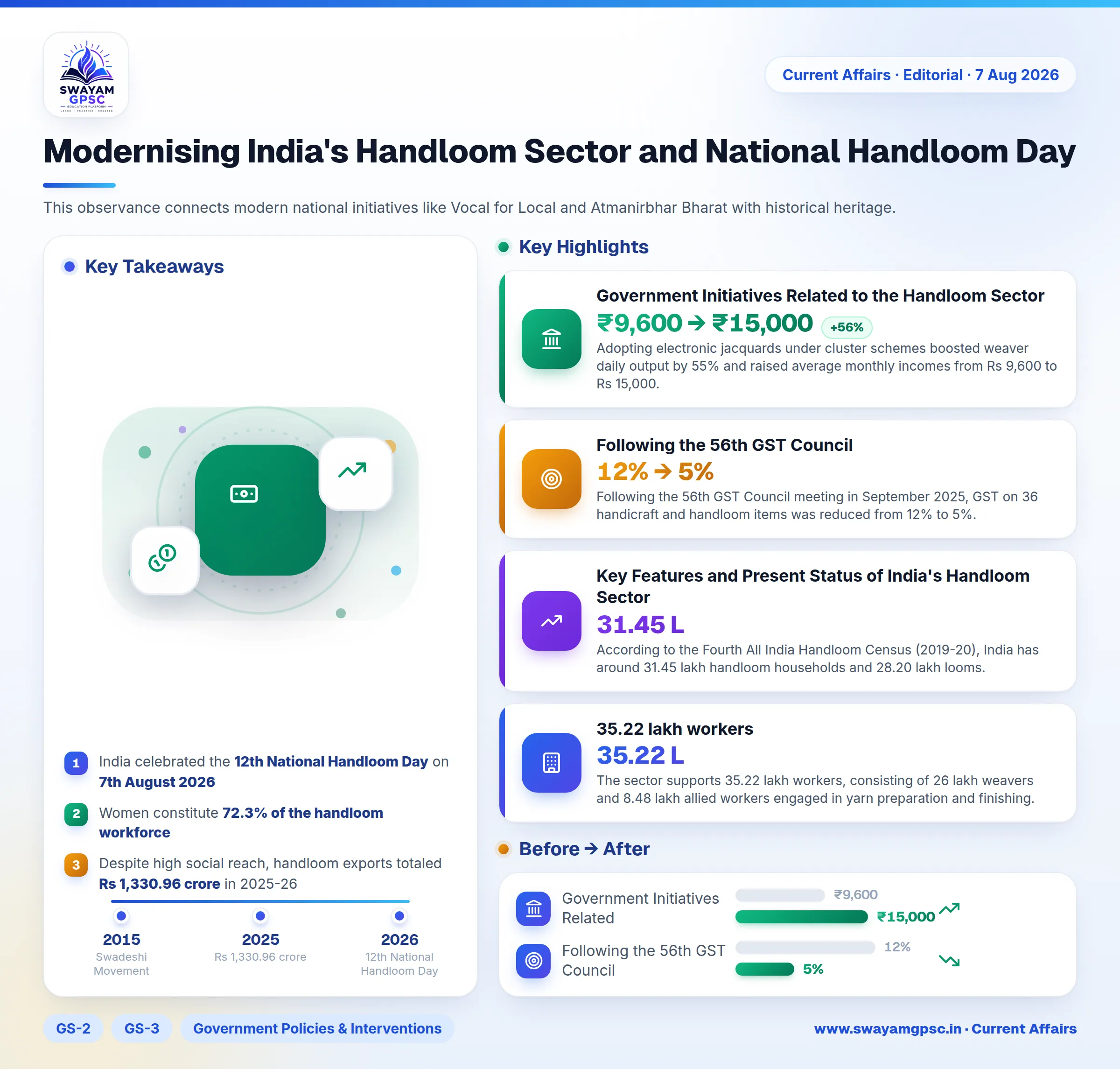
- India celebrated the 12th National Handloom Day on 7th August 2026, honoring a sector that employs over 35.22 lakh workers across 31.45 lakh households.
- Women constitute 72.3% of the handloom workforce, while nearly 90% of looms are located in rural areas across states like Assam and West Bengal.
- Despite high social reach, handloom exports totaled Rs 1,330.96 crore in 2025-26, forming a small share of India's Rs 3.25 lakh crore total textile exports.
- Key government interventions like the National Handloom Development Programme and Raw Material Supply Scheme received Rs 205 crore and Rs 200 crore allocations in 2026-27.
- Following the 56th GST Council meeting, the government reduced GST on 36 handicraft and handloom items from 12% to 5% to lower production costs.
Why in News
- India observed the 12th National Handloom Day on 7th August 2026 to celebrate its rich weaving heritage and recognize worker contributions.
- The government instituted National Handloom Day in 2015 to commemorate the launch of the Swadeshi Movement on 7th August 1905.
- The Swadeshi Movement promoted indigenous manufacturing and economic self-reliance during India's freedom struggle.
- This observance connects modern national initiatives like Vocal for Local and Atmanirbhar Bharat with historical heritage.
- The policy focus aims to transform handloom weaving into a globally competitive creative industry using digital tools and sustainable practices.
Key Features and Present Status of India's Handloom Sector
- A handloom refers to a loom operated manually without electricity, making production heavily reliant on human artistic skill.
- Khadi differs from regular handloom because it requires both hand-spun yarn and hand-woven fabric, whereas handloom yarn can be mill-spun.
- Powerlooms use electric power for fast mass production, standing in contrast to manual handloom methods.
- India's handloom tradition dates back to the Indus Valley Civilisation, with ancient references found in the Rigveda, Ramayana, Mahabharata, and Kautilya's Arthashastra.
- According to the Fourth All India Handloom Census (2019-20), India has around 31.45 lakh handloom households and 28.20 lakh looms.
- The sector supports 35.22 lakh workers, consisting of 26 lakh weavers and 8.48 lakh allied workers engaged in yarn preparation and finishing.
- Over 25.30 lakh looms operate in rural areas, showing that nearly nine out of every ten looms are located in rural India.
- The workforce shows strong regional concentration, with Assam employing 13 lakh workers, followed by West Bengal with 6.3 lakh, Tamil Nadu with 2.44 lakh, and Manipur with 2.25 lakh.
- Women drive this industry, comprising over 72% of the workforce with approximately 25.46 lakh female workers.
- The sector displays high social inclusion, employing 4.84 lakh Scheduled Caste, 6.28 lakh Scheduled Tribe, and 12.67 lakh Other Backward Classes workers.
- The census revealed severe income vulnerability, as 67.1% of handloom households earned less than Rs 5,000 per month from all sources in 2019-20.
- India boasts diverse weaving traditions including Banarasi, Jamdani, Chanderi, Kanjeevaram, and Pochampally Ikat, supported by 106 Geographical Indication (GI) handloom products.
- India exported handloom products worth Rs 1,330.96 crore in 2025-26, targeting markets in the UAE, United States, France, United Kingdom, and Spain.
- The official e-Pehchan portal launched in January 2025 approved 84,000 new digital worker identity cards by July 2026.
Government Initiatives Related to the Handloom Sector
- The National Handloom Development Programme (NHDP) and the Raw Material Supply Scheme (RMSS) serve as core operational support mechanisms.
- The NHDP operated from 2021-22 to 2025-26 with a 2026-27 budget allocation of Rs 205 crore to improve infrastructure, welfare, and market connections.
- Over 200 Handloom Producer Companies were formed between 2020-21 and 2026-27 to enhance collective bargaining and market reach.
- The Small Cluster Development Programme sanctioned 357 clusters up to June 2026, offering financial assistance up to Rs 2 crore per cluster and a 100% workshed subsidy.
- Adopting electronic jacquards under cluster schemes boosted weaver daily output by 55% and raised average monthly incomes from Rs 9,600 to Rs 15,000.
- The Raw Material Supply Scheme received Rs 200 crore in 2026-27 to reimburse yarn freight costs and provide a 15% price subsidy on specified yarns.
- Under the Weaver MUDRA Scheme, credit is provided at a concessional interest rate of 6% for three years, sanctioning over 40,000 loans worth Rs 280 crore by June 2026.
- Social security schemes like PMJJBY and PMSBY offer life and disability coverage up to Rs 2 lakh, reaching 2.02 lakh workers by May 2026.
- Worker children receive educational scholarships up to Rs 2 lakh annually for pursuing recognized textile diploma or degree courses.
- The government established 8 mega clusters receiving up to Rs 30 crore each, alongside 6 functional Craft Handloom Villages.
- Digital platforms like Government e-Marketplace (GeM) onboarded 1.50 lakh handloom entities, while Indiahandmade connected 5,413 weavers directly to consumers by June 2026.
- Quality assurance certifications include the Handloom Mark with 29,402 registrations and the India Handloom Brand with 2,305 registrations.
- The Handlooms (Reservation of Articles for Production) Act, 1985 legally reserves 11 textile items exclusively for handloom manufacturing.
- Following the 56th GST Council meeting in September 2025, GST on 36 handicraft and handloom items was reduced from 12% to 5%.
Significance of the Handloom Sector
- Handloom weaving generates crucial non-farm employment in rural areas, allowing families to combine weaving with agricultural activities.
- The sector drives women's economic empowerment by enabling over 25.5 lakh women to earn independent incomes within their local communities.
- It promotes social equity by offering sustainable livelihoods to marginalized groups including SC, ST, and OBC communities.
- Handloom production preserves centuries of unique regional craftsmanship and intangible cultural heritage across different states.
- The sector produces eco-friendly, biodegradable fabrics with a low carbon footprint, aligning with global sustainable fashion trends.
Challenges Facing the Handloom Sector
- Weavers face low and irregular earnings because they receive payment only for weaving, leaving pre-loom preparation and finishing uncompensated.
- High prices and supply shortages of quality raw yarn compress weaver profit margins significantly.
- Widespread competition from cheaper machine-made powerloom fabrics and counterfeit goods hurts genuine handloom sales.
- Inadequate access to formal bank credit forces many weavers to depend on high-interest informal moneylenders.
- Weak direct market access leaves weavers reliant on intermediaries who absorb most of the final commercial profits.
Way Forward
- Expand technological upgrades like electronic jacquards and digital design tools through Handloom 4.0 and the Centre of Excellence for Handloom Technology.
- Establish fair wage models that compensate weavers for pre-loom yarn preparation and post-loom finishing work.
- Promote Indian handloom products in premium global markets as high-value, sustainable heritage items using GI tagging.
- Scale up direct-to-consumer e-commerce onboarding on portals like Indiahandmade and GeM to eliminate middleman margins.
- Strengthen yarn subvention schemes and concessional credit mechanisms to safeguard weavers against raw material price shocks.