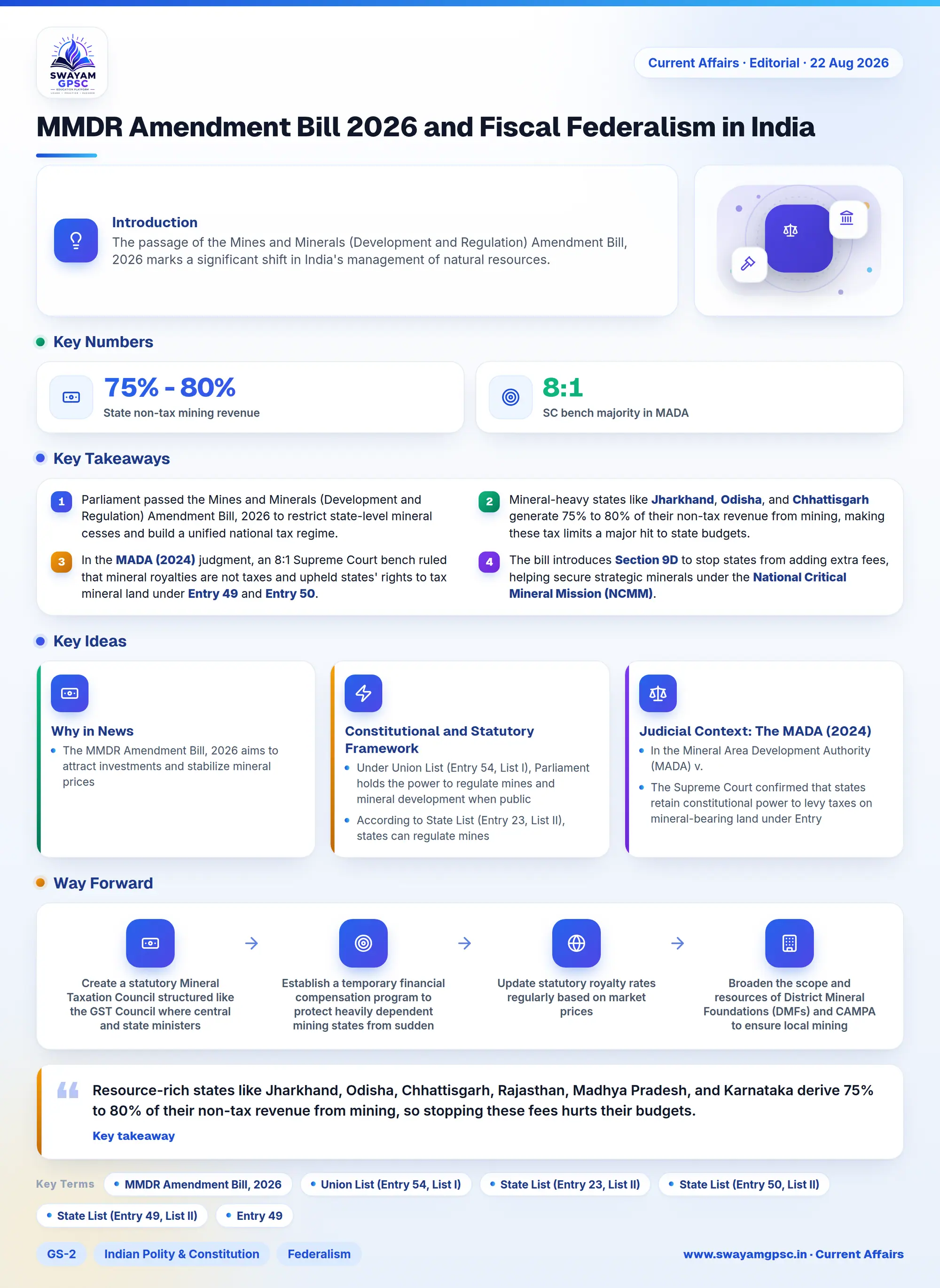
MMDR Amendment Bill 2026 and Fiscal Federalism in India
#GS-2 #Indian Polity & Constitution #Federalism #GS-3 #Economy #Taxation #Mining Sector #MMDR Amendment Bill 2026
Key takeaways
- Parliament passed the Mines and Minerals (Development and Regulation) Amendment Bill, 2026 to restrict state-level mineral cesses and build a unified national tax regime.
- Mineral-heavy states like Jharkhand, Odisha, and Chhattisgarh generate 75% to 80% of their non-tax revenue from mining, making these tax limits a major hit to state budgets.
- In the MADA (2024) judgment, an 8:1 Supreme Court bench ruled that mineral royalties are not taxes and upheld states' rights to tax mineral land under Entry 49 and Entry 50.
- The bill introduces Section 9D to stop states from adding extra fees, helping secure strategic minerals under the National Critical Mineral Mission (NCMM).
- Experts recommend establishing a Mineral Taxation Council, similar to the GST Council, along with suggestions from the Sarkaria and Punchhi Commissions to balance revenue sharing.
Introduction
- The passage of the Mines and Minerals (Development and Regulation) Amendment Bill, 2026 marks a significant shift in India's management of natural resources.
- This legislation limits the power of state governments to charge extra cesses and taxes on minerals, creating a stable tax environment across the country.
Why in News
- The MMDR Amendment Bill, 2026 aims to attract investments and stabilize mineral prices, but it reduces the independent revenue options of mineral-rich states.
Constitutional and Statutory Framework
- Under Union List (Entry 54, List I), Parliament holds the power to regulate mines and mineral development when public interest requires it.
- According to State List (Entry 23, List II), states can regulate mines, but this authority remains subject to parliamentary laws passed under Entry 54.
- Under State List (Entry 50, List II), states have the power to tax mineral rights, yet Parliament can place legal limits on this power.
- Under State List (Entry 49, List II), state governments hold exclusive rights to collect taxes on land and buildings.
- The main dispute arises because the Union Government uses Entry 54 to restrict state taxes, while states claim this absolute ban harms their fundamental constitutional rights.
Judicial Context: The MADA (2024) Landmark Judgment
- In the Mineral Area Development Authority (MADA) v. SAIL (2024) case, a 9-judge Supreme Court bench ruled 8:1 that mineral royalty under Section 9 is a contractual fee, not a government tax.
- The Supreme Court confirmed that states retain constitutional power to levy taxes on mineral-bearing land under Entry 49 and mineral rights under Entry 50.
- As a counter-response, the 2026 Amendment added Section 9D to explicitly forbid states from collecting additional cesses or fees on mineral rights.
Arguments in Favor of the Bill
- Before this amendment, differing state taxes and transit fees caused high price fluctuations, whereas a single national tax system builds investor confidence for FDI.
- Minerals serve as essential inputs for key manufacturing sectors like steel and aluminum, so removing double state taxes helps make Indian products competitive globally.
- Clear and predictable mining laws encourage exploration of vital elements like lithium under the National Critical Mineral Mission (NCMM).
- A uniform policy prevents states from competing through protectionist fees and ensures smooth movement of raw materials across regional borders.
Challenges and Arguments Against the Bill
- Resource-rich states like Jharkhand, Odisha, Chhattisgarh, Rajasthan, Madhya Pradesh, and Karnataka derive 75% to 80% of their non-tax revenue from mining, so stopping these fees hurts their budgets.
- Since GST replaced most local indirect taxes, taxing mineral land remained one of the few independent revenue sources left for states.
- Mining activity causes local environmental damage and displacement, so states need their own funds to restore nature and help affected tribal populations.
- Passing the bill without detailed talks with states or review by a Parliamentary Standing Committee violates the spirit of cooperative federalism advocated by the Sarkaria and Punchhi Commissions.
Multi-Dimensional Impact Matrix
- On the economic front, lower raw material prices boost manufacturing, but reduced revenues force state governments to borrow more money.
- On the federal front, the law unifies national trade rules under Article 301, but it increases state financial dependence on central grants.
- On the social front, faster mine approvals create local industrial jobs, but spending on tribal welfare beyond District Mineral Foundation (DMF) funds may decline.
- On the environmental front, simplified rules attract modern mining companies with clean technologies, but states lose the power to charge local environmental repair cesses.
Way Forward
- Create a statutory Mineral Taxation Council structured like the GST Council where central and state ministers decide mineral tax boundaries together.
- Establish a temporary financial compensation program to protect heavily dependent mining states from sudden revenue losses.
- Update statutory royalty rates regularly based on market prices, ensuring states automatically earn more as global mineral prices rise.
- Broaden the scope and resources of District Mineral Foundations (DMFs) and CAMPA to ensure local mining communities directly benefit.
- Maintain a balance between national economic goals and state financial autonomy to protect the spirit of cooperative federalism.
Conclusion
- Achieving a balance between national growth and state financial power requires building consensus through strong central-state institutions like a shared Mineral Taxation Council.