Mega Data Centres and Sustainable Digital Infrastructure
#GS-3 #Science & Technology #ICT #Artificial Intelligence #Energy #Environment #Sustainable Development #Infrastructure
Key takeaways
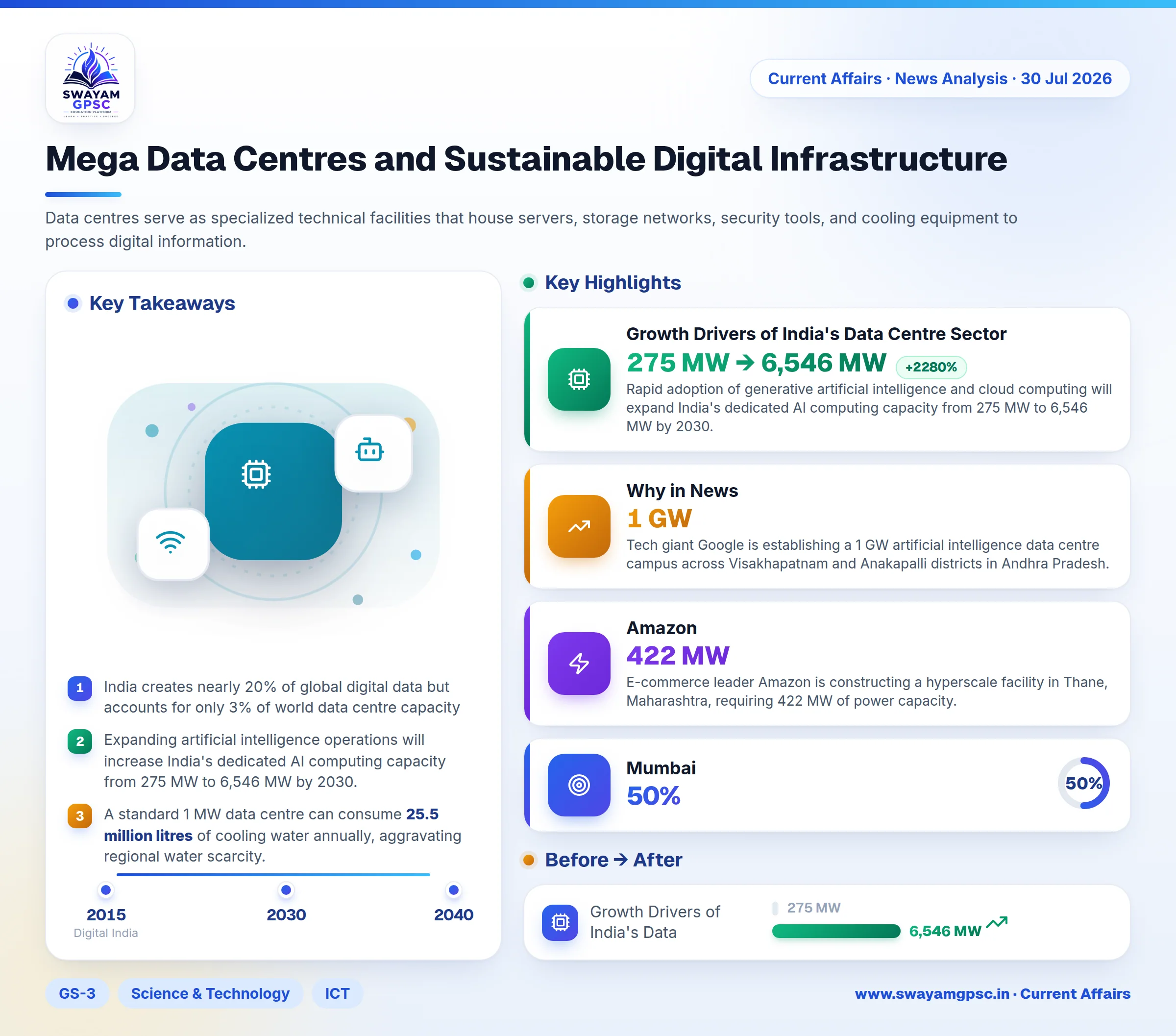
- India creates nearly 20% of global digital data but accounts for only 3% of world data centre capacity, driving rapid infrastructure expansion.
- Expanding artificial intelligence operations will increase India's dedicated AI computing capacity from 275 MW to 6,546 MW by 2030.
- A standard 1 MW data centre can consume 25.5 million litres of cooling water annually, aggravating regional water scarcity.
- Power demand from AI infrastructure will add 26.3 GW by 2031-32, potentially pushing data centre electricity use to 7% of India's total demand by 2040.
Why in News
- Citizens and activist groups in Andhra Pradesh and Maharashtra recently staged protests against new mega data centre projects over resource consumption and environmental concerns.
- Tech giant Google is establishing a 1 GW artificial intelligence data centre campus across Visakhapatnam and Anakapalli districts in Andhra Pradesh.
- E-commerce leader Amazon is constructing a hyperscale facility in Thane, Maharashtra, requiring 422 MW of power capacity.
Growth Drivers of India's Data Centre Sector
- Data centres serve as specialized technical facilities that house servers, storage networks, security tools, and cooling equipment to process digital information.
- India hosts approximately 150 operational data centres, with Mumbai commanding over 50% of total national capacity alongside emerging hubs in Visakhapatnam, Pune, and Ahmedabad.
- India produces nearly 20% of global digital data but currently controls only 3% of world data centre capacity, creating a critical infrastructure deficit.
- Rapid adoption of generative artificial intelligence and cloud computing will expand India's dedicated AI computing capacity from 275 MW to 6,546 MW by 2030.
- Over 1.03 billion active internet subscribers in India generate nearly 22 billion UPI payment transactions every month, requiring immense storage facilities.
- State governments offer lucrative incentives such as cheap land, electricity subsidies, tax reimbursements, and fast-track permits to attract big investments.
- Global technology corporations are making substantial commitments, including Google's 1 GW campus in Visakhapatnam and Reliance-Meta's 168 MW project in Jamnagar.
- Strict national data sovereignty rules require companies to store personal and financial data within domestic borders, driving server demand inside the country.
Government Promotion Initiatives
- Several states including Gujarat, Maharashtra, Tamil Nadu, and Telangana have established specialized data centre policies to attract foreign and domestic capital.
- State policies offer direct financial perks like stamp duty waivers, land concessions, subsidized power rates, and corporate tax reimbursements.
- Governments build dedicated industrial data parks equipped with uninterrupted power lines, robust water feeds, high-capacity substations, and relaxed building norms.
- The national Digital India program launched in 2015 continues to expand public online services and generate heavy data traffic across the nation.
- The National Informatics Centre maintains specialized high-performance national data centres to support critical e-governance applications.
Challenges
- Liquid cooling systems require massive amounts of water, where a single 1 MW facility can consume 25.5 million litres of water every year.
- AI facilities will add nearly 26.3 GW of power demand by 2031-32, creating sharp load spikes of 1 to 1.5 GW that can disrupt local power grids.
- Data centre energy consumption could reach 7% of total domestic electricity demand by 2040, driving fossil fuel use and heavy reliance on backup diesel generators.
- These projects absorb vast capital and land resources while generating very few permanent employment opportunities after initial construction ends.
- Project approvals often lack public disclosure, mandatory community consultations, and clear figures regarding long-term power and water draw.
- Heavy government subsidies and debt-funded expansion could produce underutilized or stranded assets if long-term AI commercial returns fall short.
Way Forward
- Developers must publicly release independently verified data on expected electricity usage, water withdrawal, waste generation, and emissions before receiving permits.
- Authorities must conduct mandatory public hearings to allow local residents, city councils, and environmental groups to review project documents beforehand.
- Data facilities must adopt recycled wastewater, closed-loop cooling systems, and rainwater collection systems to avoid depleting local drinking water reserves.
- Regulatory bodies must carry out comprehensive cumulative impact studies evaluating potential risks to nearby forests, wildlife sanctuaries, air quality, and residential areas.
- Facility owners should transition to solar, wind, and battery storage technologies to reduce grid stress and eliminate reliance on diesel backup generators.
- Planners should situate major data hubs away from densely populated cities, water-stressed basins, and delicate natural ecosystems.
- Clear binding clauses should mandate local hiring practices, technical skill development programs, and community infrastructure upgrades.
- Regulators should implement real-time tracking of utility usage, supported by strict financial penalties for environmental non-compliance.