Mecca Joint Defence Agreement and Its Strategic Implications for India
#GS-2 #Current Events #International #Bilateral Groupings & Agreements #Groupings & Agreements Involving India and/or Affecting India's Interests #Effect of Policies & Politics of Countries on India's Interests #International Treaties & Agreements
Key takeaways
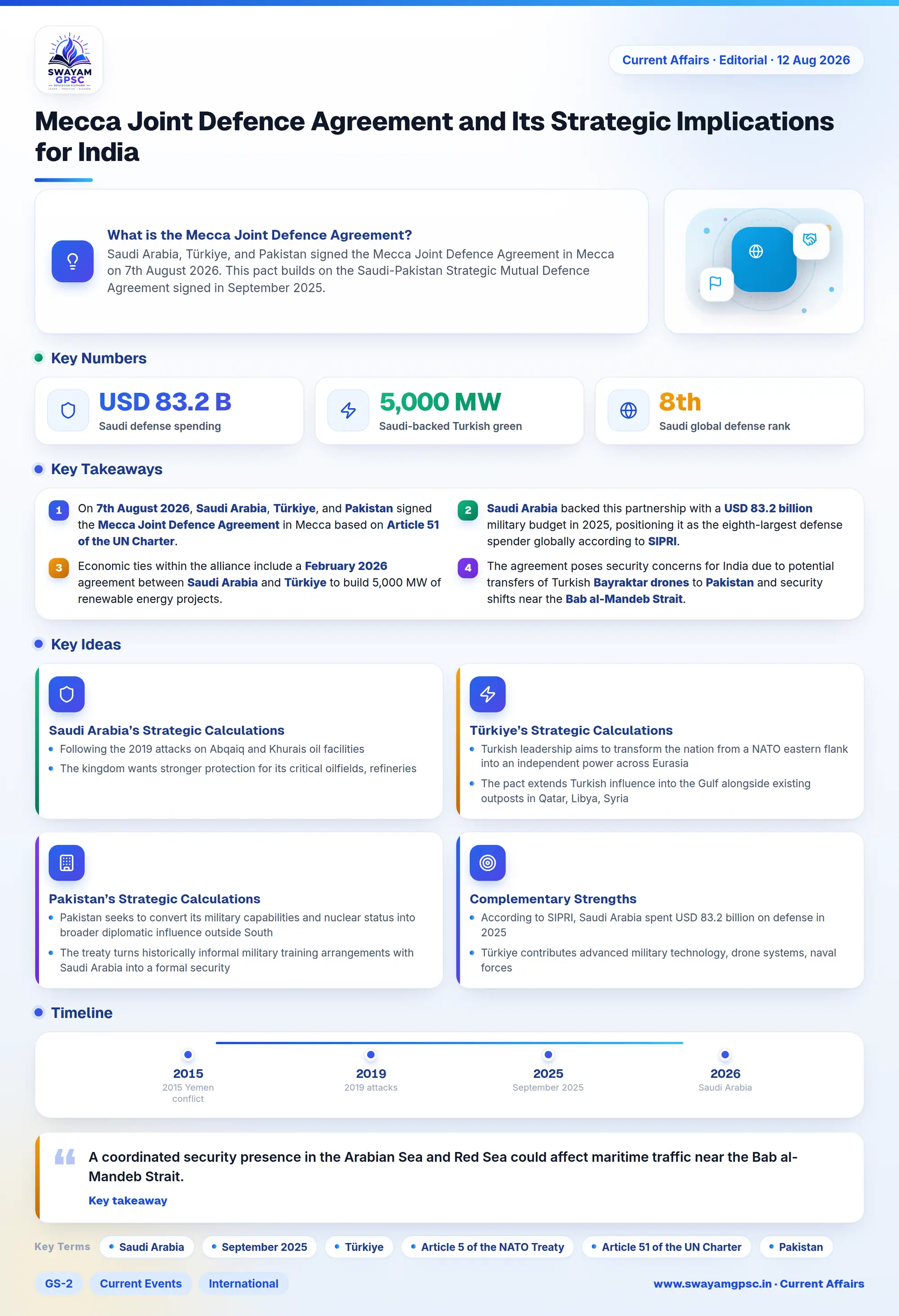
- On 7th August 2026, Saudi Arabia, Türkiye, and Pakistan signed the Mecca Joint Defence Agreement in Mecca based on Article 51 of the UN Charter.
- Saudi Arabia backed this partnership with a USD 83.2 billion military budget in 2025, positioning it as the eighth-largest defense spender globally according to SIPRI.
- Economic ties within the alliance include a February 2026 agreement between Saudi Arabia and Türkiye to build 5,000 MW of renewable energy projects.
- The agreement poses security concerns for India due to potential transfers of Turkish Bayraktar drones to Pakistan and security shifts near the Bab al-Mandeb Strait.
- India must protect its security interests by seeking assurances from Riyadh, expanding the I2U2 grouping, and building the India-Middle East-Europe Economic Corridor (IMEC).
What is the Mecca Joint Defence Agreement?
- Saudi Arabia, Türkiye, and Pakistan signed the Mecca Joint Defence Agreement in Mecca on 7th August 2026.
- This pact builds on the Saudi-Pakistan Strategic Mutual Defence Agreement signed in September 2025.
- Adding Türkiye expands the traditional bilateral partnership into a wider framework connecting the Gulf, Anatolia, and South Asia.
- The treaty includes a collective defence clause stating that an attack on one member counts as an attack on all three, similar to Article 5 of the NATO Treaty.
- The signatory nations anchored this defense right under Article 51 of the UN Charter.
- Pakistan and Türkiye declared the agreement purely defensive and open to other participating nations.
- The agreement creates a framework for regular meetings among foreign ministers, defence ministers, and military leaders.
- Assistance under the treaty includes intelligence-sharing, logistical support, air and missile defence, and potential military deployment.
- The participating governments plan to open membership to extra states, though formal accession rules remain unannounced.
Saudi Arabia’s Strategic Calculations
- Following the 2019 attacks on Abqaiq and Khurais oil facilities, Saudi Arabia sought security options beyond its traditional US reliance.
- The kingdom wants stronger protection for its critical oilfields, refineries, and ports against drone and missile threats.
- Riyadh is practicing strategic hedging by expanding ties with China, Türkiye, Pakistan, and India.
- Partnering with Türkiye offers access to modern drones and missiles, while Pakistan provides trained military manpower.
- Institutionalizing ties with Pakistan offers long-term stability for Saudi regime and territorial security.
- Hosting the agreement in Mecca reinforces Saudi claims to political leadership across the Islamic world.
Türkiye’s Strategic Calculations
- Turkish leadership aims to transform the nation from a NATO eastern flank into an independent power across Eurasia and West Asia.
- The pact extends Turkish influence into the Gulf alongside existing outposts in Qatar, Libya, Syria, and the Horn of Africa.
- Turkish defense firms gain opportunities to export unmanned aerial systems, naval platforms, and missiles to Saudi Arabia.
- The two nations expanded economic ties through a February 2026 agreement for 5,000 MW renewable energy projects in Türkiye.
- Türkiye uses its expanding regional partnerships to increase its leverage inside NATO, where it commands the second-largest army.
Pakistan’s Strategic Calculations
- Pakistan seeks to convert its military capabilities and nuclear status into broader diplomatic influence outside South Asia.
- The treaty turns historically informal military training arrangements with Saudi Arabia into a formal security obligation.
- Enhanced defense cooperation helps Pakistan secure financial deposits, oil credits, and investment from Saudi Arabia.
- The agreement helps Pakistan present itself as a regional security provider beyond its rivalry with India.
- Working with Türkiye grants Pakistan access to advanced drone technology, naval equipment, and joint production projects.
- Islamabad expects increased diplomatic backing from Riyadh and Ankara in international forums.
Complementary Strengths of the Signatories
- According to SIPRI, Saudi Arabia spent USD 83.2 billion on defense in 2025, making it the world's eighth-largest military spender.
- Türkiye contributes advanced military technology, drone systems, naval forces, and extensive NATO operational experience.
- Pakistan supplies experienced military manpower, conventional combat experience, missile systems, and latent nuclear capabilities.
Why the Pact is Not a NATO-Equivalent Alliance
- The agreement lacks a central military command structure or a supreme operational commander.
- The signatories have not established integrated air defense networks or permanently assigned joint military units.
- The text does not clarify whether cyberattacks, non-state actor raids, or maritime blockades trigger collective defence.
- The treaty does not compel automatic military action or war declarations from every member state.
- The three nations face distinct primary threats, ranging from Iran and regional militias to domestic militancy.
- Pakistan has not extended a formal nuclear guarantee or nuclear umbrella to Saudi Arabia or Türkiye.
Factors Restricting the Efficacy of the Pact
- Türkiye and Pakistan maintain necessary diplomatic and economic ties with Iran, limiting their desire for anti-Iran confrontations.
- Historical rivalries over Islamic leadership between Riyadh and Ankara present underlying diplomatic tensions.
- Pakistan faces severe financial limits, risking a position as a contracted security provider rather than an equal partner.
- During the 2015 Yemen conflict, the Parliament of Pakistan voted unanimously for neutrality, setting a clear precedent.
- The agreement lacks defined protocols for joint command, troop deployments, and intelligence sharing standards.
- Mixing Western equipment from Saudi Arabia, NATO gear from Türkiye, and Chinese platforms from Pakistan causes military integration challenges.
- Regional rivals like Iran or Israel may view the pact as hostile, sparking counter-alliances and regional arming.
Strategic and Security Implications for India
- A coordinated security presence in the Arabian Sea and Red Sea could affect maritime traffic near the Bab al-Mandeb Strait.
- The transfer of Turkish Bayraktar drone technology to Pakistan could upgrade Pakistani military capabilities against India.
- The bloc complicates India's de-hyphenated foreign policy of balancing individual ties with Riyadh, Ankara, and Tehran.
- Pakistan might attempt to use the security forum to clean its international image regarding cross-border terrorism.
- The involvement of nuclear-armed Pakistan with resource-rich Saudi Arabia requires heightened strategic alertness from New Delhi.
- Potential policy shifts or conflict involving the signatories could threaten Indian crude oil supplies and energy security.
How India Should Calibrate Its Response
- India should use the Strategic Partnership Council to seek clear assurances from Saudi Arabia regarding South Asian disputes.
- Diplomats must maintain strong independent bilateral relations with Riyadh, Abu Dhabi, Doha, and Muscat.
- New Delhi should strengthen partnerships through forums like I2U2 and increase naval exercises with friendly nations.
- India must upgrade its domestic air defense systems and electronic warfare capabilities to counter advanced drone risks.
- The government should accelerate the India-Middle East-Europe Economic Corridor (IMEC) to secure trade and energy routes.
- India must remain active in international bodies like the UN and FATF to counter state-sponsored terrorism.
- Diplomats should maintain balanced engagement with Tehran, Tel Aviv, and members of the Indian Ocean Rim Association.
Conclusion
- The Mecca Joint Defence Agreement operates as a strategic hedging tool rather than a fully integrated military alliance. India must maintain active diplomatic engagement and enhance its defensive readiness without raising unnecessary alarm.