Managing the El Niño Threat to India
#GS-1 #GS-2 #GS-3 #Physical Geography #Economy #Infrastructure #Agriculture #Climate Change #National #Water Resources
Key takeaways
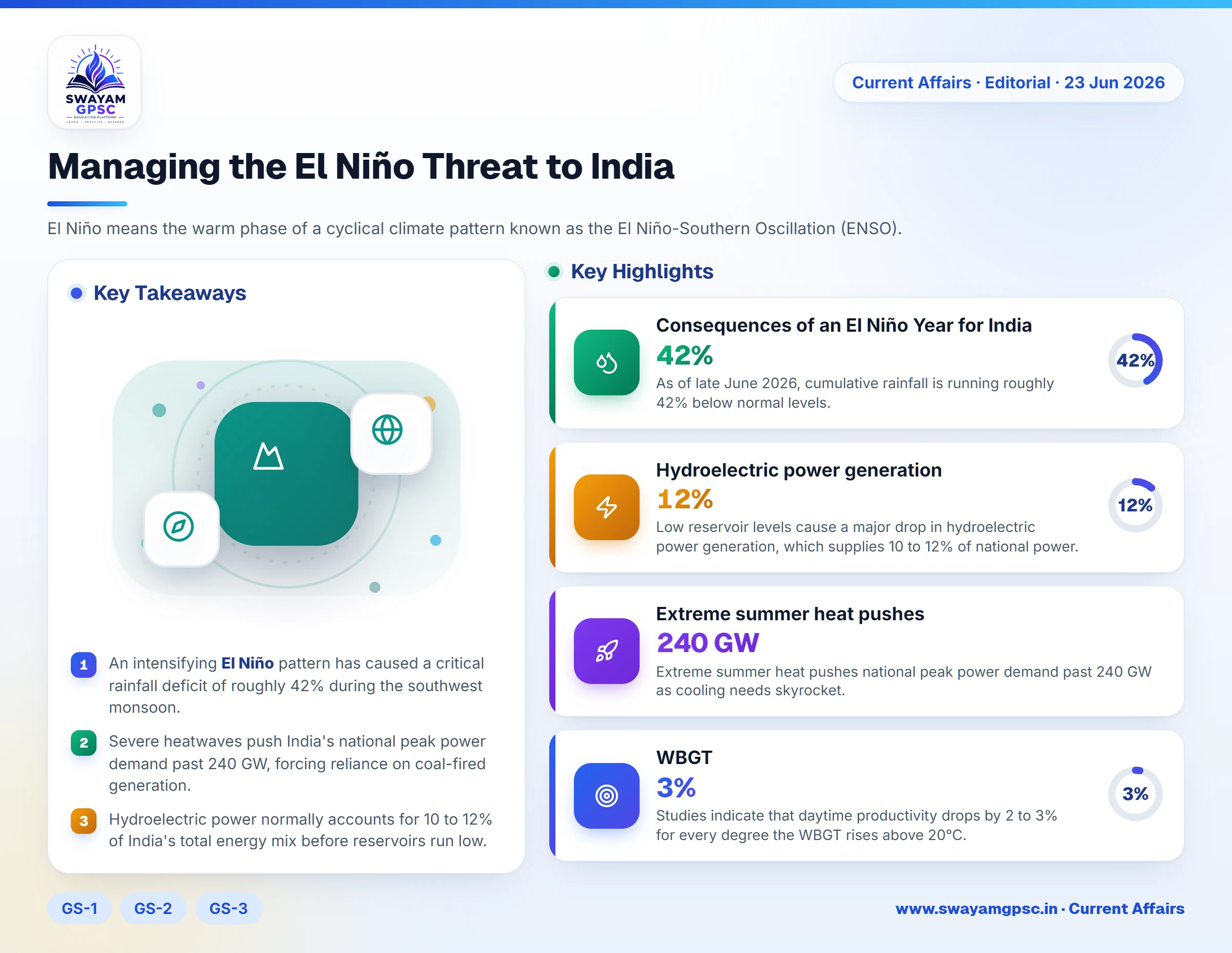
- An intensifying El Niño pattern has caused a critical rainfall deficit of roughly 42% during the southwest monsoon.
- Severe heatwaves push India's national peak power demand past 240 GW, forcing reliance on coal-fired generation.
- Hydroelectric power normally accounts for 10 to 12% of India's total energy mix before reservoirs run low.
- Proactive measures like expanding drought-hardy millets, which use 70% less water than rice, can safeguard food security.
Why in News
- A developing El Niño pattern is threatening agricultural cycles and food inflation across India.
- Experts point out that systemic weaknesses in domestic farming require immediate management on the supply side.
- Smart policy steps and better safety nets can protect the national economy from climate shocks.
What is El Niño
- El Niño means the warm phase of a cyclical climate pattern known as the El Niño-Southern Oscillation (ENSO).
- It happens when surface waters in the tropical Pacific Ocean experience abnormal warming.
- The opposite phase is called La Niña, which brings cooler conditions and stronger winds.
- Under normal conditions, strong trade winds blow from east to west across the Pacific Ocean.
- During El Niño, these trade winds weaken or reverse direction, pushing warm water backward.
- Cold water upwelling along South America stops because warm water pushes the thermocline deeper.
- Heavy rainfall shifts away from Indonesia toward the central and eastern parts of the Pacific Ocean.
- Scientists track sea surface temperatures using the Oceanic Niño Index (ONI) in specific Pacific zones.
- An El Niño is officially declared when anomalies reach +0.5°C or higher for five straight three-month periods.
- Air pressure differences between Tahiti and Darwin form the Southern Oscillation Index (SOI).
- Negative SOI values act as a clear sign that an El Niño event is underway.
- These shifts alter global jet streams and create widespread weather changes known as teleconnections.
- South American countries face heavy floods, while Australia and Southeast Asia suffer from intense droughts.
- By releasing massive ocean heat, El Niño years frequently set records as the hottest in human history.
- While frequency trends are debated, experts agree that climate change makes individual events much more intense.
Consequences of an El Niño Year for India
- The main impact on India is a heavy suppression of the southwest monsoon from June to September.
- Shifted wind patterns create a descending limb of dry air over the Indian subcontinent.
- As of late June 2026, cumulative rainfall is running roughly 42% below normal levels.
- Global weather agencies warn that this El Niño could grow into a very strong event by early next year.
- Past strong events like those in 2015-16 and 2023-24 caused severe agricultural droughts.
- Delayed sea breezes trigger multi-day heatwaves across central and northern regions with temperatures crossing 45°C.
- Historical dry spells have kept daily temperatures above 40°C for up to 45 days straight.
- Low reservoir levels cause a major drop in hydroelectric power generation, which supplies 10 to 12% of national power.
- Extreme summer heat pushes national peak power demand past 240 GW as cooling needs skyrocket.
- Rising power demand forces reliance on coal plants, driving up spot electricity prices on the Indian Energy Exchange (IEX).
- Agricultural job losses dry up rural cash flow, hurting sales for tractors, two-wheelers, and consumer goods.
- Factories often face water cuts when local governments prioritize drinking supplies over industrial needs.
- Supply-side food inflation raises the Consumer Price Index (CPI) and prevents the Monetary Policy Committee (MPC) from cutting rates.
- Government spending increases as rural employment programs like VB-G RAM G expand to support struggling farmers.
- High wet-bulb temperatures stop the human body from cooling down, lowering outdoor worker productivity.
- Studies indicate that daytime productivity drops by 2 to 3% for every degree the WBGT rises above 20°C.
- Rapid urbanization and falling water tables cause severe municipal shortages in major tech hubs.
- In Bengaluru, over-extraction has pushed groundwater depths down from 400 feet to over 1,200 feet in places.
- Chennai faced a historic Day Zero crisis in June 2019 when city reservoirs ran completely dry.
- Emergency measures during the Chennai crisis required hauling drinking water by trains from 200 kilometers away.
Way Forward
- The government can use minimum support price (MSP) signals to discourage water-intensive crops in dry zones.
- Promoting drought-resistant crops like millets, which need 70% less water than rice, builds lasting resilience.
- Modern drip and sprinkler setups prevent water loss through evaporation during dry monsoon breaks.
- AI-driven farming tools help growers adjust sowing dates and fertilizer use based on local weather forecasts.
- Building solar canopies over major canals stops water from evaporating while generating clean energy.
- The flowing water underneath naturally cools the solar panels, raising their electricity generation efficiency.
- Investing in CRISPR gene-editing helps agricultural scientists develop fast-maturing and heat-tolerant crop seeds.
- City planners must restore urban wetlands and adopt cool roof building codes to fight urban heat islands.
- Expanding pumped hydro storage and green energy corridors helps move surplus solar power across states smoothly.
- The Food Corporation of India (FCI) must maintain strategic grain reserves to keep food inflation under control.