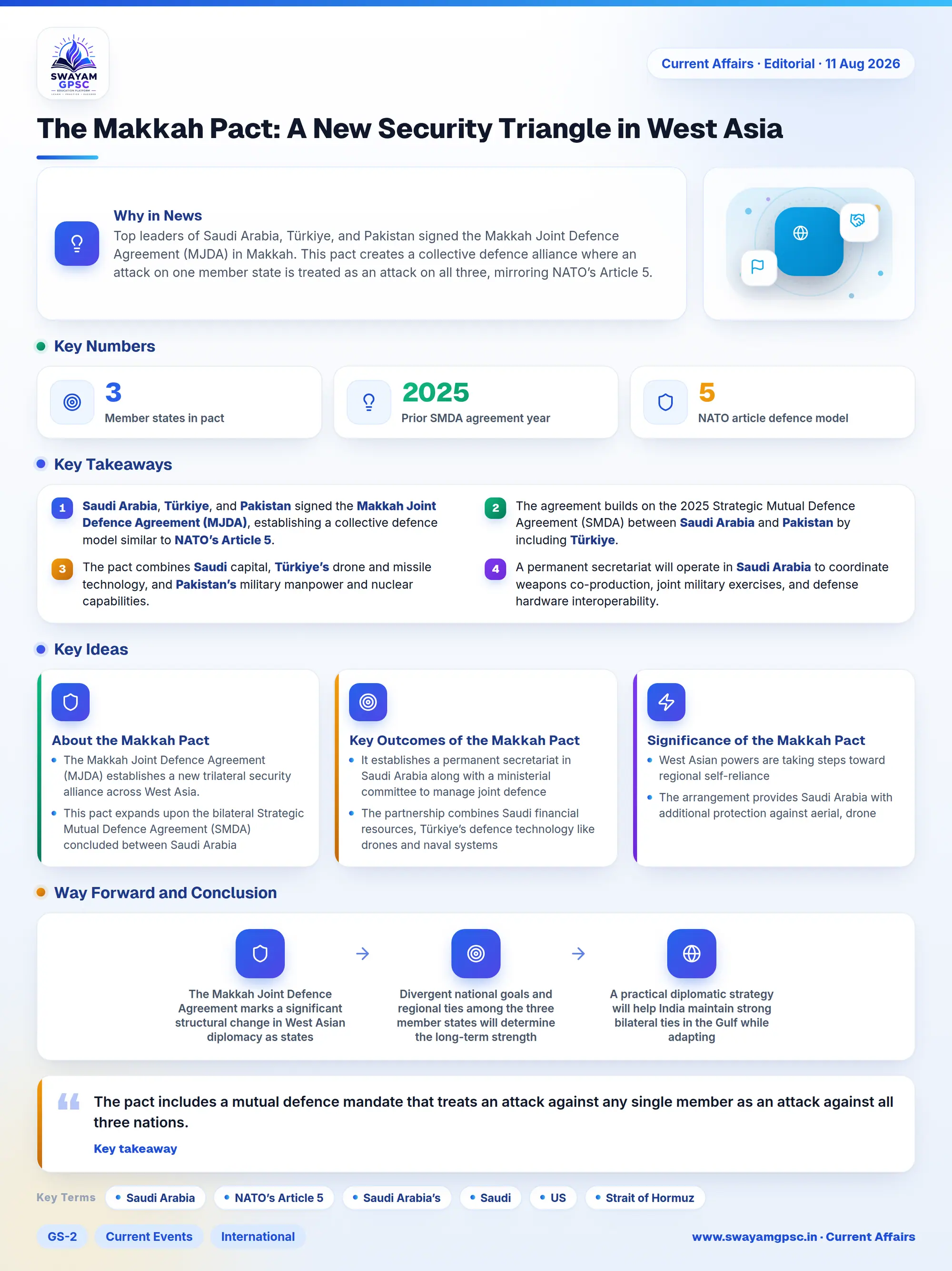
The Makkah Pact: A New Security Triangle in West Asia
#GS-2 #Current Events #International #GS-3 #Science & Technology #Defence #West Asia Geopolitics #Security Alliances
Key takeaways
- Saudi Arabia, Türkiye, and Pakistan signed the Makkah Joint Defence Agreement (MJDA), establishing a collective defence model similar to NATO’s Article 5.
- The agreement builds on the 2025 Strategic Mutual Defence Agreement (SMDA) between Saudi Arabia and Pakistan by including Türkiye.
- The pact combines Saudi capital, Türkiye’s drone and missile technology, and Pakistan’s military manpower and nuclear capabilities.
- A permanent secretariat will operate in Saudi Arabia to coordinate weapons co-production, joint military exercises, and defense hardware interoperability.
- The new security bloc extends its reach into key maritime choke points like the Strait of Hormuz and Bab al-Mandeb.
Why in News
- Top leaders of Saudi Arabia, Türkiye, and Pakistan signed the Makkah Joint Defence Agreement (MJDA) in Makkah.
- This pact creates a collective defence alliance where an attack on one member state is treated as an attack on all three, mirroring NATO’s Article 5.
About the Makkah Pact
- The Makkah Joint Defence Agreement (MJDA) establishes a new trilateral security alliance across West Asia.
- This pact expands upon the bilateral Strategic Mutual Defence Agreement (SMDA) concluded between Saudi Arabia and Pakistan in 2025 by adding Türkiye.
- The agreement primarily addresses Saudi Arabia’s security needs during regional instability by combining three major Islamic military powers into a joint deterrence system.
Key Outcomes of the Makkah Pact
- The pact includes a mutual defence mandate that treats an attack against any single member as an attack against all three nations.
- It establishes a permanent secretariat in Saudi Arabia along with a ministerial committee to manage joint defence policy and hold regular meetings.
- The partnership combines Saudi financial resources, Türkiye’s defence technology like drones and naval systems, and Pakistan’s military troops and nuclear status.
- Member states will integrate their military operations through joint exercises, weapons co-production, hardware development, and military equipment interoperability.
Significance of the Makkah Pact
- West Asian powers are taking steps toward regional self-reliance, reducing their complete dependence on traditional US security guarantees.
- The arrangement provides Saudi Arabia with additional protection against aerial, drone, and asymmetric threats targeting its energy infrastructure and trade routes.
- It connects three distinct geopolitical zones by linking major military powers in the Gulf, Eastern Mediterranean, and South Asia.
- The alliance represents an emerging non-Western security structure in the Global South that functions outside traditional Western alliances.
- It extends military influences across the Indian Ocean, directly impacting maritime trade security and prices at key transit points like the Strait of Hormuz and Bab al-Mandeb.
Challenges
- Historical distrust stemming from Ottoman times and political competition over Sunni leadership between Saudi Arabia and Türkiye could create internal friction.
- The text leaves major strategic details unclear, including command structures, exact troop commitments, and guidelines for handling non-state actors.
- Both Türkiye and Pakistan share extensive borders and trade ties with Iran, making them hesitant to participate in anti-Iran operations.
- Command structures, deployment rules, and domestic political instability inside member nations could cause operational disagreements.
- Neighboring countries like Iran, the UAE, Greece, and Israel may feel threatened, leading to the formation of rival alliances.
Implications for India
- The agreement gives Pakistan temporary political leverage and strategic confidence by linking its military with major West Asian powers.
- Saudi Arabia views its economic and energy ties with India as essential, making it unlikely to back any aggressive action by Pakistan against India.
- An increased military footprint in the Arabian Sea requires India to closely monitor its vital western sea lanes.
- The pact focuses mainly on West Asian security issues rather than South Asian disputes, restricting Pakistan’s ability to target India.
- India should maintain a balanced foreign policy that protects its strategic relationship with Saudi Arabia while avoiding overreaction.
Way Forward and Conclusion
- The Makkah Joint Defence Agreement marks a significant structural change in West Asian diplomacy as states seek self-reliant security setups.
- Divergent national goals and regional ties among the three member states will determine the long-term strength of this strategic triangle.
- A practical diplomatic strategy will help India maintain strong bilateral ties in the Gulf while adapting to changing regional security arrangements.