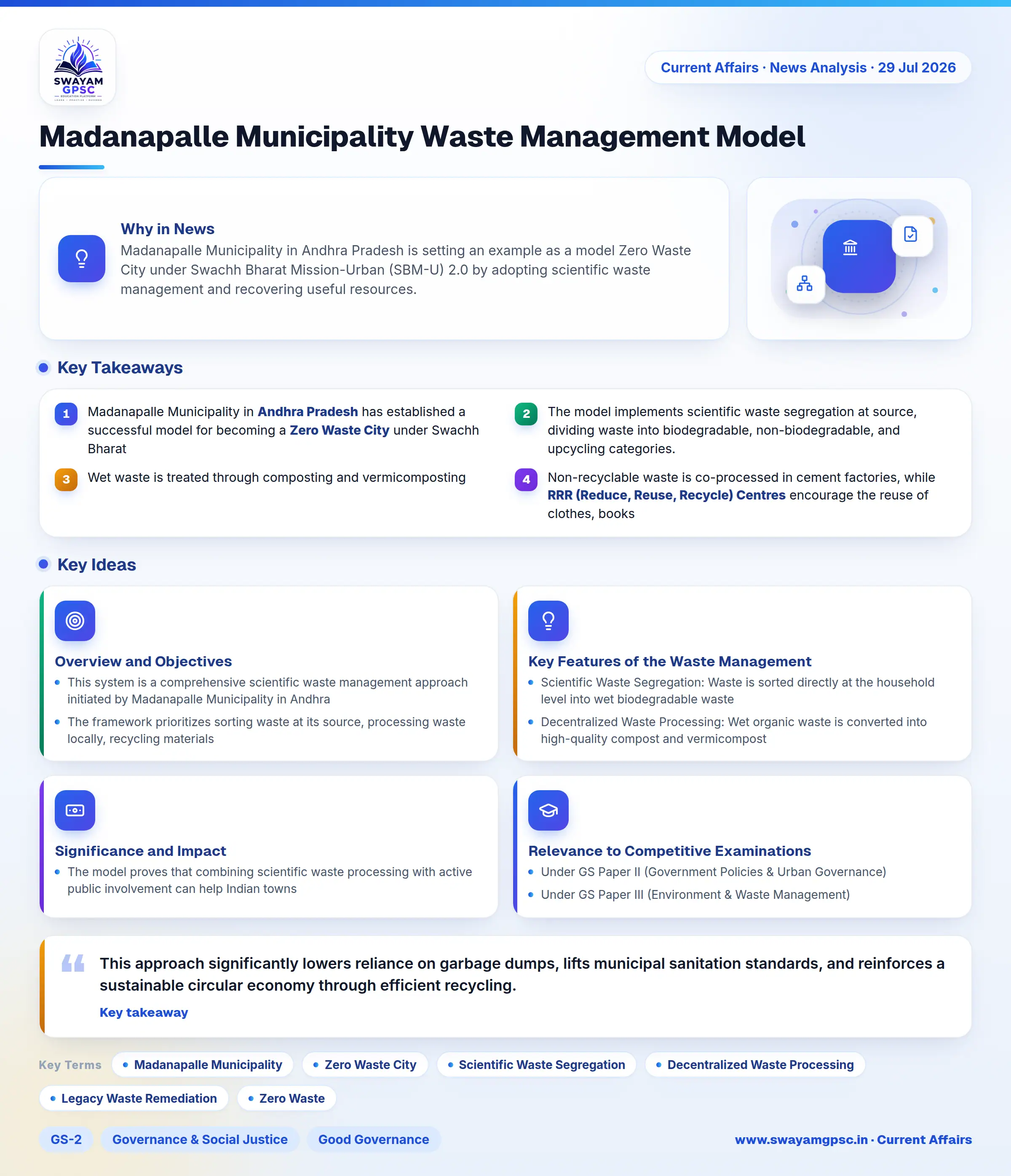
Madanapalle Municipality Waste Management Model
#GS-2 #Governance & Social Justice #Good Governance #GS-3 #Environment #Sustainable Development #Urban Governance #Swachh Bharat Mission
Key takeaways
- Madanapalle Municipality in Andhra Pradesh has established a successful model for becoming a Zero Waste City under Swachh Bharat Mission-Urban (SBM-U) 2.0.
- The model implements scientific waste segregation at source, dividing waste into biodegradable, non-biodegradable, and upcycling categories.
- Wet waste is treated through composting and vermicomposting, whereas dry recyclable waste is processed at Material Recovery Facilities (MRFs).
- Non-recyclable waste is co-processed in cement factories, while RRR (Reduce, Reuse, Recycle) Centres encourage the reuse of clothes, books, and electronics.
- Legacy waste dump sites are restored using bio-mining and bio-remediation, transforming reclaimed land into green public spaces.
Why in News
- Madanapalle Municipality in Andhra Pradesh is setting an example as a model Zero Waste City under Swachh Bharat Mission-Urban (SBM-U) 2.0 by adopting scientific waste management and recovering useful resources.
Overview and Objectives
- This system is a comprehensive scientific waste management approach initiated by Madanapalle Municipality in Andhra Pradesh under Swachh Bharat Mission-Urban (SBM-U) 2.0.
- The framework prioritizes sorting waste at its source, processing waste locally, recycling materials, and cleaning up old landfill sites to create a Zero Waste City.
- The main objective is to cut down landfill dumping through scientific techniques, extract maximum value from waste, and build a sustainable urban circular economy.
Key Features of the Waste Management Model
- Scientific Waste Segregation: Waste is sorted directly at the household level into wet biodegradable waste, dry non-biodegradable waste, and materials suitable for upcycling.
- Decentralized Waste Processing: Wet organic waste is converted into high-quality compost and vermicompost, while recyclable dry items go to dedicated Material Recovery Facilities (MRFs).
- Resource Recovery and Circular Economy: Waste that cannot be recycled is safely co-processed in cement manufacturing units, while dedicated RRR (Reduce, Reuse, Recycle) Centres collect and distribute old clothes, books, and electronics.
- Legacy Waste Remediation: Municipal workers clear old accumulated garbage heaps using bio-mining and bio-remediation techniques, turning the reclaimed land into urban parks and community assets.
Significance and Impact
- This approach significantly lowers reliance on garbage dumps, lifts municipal sanitation standards, and reinforces a sustainable circular economy through efficient recycling.
- The model proves that combining scientific waste processing with active public involvement can help Indian towns attain their Zero Waste targets under the Swachh Bharat Mission.
Relevance to Competitive Examinations
- Under GS Paper II (Government Policies & Urban Governance), this topic serves as an active case study of Swachh Bharat Mission-Urban 2.0 executing decentralized sanitation through community participation.
- Under GS Paper III (Environment & Waste Management), the model illustrates practical solutions for solid waste management, resource extraction, and circular economic practices in urban centers.
- Under GS Paper III (Environment & Waste Management), it highlights techniques to build eco-friendly cities by curbing landfill volumes, preserving natural resources, and expanding urban green zones.