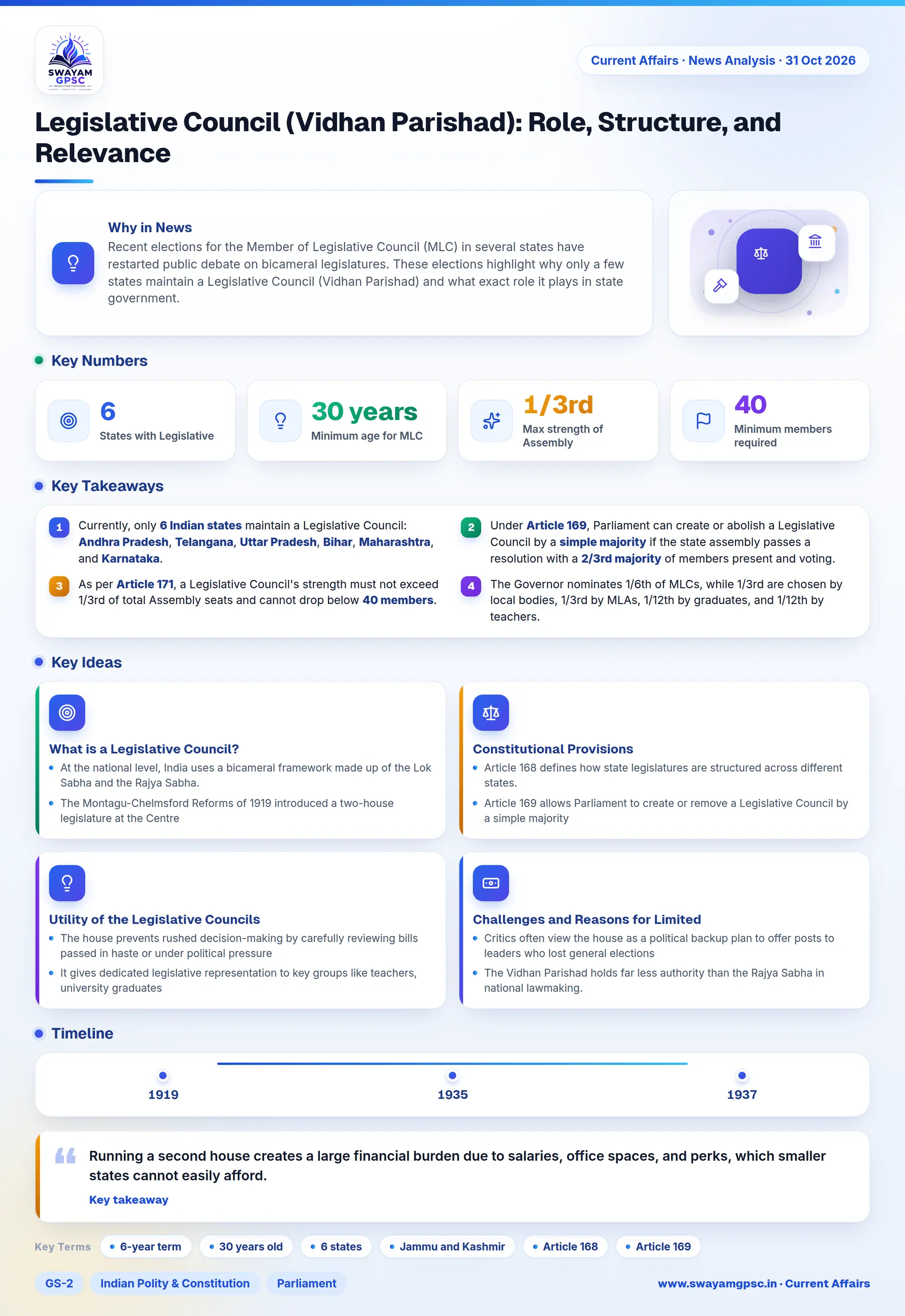
Legislative Council (Vidhan Parishad): Role, Structure, and Relevance
#GS-2 #Indian Polity & Constitution #Parliament #Executive #Current Events #National #Legislative Council #Vidhan Parishad
Key takeaways
- Currently, only 6 Indian states maintain a Legislative Council: Andhra Pradesh, Telangana, Uttar Pradesh, Bihar, Maharashtra, and Karnataka.
- Under Article 169, Parliament can create or abolish a Legislative Council by a simple majority if the state assembly passes a resolution with a 2/3rd majority of members present and voting.
- As per Article 171, a Legislative Council's strength must not exceed 1/3rd of total Assembly seats and cannot drop below 40 members.
- The Governor nominates 1/6th of MLCs, while 1/3rd are chosen by local bodies, 1/3rd by MLAs, 1/12th by graduates, and 1/12th by teachers.
- Unlike the Rajya Sabha, a Legislative Council cannot veto ordinary bills and can delay them for a maximum duration of 4 months.
Why in News
- Recent elections for the Member of Legislative Council (MLC) in several states have restarted public debate on bicameral legislatures.
- These elections highlight why only a few states maintain a Legislative Council (Vidhan Parishad) and what exact role it plays in state government.
What is a Legislative Council?
- At the national level, India uses a bicameral framework made up of the Lok Sabha and the Rajya Sabha.
- The Montagu-Chelmsford Reforms of 1919 introduced a two-house legislature at the Centre, while the Government of India Act of 1935 established it in selected provinces.
- India's very first provincial Legislative Council started its work in Bengal back in 1937.
- The Constitution allows each state to decide whether it wants a single house or two houses in its legislature.
- In states with two houses, the lower house is the Legislative Assembly (Vidhan Sabha), which represents the public directly through general elections based on universal adult suffrage.
- The upper house is the Legislative Council (Vidhan Parishad), which serves as a revising body and operates as a permanent house that cannot be dissolved.
- Every member of the Vidhan Parishad serves a 6-year term, with 1/3rd of its members retiring every 2 years.
- To become an MLC, a candidate must be at least 30 years old, whereas Legislative Assembly candidates need to be only 25 years old.
- At present, only 6 states have a Vidhan Parishad: Andhra Pradesh, Telangana, Uttar Pradesh, Bihar, Maharashtra, and Karnataka.
- Jammu and Kashmir also had a Legislative Council until Parliament passed the Jammu and Kashmir Reorganisation Act of 2019.
Constitutional Provisions and Composition
- Article 168 defines how state legislatures are structured across different states.
- Article 169 allows Parliament to create or remove a Legislative Council by a simple majority, provided the state assembly first passes a resolution requesting it.
- The state assembly must pass this resolution by a special majority, meaning a majority of total membership and a 2/3rd majority of members present and voting.
- Article 171 sets the maximum size of a Vidhan Parishad at 1/3rd of the state assembly's total seats, with a minimum size fixed at 40 members.
- MLCs are chosen through indirect elections using proportional representation with a single transferable vote.
- Local bodies like municipalities, Gram Panchayats, Panchayat Samitis, and Zila Parishads elect 1/3rd of the total MLC seats.
- Members of the Legislative Assembly (MLAs) elect another 1/3rd of the MLCs from people who are not current assembly members.
- State residents who have been university graduates for at least three years elect 1/12th of the total members.
- Teachers who have taught for at least three years in secondary schools or higher institutions elect another 1/12th of the members.
- The Governor nominates the remaining 1/6th of members from fields like literature, science, art, the cooperative movement, and social service.
Utility of the Legislative Councils
- The house prevents rushed decision-making by carefully reviewing bills passed in haste or under political pressure by the lower house.
- It gives dedicated legislative representation to key groups like teachers, university graduates, and local local body representatives.
- The Governor's nomination quota brings non-political experts and subject matter specialists directly into the lawmaking process.
- The upper house reduces the heavy legislative load of the assembly by introducing non-financial bills.
Challenges and Reasons for Limited Adoption
- Running a second house creates a large financial burden due to salaries, office spaces, and perks, which smaller states cannot easily afford.
- Critics often view the house as a political backup plan to offer posts to leaders who lost general elections or to political allies.
- The Vidhan Parishad holds far less authority than the Rajya Sabha in national lawmaking.
- Under Article 197, the upper house cannot reject ordinary bills outright and can only delay them for up to 4 months in total.
- The upper house cannot reject or amend Money Bills, and it has only 14 days to give recommendations that the lower house can freely ignore.
- Unlike Parliament, state legislatures have no constitutional rule for holding a joint sitting to resolve disagreements between houses.
- Opponents argue the house acts mostly as a delay mechanism that slows down urgent policy decisions.
- The upper house does not protect state-level federalism, because it represents specific interest groups rather than distinct political units.
Comparing Rajya Sabha and State Legislative Council
- Article 80 sets rules for the Rajya Sabha, while Article 169 and Article 171 govern the creation, removal, and structure of the Vidhan Parishad.
- The Rajya Sabha is a permanent central body that cannot be removed, whereas Parliament can remove a Vidhan Parishad completely.
- The Rajya Sabha can have up to 250 members, while a Vidhan Parishad is capped at 1/3rd of assembly seats with a minimum limit of 40 members.
- The President nominates 12 members to the Rajya Sabha, but the Governor nominates 1/6th of all members in a Vidhan Parishad.
- The Vice-President of India serves as the ex-officio Chairman of the Rajya Sabha, while Vidhan Parishad members elect their own Chairman from within the house.
- The President can call a Joint Sitting under Article 108 for Parliament, but state legislatures have no provision for joint sittings.
- Rajya Sabha members vote in presidential and vice-presidential elections, but MLCs do not participate in either election.