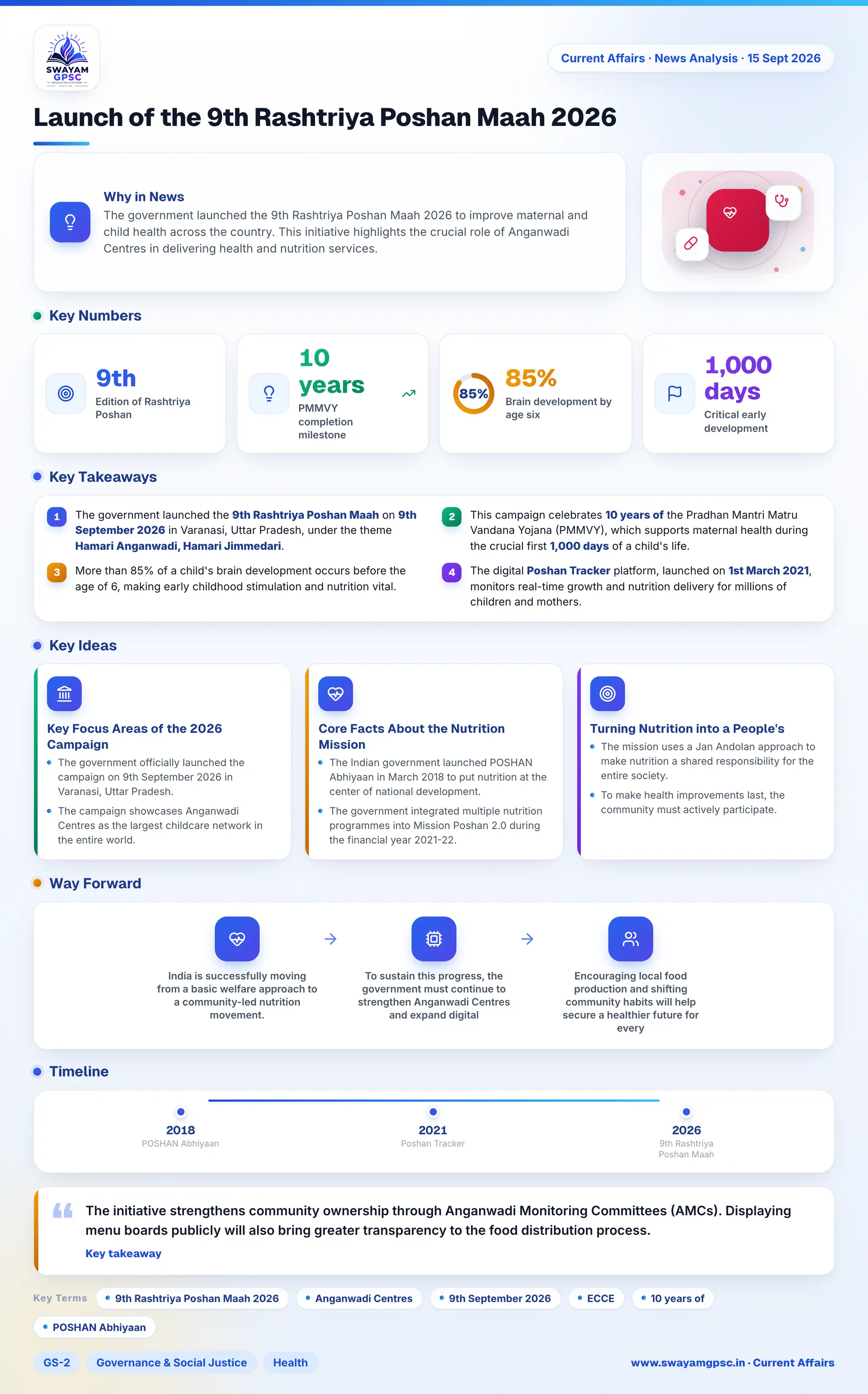
Launch of the 9th Rashtriya Poshan Maah 2026
#GS-2 #Governance & Social Justice #Health #Current Events #National #Government Policies #Nutrition
Key takeaways
- The government launched the 9th Rashtriya Poshan Maah on 9th September 2026 in Varanasi, Uttar Pradesh, under the theme Hamari Anganwadi, Hamari Jimmedari.
- This campaign celebrates 10 years of the Pradhan Mantri Matru Vandana Yojana (PMMVY), which supports maternal health during the crucial first 1,000 days of a child's life.
- More than 85% of a child's brain development occurs before the age of 6, making early childhood stimulation and nutrition vital.
- The digital Poshan Tracker platform, launched on 1st March 2021, monitors real-time growth and nutrition delivery for millions of children and mothers.
Why in News
- The government launched the 9th Rashtriya Poshan Maah 2026 to improve maternal and child health across the country.
- This initiative highlights the crucial role of Anganwadi Centres in delivering health and nutrition services.
- It focuses heavily on promoting balanced and protein-rich diets for pregnant women and lactating mothers.
Key Focus Areas of the 2026 Campaign
- The government officially launched the campaign on 9th September 2026 in Varanasi, Uttar Pradesh. The event took place at the Rudraksh International Cooperation and Convention Centre.
- The campaign showcases Anganwadi Centres as the largest childcare network in the entire world. These centres offer essential nutrition, care, and early learning services to young children.
- The official theme for this year is Hamari Anganwadi, Hamari Jimmedari. This theme encourages local communities to take active responsibility for improving their local centres.
- The campaign aims to improve dietary diversity by promoting protein-rich foods. It encourages families to use locally available and nutritious items to fight malnutrition.
- Anganwadi Centres will improve the quality of the Supplementary Nutrition Programme (SNP). They will serve fresh, hot cooked meals with better menu rotation and strict hygiene.
- The initiative strengthens community ownership through Anganwadi Monitoring Committees (AMCs). Displaying menu boards publicly will also bring greater transparency to the food distribution process.
- The programme connects nutrition directly with Early Childhood Care and Education (ECCE). Proper nutrition builds a strong foundation for a child's brain development and learning.
- The campaign marks 10 years of the Pradhan Mantri Matru Vandana Yojana (PMMVY). It focuses on maternal health and the critical first 1,000 days of a child's life.
Core Facts About the Nutrition Mission
- The Indian government launched POSHAN Abhiyaan in March 2018 to put nutrition at the center of national development. Different ministries work together under this mission to reduce malnutrition.
- The government integrated multiple nutrition programmes into Mission Poshan 2.0 during the financial year 2021-22. The Ministry of Women and Child Development oversees this unified national mission.
- The first component, POSHAN Abhiyaan, uses digital technology, community mobilization, and behavioral change to monitor and improve health outcomes.
- The second component, Anganwadi Services, delivers supplementary food, hot meals, and early childhood care to local communities.
- The third component, the Scheme for Adolescent Girls, provides targeted nutritional support to girls who are currently out of school.
- The government organizes Rashtriya Poshan Maah every September to spread awareness about Mission Poshan 2.0 and involve local communities.
- Malnutrition remains a major public health challenge in India. It negatively affects the health, learning ability, and productivity of women and children.
Turning Nutrition into a People's Movement
- The mission uses a Jan Andolan approach to make nutrition a shared responsibility for the entire society. It shifts the focus from being just a government scheme to a public movement.
- To make health improvements last, the community must actively participate. This ownership drives positive changes in infant feeding, diverse diets, hygiene, and regular healthcare visits.
Understanding the Poshan Pakhwada Initiative
- The government has organized Poshan Pakhwada every year since 2018 as a two-week campaign in April. This drive reinforces healthy habits and mobilizes communities.
- The 8th Poshan Pakhwada took place from 9th April to 23rd April 2026. The central theme focused on maximizing brain development in the first six years of life.
- Scientific data shows that over 85% of human brain development occurs before the age of six. The most rapid growth happens during the first 1,000 days of a child's life.
- The 2026 campaign expanded the definition of nutrition. It promoted early childhood stimulation alongside proper food to ensure optimal brain growth.
- Both Poshan Maah and Poshan Pakhwada serve as powerful tools. They build awareness about immunity, health, and wellness across Indian families.
Digital Monitoring with Poshan Tracker
- The government launched the Poshan Tracker app on 1st March 2021 to monitor Anganwadi services digitally and make delivery transparent.
- The app tracks key indicators in real time. These include daily attendance, the opening of centres, early childhood activities, and child growth.
- The Poshan Tracker monitors services for pregnant women, lactating mothers, adolescent girls, and children under six years of age.
Way Forward
- India is successfully moving from a basic welfare approach to a community-led nutrition movement.
- To sustain this progress, the government must continue to strengthen Anganwadi Centres and expand digital tracking.
- Encouraging local food production and shifting community habits will help secure a healthier future for every child.