Kishau Multipurpose Project: Interstate Consensus on Yamuna Waters
#GS-2 #GS-3 #Indian Polity & Constitution #Federalism #Governance & Social Justice #Economy #Infrastructure #Environment #Current Events #National
Key takeaways
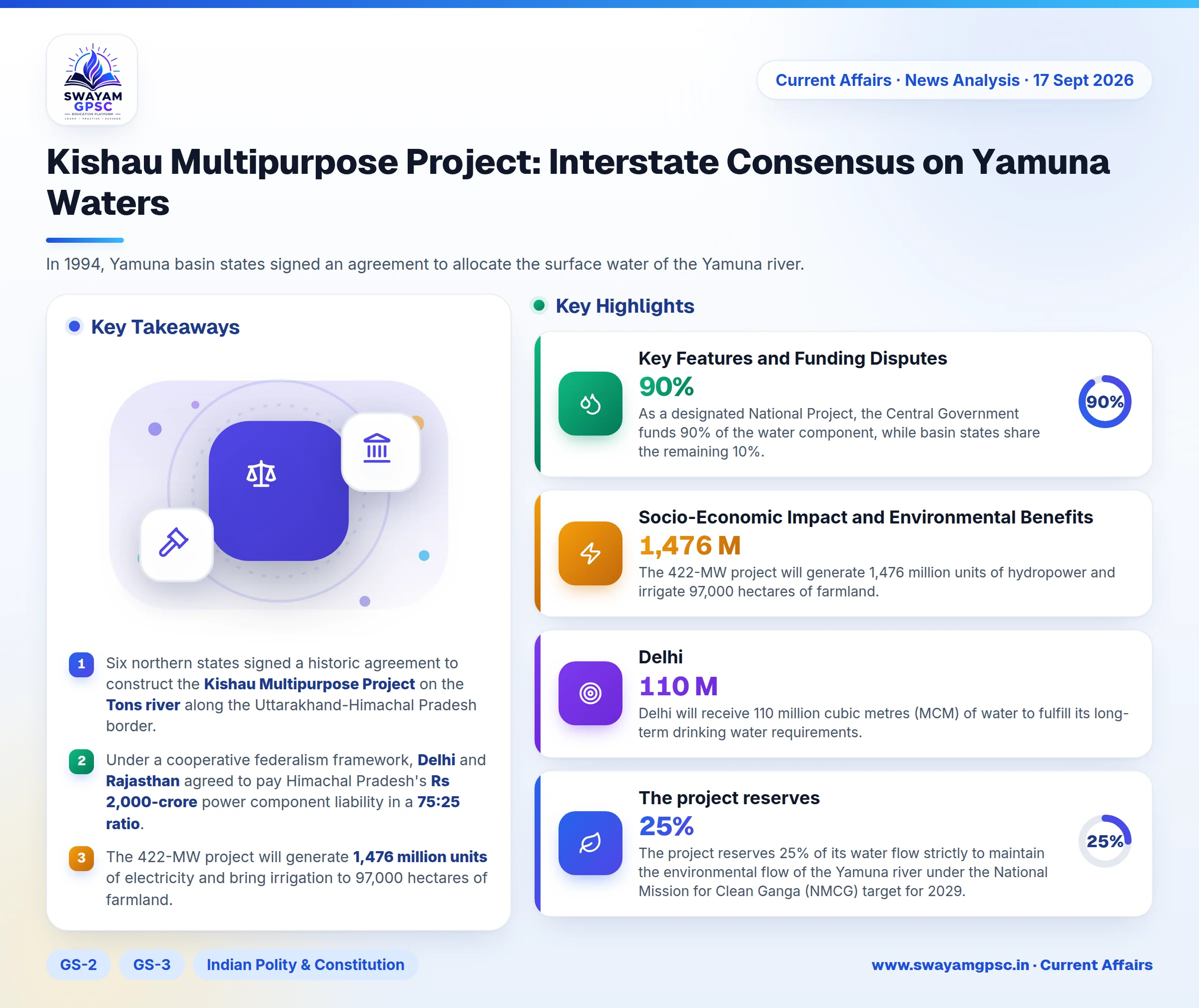
- Six northern states signed a historic agreement to construct the Kishau Multipurpose Project on the Tons river along the Uttarakhand-Himachal Pradesh border.
- Under a cooperative federalism framework, Delhi and Rajasthan agreed to pay Himachal Pradesh's Rs 2,000-crore power component liability in a 75:25 ratio.
- The 422-MW project will generate 1,476 million units of electricity and bring irrigation to 97,000 hectares of farmland.
- Delhi will receive 110 MCM of drinking water, and 25% of the project water is reserved for Yamuna river environmental flow to support the 2029 clean Yamuna target.
Why in News
- Six northern states signed a historic Memorandum of Understanding (MoU) to clear the long-pending Kishau Multipurpose Project.
- The states involved include Uttarakhand, Himachal Pradesh, Uttar Pradesh, Haryana, Rajasthan, and Delhi.
- This agreement resolves a major dispute regarding cost-sharing and water allocation among Yamuna basin states.
Background and the 1994 Yamuna Agreement
- In 1994, Yamuna basin states signed an agreement to allocate the surface water of the Yamuna river.
- The Upper Yamuna stretch from Yamunotri glacier to Okhla barrage lacked major water storage structures.
- To fix this, the 1994 agreement identified three storage projects: Lakhwar in Uttarakhand, Renukaji in Himachal Pradesh, and Kishau on the HP-Uttarakhand border.
Key Features and Funding Disputes
- The Kishau Multipurpose Project involves building a 232.6-metre-high concrete gravity dam on the Tons river, a main tributary of the Yamuna.
- As a designated National Project, the Central Government funds 90% of the water component, while basin states share the remaining 10%.
- A major deadlock arose over the Rs 2,000-crore power component, which Himachal Pradesh refused to pay due to local ecological and displacement burdens.
Resolution Through Cooperative Federalism
- The financial deadlock was solved through cooperative federalism among the participating states.
- Downstream beneficiary states agreed to cover Himachal Pradesh's power liability to ensure project progress.
- Delhi and Rajasthan agreed to pay this Rs 2,000-crore liability in a 75:25 ratio based on their drinking water benefits.
Socio-Economic Impact and Environmental Benefits
- The 422-MW project will generate 1,476 million units of hydropower and irrigate 97,000 hectares of farmland.
- Delhi will receive 110 million cubic metres (MCM) of water to fulfill its long-term drinking water requirements.
- The project reserves 25% of its water flow strictly to maintain the environmental flow of the Yamuna river under the National Mission for Clean Ganga (NMCG) target for 2029.