Key Issues and Constitutional Framework in India's Delimitation Process
#GS-2 #Indian Polity & Constitution #Constitution #Federalism #Parliament #Current Events #National #Delimitation Commission #Electoral Reforms
Key takeaways
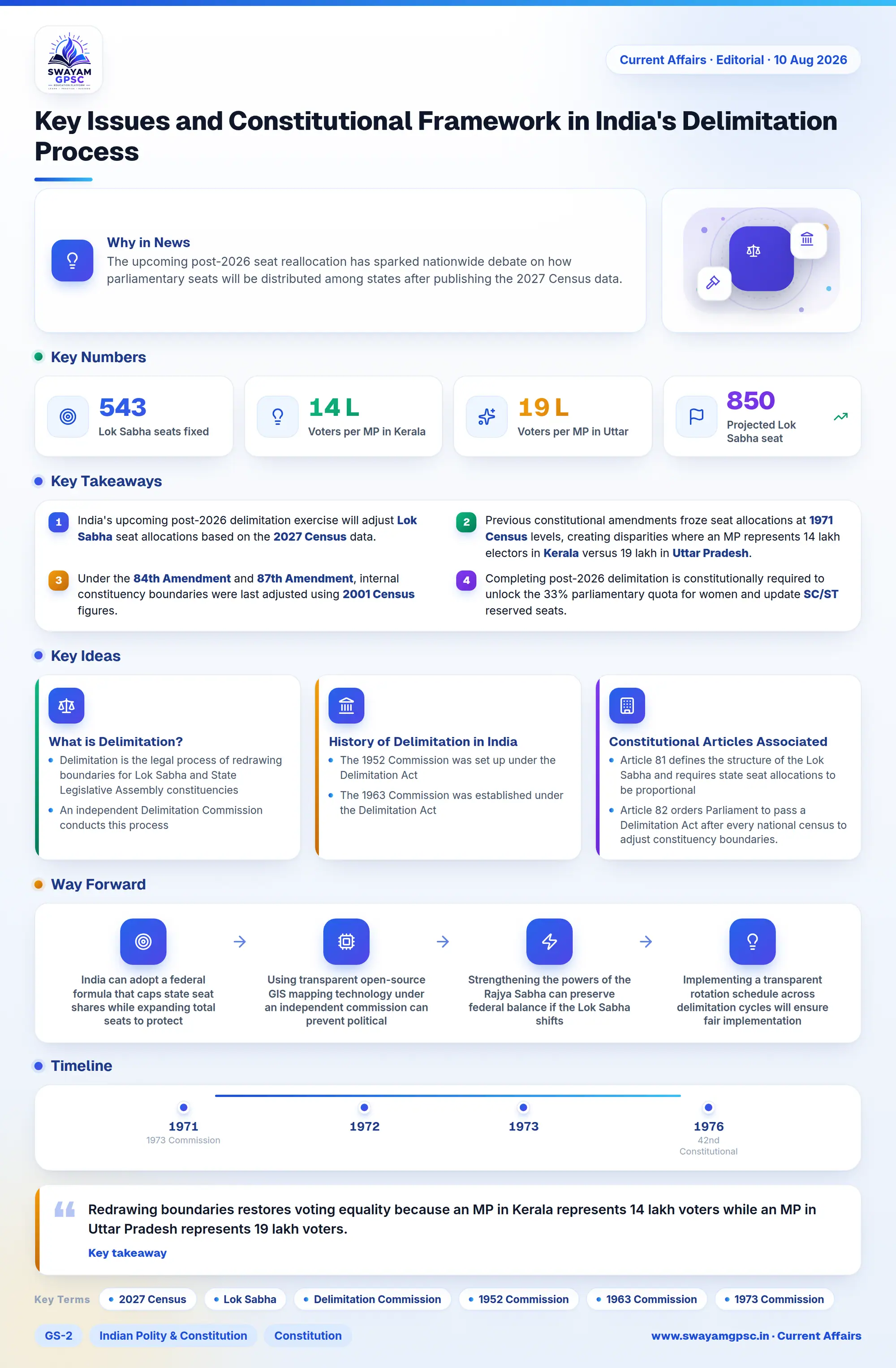
- India's upcoming post-2026 delimitation exercise will adjust Lok Sabha seat allocations based on the 2027 Census data.
- Previous constitutional amendments froze seat allocations at 1971 Census levels, creating disparities where an MP represents 14 lakh electors in Kerala versus 19 lakh in Uttar Pradesh.
- Under the 84th Amendment and 87th Amendment, internal constituency boundaries were last adjusted using 2001 Census figures.
- Completing post-2026 delimitation is constitutionally required to unlock the 33% parliamentary quota for women and update SC/ST reserved seats.
- Projections indicate total Lok Sabha seats could expand up to 850 to maintain regional equity and voter representation.
Why in News
- The upcoming post-2026 seat reallocation has sparked nationwide debate on how parliamentary seats will be distributed among states after publishing the 2027 Census data.
What is Delimitation?
- Delimitation is the legal process of redrawing boundaries for Lok Sabha and State Legislative Assembly constituencies to reflect changes in population.
- An independent Delimitation Commission conducts this process, and its legal orders carry the force of law without being subject to judicial review.
History of Delimitation in India
- The 1952 Commission was set up under the Delimitation Act, 1952 using the 1951 Census to allocate initial parliamentary and assembly seats.
- The 1963 Commission was established under the Delimitation Act, 1962 following the 1961 Census and state reorganization.
- The 1973 Commission operated under the Delimitation Act, 1972 using the 1971 Census and fixed Lok Sabha seats at 543.
- The 42nd Constitutional Amendment in 1976 froze inter-state seat allocations at 1971 levels until 2000 to protect family planning states.
- The 84th Amendment and 87th Amendment extended this seat freeze until after 2026 while permitting internal constituency redrawing using 2001 Census data.
Constitutional Articles Associated with Delimitation
- Article 81 defines the structure of the Lok Sabha and requires state seat allocations to be proportional to population.
- Article 82 orders Parliament to pass a Delimitation Act after every national census to adjust constituency boundaries.
- Article 170 mandates the division of each state into territorial constituencies for its State Legislative Assembly after every census.
- Articles 330 and 332 provide proportional seat reservation for Scheduled Castes (SCs) and Scheduled Tribes (STs) based on census data.
Projected Benefits and Gains of Delimitation
- Redrawing boundaries restores voting equality because an MP in Kerala represents 14 lakh voters while an MP in Uttar Pradesh represents 19 lakh voters.
- Updated constituency maps reflect population growth, rural-to-urban migration, and regional demographic shifts occurring since 1971.
- Conducting delimitation unlocks the 33% quota for women in Parliament and Assemblies, which is legally linked to this exercise.
- Adjusting boundary lines ensures fair political representation for SC and ST communities based on updated census figures.
- Using digital tools in the 2027 Census will speed up boundary allocation compared to older manual methods.
Challenges Associated with Delimitation
- Southern states that successfully reduced fertility rates risk losing parliamentary seats to northern states with higher population growth.
- States making large contributions to national GDP may lose political influence in Parliament to more populous states.
- Political parties might engage in gerrymandering through cracking or packing voter groups to unfairly gain electoral advantages.
- Increasing total parliamentary seats up to 850 could make legislative management difficult and overburden individual MPs.
- Reallocating seats triggers political tension between states over federal funds and legislative power.
Way Forward
- India can adopt a federal formula that caps state seat shares while expanding total seats to protect population-stabilized states.
- Using transparent open-source GIS mapping technology under an independent commission can prevent political gerrymandering.
- Strengthening the powers of the Rajya Sabha can preserve federal balance if the Lok Sabha shifts toward populous northern states.
- Implementing a transparent rotation schedule across delimitation cycles will ensure fair implementation of reserved seats.
Conclusion
- The upcoming post-2026 exercise is a crucial moment for balancing equal voter representation with federal protections for responsible states.