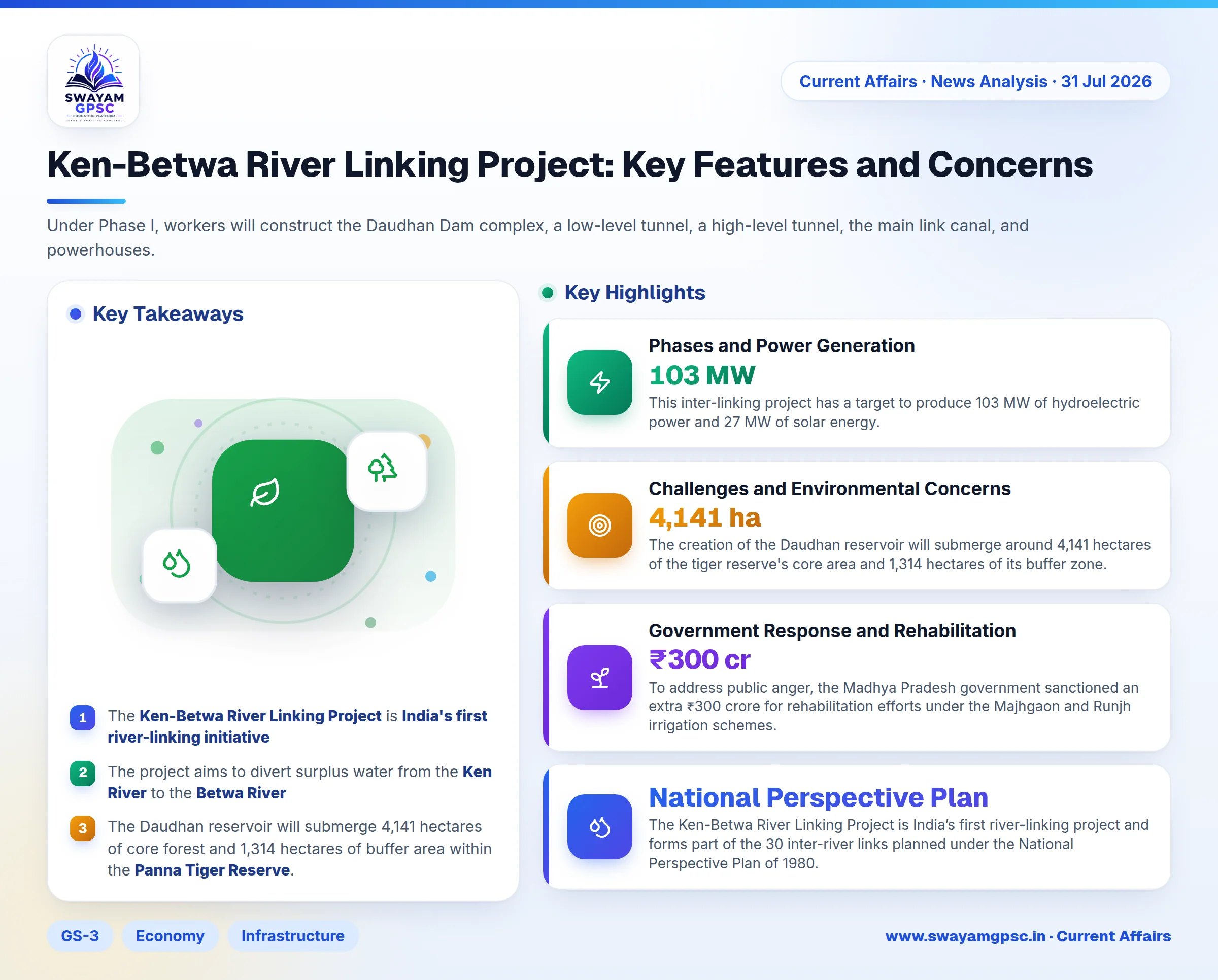
Ken-Betwa River Linking Project: Key Features and Concerns
#GS-3 #Economy #Infrastructure #Environment #Wildlife #Current Events #National
Key takeaways
- The Ken-Betwa River Linking Project is India's first river-linking initiative, launched as part of the 30 links proposed under the 1980 National Perspective Plan.
- The project aims to divert surplus water from the Ken River to the Betwa River, generating 103 MW of hydro power and 27 MW of solar power for the drought-prone Bundelkhand region.
- The Daudhan reservoir will submerge 4,141 hectares of core forest and 1,314 hectares of buffer area within the Panna Tiger Reserve.
- The Madhya Pradesh government approved an additional ₹300 crore for rehabilitation and identified 750 newly affected families for compensation.
Why in News
- Tribal communities in Madhya Pradesh recently launched protests against the Ken-Betwa River Linking Project (KBRL) due to worries about land displacement, compensation, and damage to local ecosystems.
Overview and Objectives
- The Ken-Betwa River Linking Project is India’s first river-linking project and forms part of the 30 inter-river links planned under the National Perspective Plan of 1980.
- A dedicated Special Purpose Vehicle called the Ken-Betwa Link Project Authority handles the execution of this major water infrastructure initiative.
- The core goal of this project is to move surplus water from the Ken River in Madhya Pradesh to the water-deficit Betwa River in Uttar Pradesh.
- Both the Ken River and the Betwa River act as key tributaries of the Yamuna River.
Phases and Power Generation
- Under Phase I, workers will construct the Daudhan Dam complex, a low-level tunnel, a high-level tunnel, the main link canal, and powerhouses.
- Under Phase II, the project will build the Lower Orr Dam across the Orr River, which flows as a tributary into the Betwa, alongside the Bina Complex Multipurpose Project and Kotha Barrage.
- This inter-linking project has a target to produce 103 MW of hydroelectric power and 27 MW of solar energy.
Significance of the Project
- The project targets the Bundelkhand region, which frequently suffers from severe drought across districts in Madhya Pradesh and Uttar Pradesh.
- Successful completion will bring reliable drinking water, expand farm irrigation, boost the rural economy, and prevent distress migration from villages.
Challenges and Environmental Concerns
- Environmental experts have raised serious concerns about the threat to the Panna Tiger Reserve.
- The creation of the Daudhan reservoir will submerge around 4,141 hectares of the tiger reserve's core area and 1,314 hectares of its buffer zone.
Government Response and Rehabilitation
- To address public anger, the Madhya Pradesh government sanctioned an extra ₹300 crore for rehabilitation efforts under the Majhgaon and Runjh irrigation schemes.
- Authorities also conducted a new field survey that added nearly 750 additional affected families to the official compensation list.