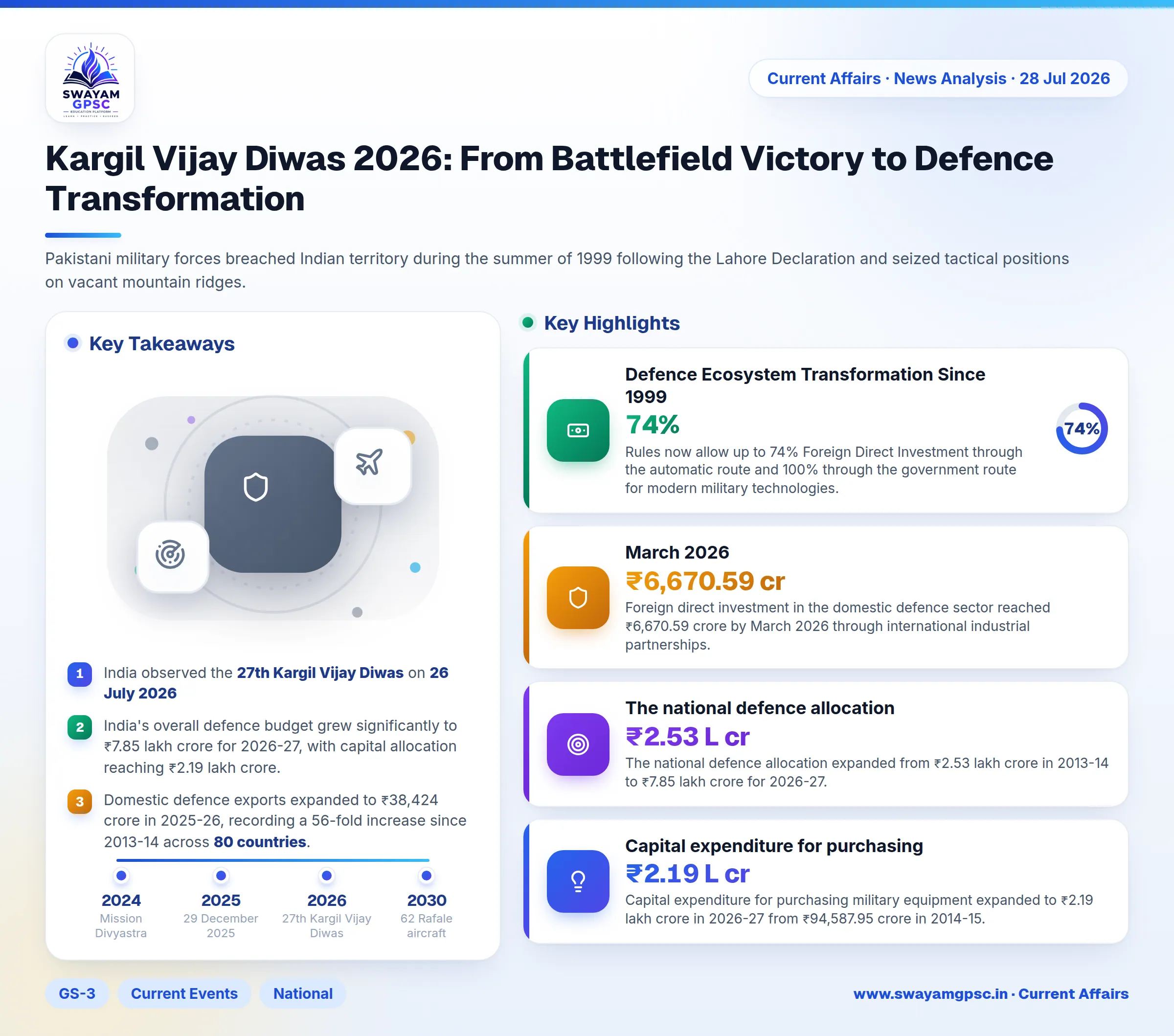
Kargil Vijay Diwas 2026: From Battlefield Victory to Defence Transformation
#GS-3 #Current Events #National #Science & Technology #Defence #Security Challenges & their Management in Border Areas
Why in News
- India celebrated the **27th Kargil Vijay Diwas** on **26 July 2026** to commemorate the bravery of soldiers who reclaimed the heights of Kargil in **1999**.
- Military historians view the Kargil War as the only conventional war fought directly between two nuclear-armed states.
Key Facts About the Kargil War
- Pakistani military forces breached Indian territory during the **summer of 1999** following the **Lahore Declaration** and seized tactical positions on vacant mountain ridges.
- The intrusion occurred under **Pakistan's Operation Badr**, where enemy troops wore disguises as local militants to block the **Srinagar-Leh Highway**.
- Pakistan aimed to cut off connectivity between Kashmir and Ladakh, isolate military positions on the **Siachen Glacier**, and force concessions on Kashmir.
- Local inhabitants first noticed unusual activity in the Kargil area on **3 May 1999**, leading to military patrols and aerial checks that identified deep intrusions.
- Indian forces faced extreme challenges operating at altitudes over **5,000 metres** under sub-zero temperatures and constant enemy gunfire.
- The Indian Armed Forces launched **Operation Vijay** to regain control of all occupied ridges while strictly observing government orders not to cross the **Line of Control**.
- The **Indian Air Force** started **Operation Safed Sagar** on **26 May 1999**, and the **Indian Navy** mobilized its fleet to maintain total readiness.
- The strategic approach focused on holding the enemy in place, forcing them off the peaks, and stopping any fresh supply lines.
- The victory at **Point 4590** during the **Battle of Tololing** on **13 June 1999** marked the first major tactical breakthrough for Indian forces.
- Indian troops captured the strategic peak of **Tiger Hill** in the Dras area on **4 July 1999** through a difficult night assault.
- Soldiers fought intense battles across multiple sectors, including **Point 4875**, **Batalik**, **Mushkoh Valley**, and **Kaksar**.
- Indian forces cleared all enemy posts after nearly **three months** of combat without stepping across the **Line of Control**.
- Prime Minister **Atal Bihari Vajpayee** officially declared **Operation Vijay** a complete victory on **14 July 1999**.
The Heroes Who Defined Kargil
- Officers and soldiers such as **Captain Vikram Batra**, **Grenadier Yogendra Singh Yadav**, and **Captain Vijyant Thapar** demonstrated exceptional leadership on the battlefield.
- The government conferred the **Param Vir Chakra** on **four** military personnel for supreme gallantry.
- Gallantry awards included **9 Maha Vir Chakra** medals presented for extraordinary bravery in combat operations.
- A total of **55 soldiers** received the **Vir Chakra** for fearless performance against enemy troops.
- Distinguished service awards included **1 Sarvottam Yudh Seva Medal**, **6 Uttam Yudh Seva Medals**, and **8 Yudh Seva Medals**.
- The armed forces recognized outstanding service by awarding **83 Sena Medals** and **24 Vayu Sena Medals**.
Defence Ecosystem Transformation Since 1999
- The government formed the **Department of Military Affairs** under the **Chief of Defence Staff** to unify military strategy across the Army, Navy, and Air Force.
- The role of **Chief of Defence Staff** provides unified military advice to political leaders, a post first held by **General Bipin Rawat** in **2020**.
- Rules now allow up to **74% Foreign Direct Investment** through the automatic route and **100%** through the government route for modern military technologies.
- Foreign direct investment in the domestic defence sector reached **₹6,670.59 crore** by **March 2026** through international industrial partnerships.
- The national defence allocation expanded from **₹2.53 lakh crore** in **2013-14** to **₹7.85 lakh crore** for **2026-27**.
- Capital expenditure for purchasing military equipment expanded to **₹2.19 lakh crore** in **2026-27** from **₹94,587.95 crore** in **2014-15**.
- Total domestic defence production touched a record high of **₹1.78 lakh crore** during **2025-26**.
- Defence sales to over **80 countries** reached **₹38,424 crore** in **2025-26**, growing **56 times** over **2013-14** levels.
- Domestic manufacturers now supply nearly **65%** of all defence equipment, significantly reducing foreign import reliance.
- The Ministry of Defence uses the **Srijan Defence Portal** to link state defence units with private companies, startups, and research bodies.
- Official notifications cover **5,012 items** under **five Positive Indigenisation Lists** to boost local production under **Aatmanirbhar Bharat**.
- Indian entities indigenised more than **15,700 defence items** over five years, including **3,204** listed on positive indigenisation schedules.
- State defence undertakings issued domestic contracts worth **₹9,782 crore** to support domestic small businesses and technology startups.
- The **UP Defence Industrial Corridor** secured investment pledges worth **₹42,057 crore** by **April 2026**, with **₹4,409 crore** actively deployed.
- Investments in the **Tamil Nadu Defence Industrial Corridor** reached **₹6,446 crore** out of **₹32,699 crore** committed by **April 2026**.
- The **Agnipath Scheme** recruits young personnel as **Agniveers** for four-year terms to maintain a young, tech-savvy fighting force.
- Enrolled **Agniveers** receive structured military training, skill certificates, and academic opportunities through **IGNOU** and **NIOS**.
Modern Platforms in Military Service
- The Indian Army inducted the main battle tank **Arjun Mk IA** in **February 2021** to boost armoured striking power.
- Prime Minister Modi commissioned **INS Vikrant**, India's first home-built aircraft carrier, on **2 September 2022**.
- The Indian military will operate **62 Rafale aircraft** by **2030**, including **26 Rafale M** fighters for carrier operations.
- The military added **Apache attack helicopters** and **Chinook heavy-lift helicopters** to handle combat strikes and heavy tactical transport.
- Armed forces now deploy specialized drone fleets for reconnaissance, battlefield surveillance, and precision strikes.
- The **BrahMos** supersonic cruise missile hits targets up to **290 km** away while flying at speeds near **Mach 2.8**.
- Naval shipbuilders are constructing seven advanced stealth frigates under the **Project 17A** shipbuilding program.
- The Navy deployed indigenous **Sandhayak-class survey vessels** like **INS Sandhayak** to map sea routes and coastal waters.
- The Navy commissioned anti-submarine vessels under the **Arnala-class**, featuring **INS Arnala** as its primary waterjet-propelled warship.
Emerging Technologies and Strategic Capabilities
- India successfully demonstrated anti-satellite weapon capability through **Mission Shakti** on **27 March 2019**.
- The military integrated **75 artificial intelligence tools** in **2022** for autonomous operations, cyber defence, and logistics.
- Defence scientists tested multi-warhead technology on long-range missiles under **Mission Divyastra** on **11 March 2024**.
- Testing of the **Pinaka Long Range Guided Rocket** on **29 December 2025** demonstrated accurate strike capability up to **120 kilometres**.
- The **DRDO** tested an advanced air defence umbrella on **23 August 2025** combining interceptors, lasers, and short-range weapons.
- Ground tests for scramjet engines and a new **Hypersonic Wind Tunnel in Hyderabad** supported next-generation hypersonic missile work.
- The **DRDO** flight-tested the indigenous **Kusha Long Range Surface to Air Missile** in **July 2026** to defeat enemy aircraft and missiles.
- Engineers successfully launched the indigenous **Long Range Land Attack Cruise Missile** from **Dr APJ Abdul Kalam Island** in **June 2026**.
- The **DRDO** handed over operational clearance for the **Netra Airborne Early Warning and Control System** in **June 2026**.
Proactive Counter-Terrorism Operations
- India executed targeted **Surgical Strikes** across the **Line of Control** following the **Uri terror attack** to dismantle terrorist launchpads.
- The **Indian Air Force** conducted airstrikes on a **Jaish-e-Mohammed** facility in **Balakot** following the **Pulwama terror attack**.
Operation SINDOOR
- Indian forces launched **Operation SINDOOR** after the Pahalgam attack, destroying **nine terrorist camps** using precision weapons and loitering munitions.
- Integrated air defence platforms intercepted incoming enemy attacks, reflecting a proactive national security approach.
Conclusion
- **Kargil Vijay Diwas** stands as a reminder of military devotion, sacrifice, and resolute decision-making during national crises.
- The lessons from 1999 continue to drive structural reforms, domestic manufacturing, and technology adoption across India's military forces.