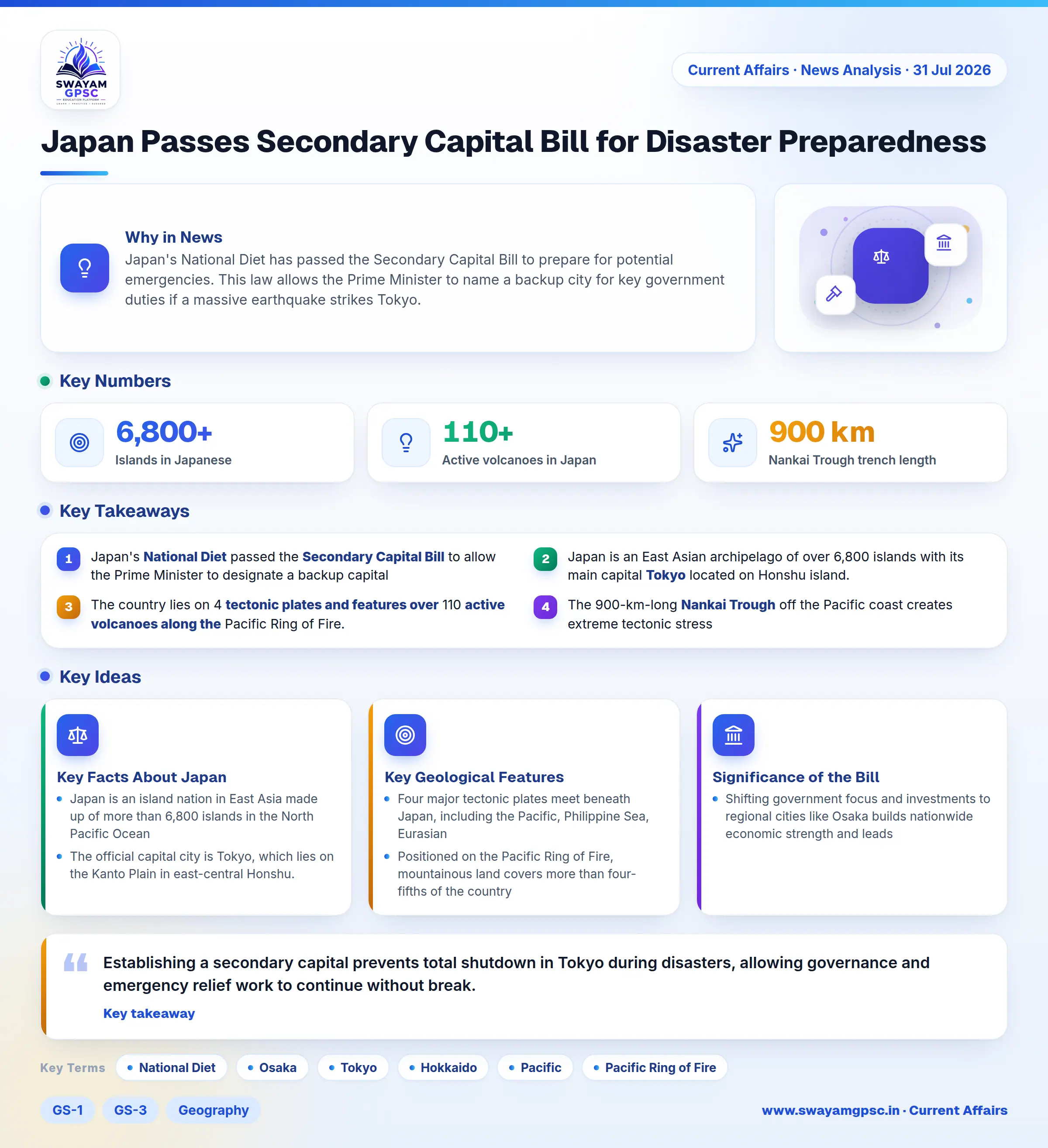
Japan Passes Secondary Capital Bill for Disaster Preparedness
#GS-1 #GS-3 #Geography #Physical Geography #Current Events #International #Mapping #Japan #Secondary Capital Bill
Key takeaways
- Japan's National Diet passed the Secondary Capital Bill to allow the Prime Minister to designate a backup capital, with Osaka as the leading candidate.
- Japan is an East Asian archipelago of over 6,800 islands with its main capital Tokyo located on Honshu island.
- The country lies on 4 tectonic plates and features over 110 active volcanoes along the Pacific Ring of Fire.
- The 900-km-long Nankai Trough off the Pacific coast creates extreme tectonic stress, making backup governance plans critical for disaster resilience.
Why in News
- Japan's National Diet has passed the Secondary Capital Bill to prepare for potential emergencies. This law allows the Prime Minister to name a backup city for key government duties if a massive earthquake strikes Tokyo.
- Among candidate cities, Osaka stands as the primary contender for the backup capital due to strong political support and existing modern infrastructure.
Key Facts About Japan
- Japan is an island nation in East Asia made up of more than 6,800 islands in the North Pacific Ocean, operating as a constitutional monarchy with its National Diet.
- The official capital city is Tokyo, which lies on the Kanto Plain in east-central Honshu.
- Water bodies surrounding the country include the Sea of Japan, the Pacific Ocean, the Sea of Okhotsk, and the East China Sea.
- Its main territory comprises four large islands, which are Hokkaido, Honshu (the biggest and most populated), Shikoku, and Kyushu.
Key Geological Features
- Four major tectonic plates meet beneath Japan, including the Pacific, Philippine Sea, Eurasian, and North American plates, making the region highly prone to earthquakes.
- Positioned on the Pacific Ring of Fire, mountainous land covers more than four-fifths of the country, containing over 110 active volcanoes and numerous hot springs.
- The Nankai Trough is a 900-km-long ocean trench along the Pacific coast where tectonic plate movement creates extreme stress, generating large earthquakes and tsunamis.
- Narrow fertile plains and steep river valleys formed by river deposits host almost all of Japan's cities and industrial centres.
Significance of the Bill
- Establishing a secondary capital prevents total shutdown in Tokyo during disasters, allowing governance and emergency relief work to continue without break.
- Shifting government focus and investments to regional cities like Osaka builds nationwide economic strength and leads to balanced growth.