Jammu and Kashmir Integration: Article 370 and Statehood Debate
#GS-2 #Indian Polity & Constitution #Constitution #Federalism #Parliament #Executive #Governance & Social Justice #Social Justice #Vulnerable Sections #Current Events #National
Key takeaways
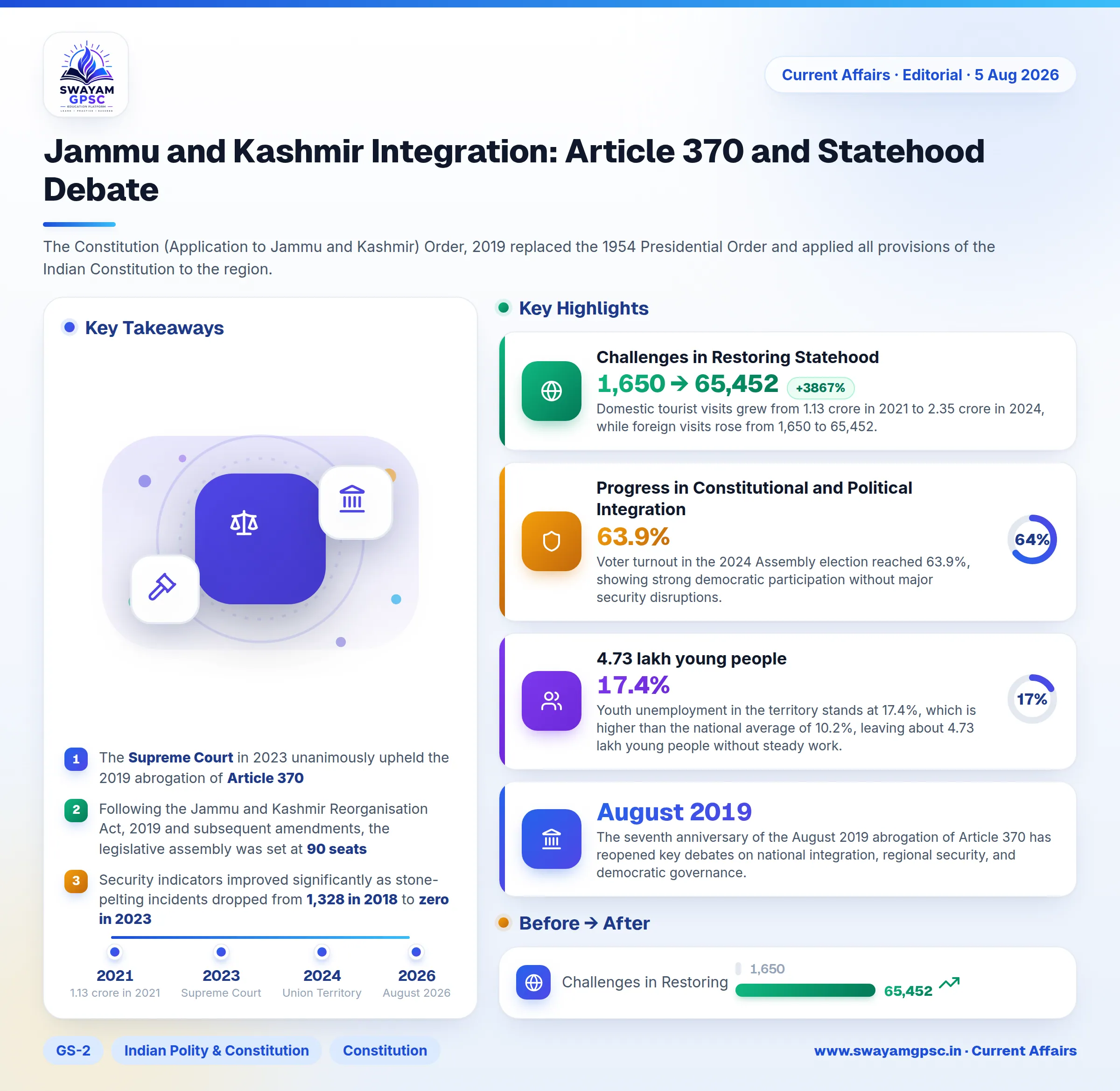
- The Supreme Court in 2023 unanimously upheld the 2019 abrogation of Article 370, ruling that Jammu and Kashmir retained no internal sovereignty after accession.
- Following the Jammu and Kashmir Reorganisation Act, 2019 and subsequent amendments, the legislative assembly was set at 90 seats, including 7 seats for Scheduled Castes and 9 seats for Scheduled Tribes.
- Security indicators improved significantly as stone-pelting incidents dropped from 1,328 in 2018 to zero in 2023, enabling a 63.9% voter turnout in the 2024 Assembly elections.
- Socioeconomic development remains crucial as youth unemployment stands at 17.4%, despite domestic tourism expanding to 2.35 crore visits in 2024.
Why in News
- The seventh anniversary of the August 2019 abrogation of Article 370 has reopened key debates on national integration, regional security, and democratic governance.
- The Supreme Court upheld the abrogation in 2023 and directed the Union government to restore statehood to Jammu and Kashmir at the earliest.
- Although successful Assembly elections took place in 2024, Jammu and Kashmir continues to function as a Union Territory.
- This delay in restoring full statehood creates administrative challenges, increases youth unemployment, and slows down emotional integration.
Constitutional Changes Made in 2019
- The Constitution (Application to Jammu and Kashmir) Order, 2019 replaced the 1954 Presidential Order and applied all provisions of the Indian Constitution to the region.
- This change made the separate Constitution of Jammu and Kashmir completely inoperative.
- A Presidential Declaration on 6th August 2019 rendered all clauses of Article 370 inoperative, except for the provision extending the Indian Constitution.
- The government removed Article 35A, which had previously allowed the state legislature to grant special rights over land, public jobs, and scholarships to permanent residents.
- The Jammu and Kashmir Reorganisation Act, 2019 divided the state into two Union Territories: Jammu and Kashmir with a legislature, and Ladakh without a legislature.
- Both new Union Territories officially came into existence on 31st October 2019.
- The President appoints a Lieutenant Governor under Article 239 to manage the territory with help from a Council of Ministers.
- Parliament allocated 5 seats in the Lok Sabha and 4 seats in the Rajya Sabha to Jammu and Kashmir, while Ladakh received 1 Lok Sabha seat.
- The legislative assembly initially had 107 seats, but after excluding 24 vacant seats for Pakistan-occupied areas and applying the 2023 amendment, the active strength rose to 90 elected seats.
- The 2023 amendment reserved 7 seats for Scheduled Castes and 9 seats for Scheduled Tribes, marking the first reservation for Scheduled Tribes in the assembly.
- The Lieutenant Governor received powers to nominate up to 2 members from the Kashmiri migrant community and 1 member representing displaced persons from Pakistan-occupied Jammu and Kashmir.
- The Jammu and Kashmir Reorganisation (Second Amendment) Act, 2023 reserves one-third of assembly seats for women, which will apply after the next census and delimitation.
- The High Court of Jammu and Kashmir was retained as the common high court for both Jammu and Kashmir and Ladakh.
- The Jammu and Kashmir Public Service Commission handles local recruitment for the territory, while the Union Public Service Commission manages recruitment for Ladakh.
- The Lieutenant Governor can issue Ordinances when the Assembly is not sitting, subject to approval from the President.
Constitutional Framework of Article 370
- Article 370 was placed in Part XXI of the Indian Constitution, which deals with temporary, transitional, and special provisions.
- Parliament could only make laws for the state on defence, external affairs, and communications, while other laws required approval from the state government.
- Jammu and Kashmir maintained its own separate state constitution, a distinct regional flag, and residual lawmaking powers.
- Clause 3 of Article 370 allowed the President to declare the article inoperative only upon receiving a recommendation from the state Constituent Assembly.
Supreme Court Ruling on Article 370
- In the Re: Article 370 of the Constitution (2023) case, a five-judge Constitution Bench unanimously supported the constitutional changes made by Parliament.
- The Court ruled that Jammu and Kashmir did not keep any internal sovereignty after signing the Instrument of Accession in 1947.
- The judges clarified that Article 370 was a temporary provision designed to achieve gradual constitutional integration over time.
- The Court decided that the President retained the power to disable Article 370 even after the state Constituent Assembly dissolved.
- The ruling confirmed that actions taken during President's Rule remain subject to judicial review, though the central government can exercise regular administrative powers.
- The Court left open the broader question of whether Parliament can permanently change a state into a Union Territory under Article 3.
- This question remained open because the Solicitor General assured the bench that full statehood for Jammu and Kashmir would be restored.
- The Court ordered Assembly elections by 30th September 2024 and asked the Union government to restore statehood as soon as possible.
- While the election requirement was fulfilled in 2024, statehood remains unrestored as of August 2026.
Progress in Constitutional and Political Integration
- Organized stone-pelting incidents fell from 1,328 in 2018 to zero in 2023, while organized strike calls dropped from 52 to zero over the same period.
- Political parties opposed to the 2019 changes participated in the 2024 elections under the Indian Constitution, bringing back competitive democratic politics.
- Voter turnout in the 2024 Assembly election reached 63.9%, showing strong democratic participation without major security disruptions.
- Ending the permanent resident system allowed West Pakistani refugees, Valmikis, Gorkhas, and long-term workers to gain citizenship rights and access government schemes.
- Regional parties now express their political demands through assembly debates, legal channels, and democratic elections rather than street protests.
- The 2024 election results showed that distinct political identities remain strong, particularly across the Kashmir Valley and Jammu regions.
- Extending central laws broadened the reach of the Right to Education, anti-corruption rules, and labor welfare protections across the entire territory.
Challenges in Restoring Statehood
- Cross-border terrorism remains a threat because Pakistan-based militant groups retain the capacity to execute targeted attacks, like the Pahalgam terror attack.
- Militants have shifted toward targeted killings of civilians and workers using smaller networks, as shown by a drug and arms seizure in Karnah in June 2024.
- Youth unemployment in the territory stands at 17.4%, which is higher than the national average of 10.2%, leaving about 4.73 lakh young people without steady work.
- Domestic tourist visits grew from 1.13 crore in 2021 to 2.35 crore in 2024, while foreign visits rose from 1,650 to 65,452.
- Heavy reliance on tourism leaves the local economy vulnerable to security threats, climate events, and overburdened infrastructure.
- Development remains uneven across different geographical regions, including Jammu, the Kashmir Valley, Pir Panjal, Chenab Valley, and border districts.
- The displacement of Kashmiri Pandits remains an unresolved humanitarian issue that requires physical security, property restoration, and job opportunities.
- Hostile online networks use social media and disinformation to radicalize local youth and exploit local economic grievances.
Way Forward
- The central government should publish a clear, time-bound roadmap to restore full statehood while keeping control over defence, borders, and national counterterrorism.
- Security forces should focus on anti-drone systems, border monitoring, and cyber intelligence while building trust with local communities.
- Security procedures should avoid disrupting normal daily life so that citizens view law enforcement agencies as professional and supportive.
- The government should hold regular elections for panchayats and municipalities to strengthen local self-governance across all districts.
- State agencies should create job opportunities by backing private investments in food processing, tourism, handicrafts, and information technology.
- Authorities must establish a clear strategy for Kashmiri Pandit resettlement that includes housing, temple restoration, and legal mechanisms for property recovery.
- Community-level dialogues involving women, youth, and civil society groups can rebuild trust among different social groups.
- The Union government and regional leaders should set up regular, structured consultations to address regional needs through cooperative federalism.