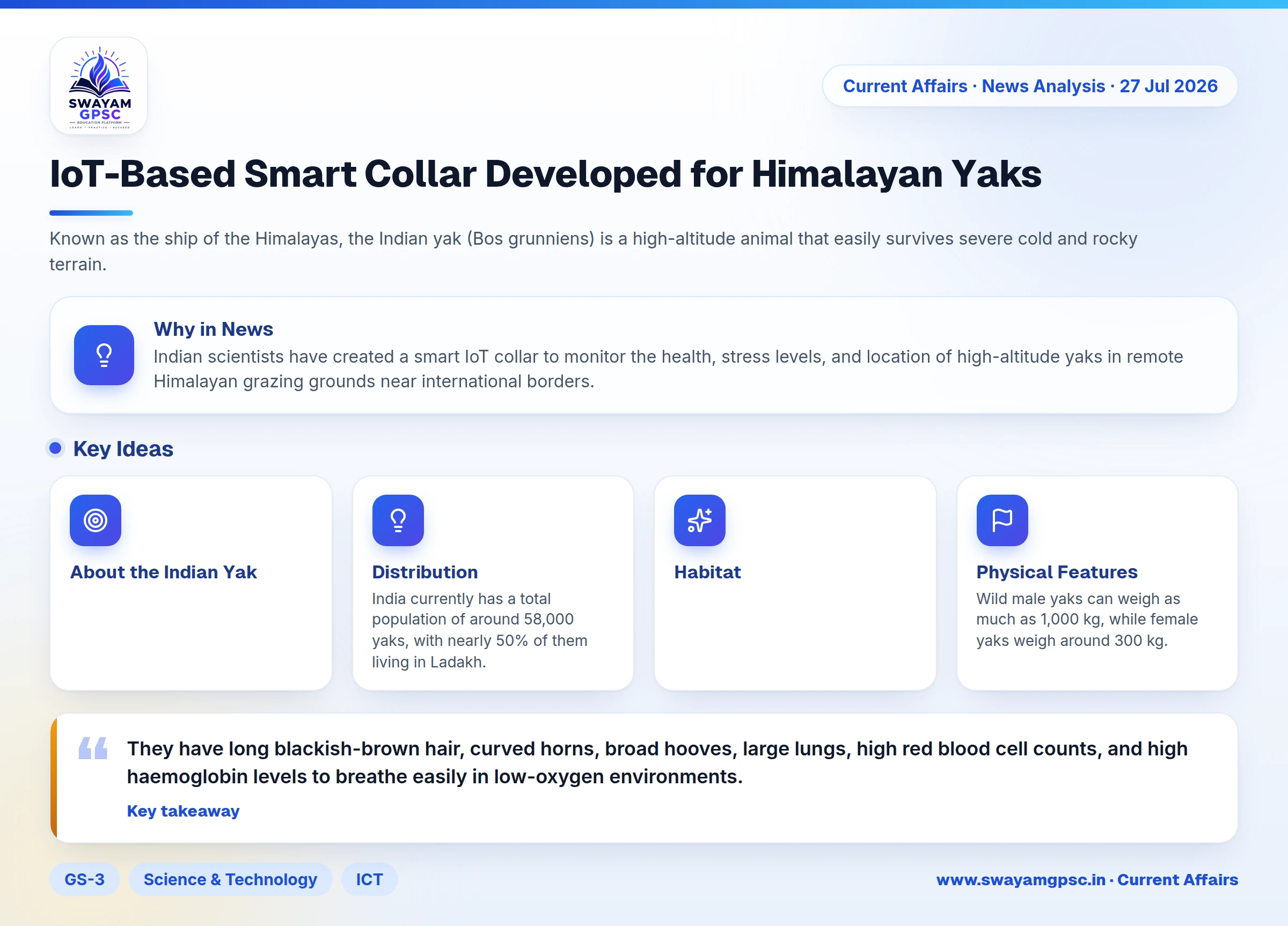
IoT-Based Smart Collar Developed for Himalayan Yaks
#GS-3 #Science & Technology #ICT #Environment #Wildlife #Current Events #National
Why in News
- Indian scientists have created a smart **IoT** collar to monitor the health, stress levels, and location of high-altitude yaks in remote Himalayan grazing grounds near international borders.
About the Indian Yak
- Known as the **ship of the Himalayas**, the Indian yak (**Bos grunniens**) is a high-altitude animal that easily survives severe cold and rocky terrain.
- This animal serves as an important source of daily living and income for local communities across the Himalayan belt.
Distribution
- India currently has a total population of around **58,000** yaks, with nearly **50%** of them living in **Ladakh**.
- Other main regions where yaks are reared include **Arunachal Pradesh**, **Sikkim**, **Himachal Pradesh**, and **Uttarakhand**.
- Wild yaks live mostly in the high pastures of the **Tibetan Plateau**.
Habitat
- Yaks live in high alpine meadows, alpine steppes, and desert steppes located between **3,200** and **5,400** metres above sea level.
- They prefer freezing cold plateaus and move from one area to another with changing seasons to look for grass, moss, and lichens.
Physical Features
- Wild male yaks can weigh as much as **1,000 kg**, while female yaks weigh around **300 kg**.
- They have long blackish-brown hair, curved horns, broad hooves, large lungs, high red blood cell counts, and high haemoglobin levels to breathe easily in low-oxygen environments.
Behaviour and Food Habits
- Yaks graze mainly during the daytime and naturally move together in herds.
- Females and young calves stay in larger herds, while adult males usually live alone or form smaller groups.
- Their natural diet consists of short grasses, shrubs, forbs, mosses, lichens, and other low-growing mountain plants.
Reproduction and Lifespan
- Wild yaks enter their mating season in **September**, and female yaks give birth to calves in **June** after a **9**-month gestation period.
- A female yak typically produces **1** calf every **2** years, and wild yaks can live up to **25** years.
Conservation Status of Wild Yak
- Under the **IUCN Red List**, the wild yak (**Bos mutus**) is classified as **Vulnerable**.
- Under the international **CITES** convention, it is placed in **Appendix I**.
- Under India's **Wildlife Protection Act, 1972**, it receives the highest level of legal protection under **Schedule I**.