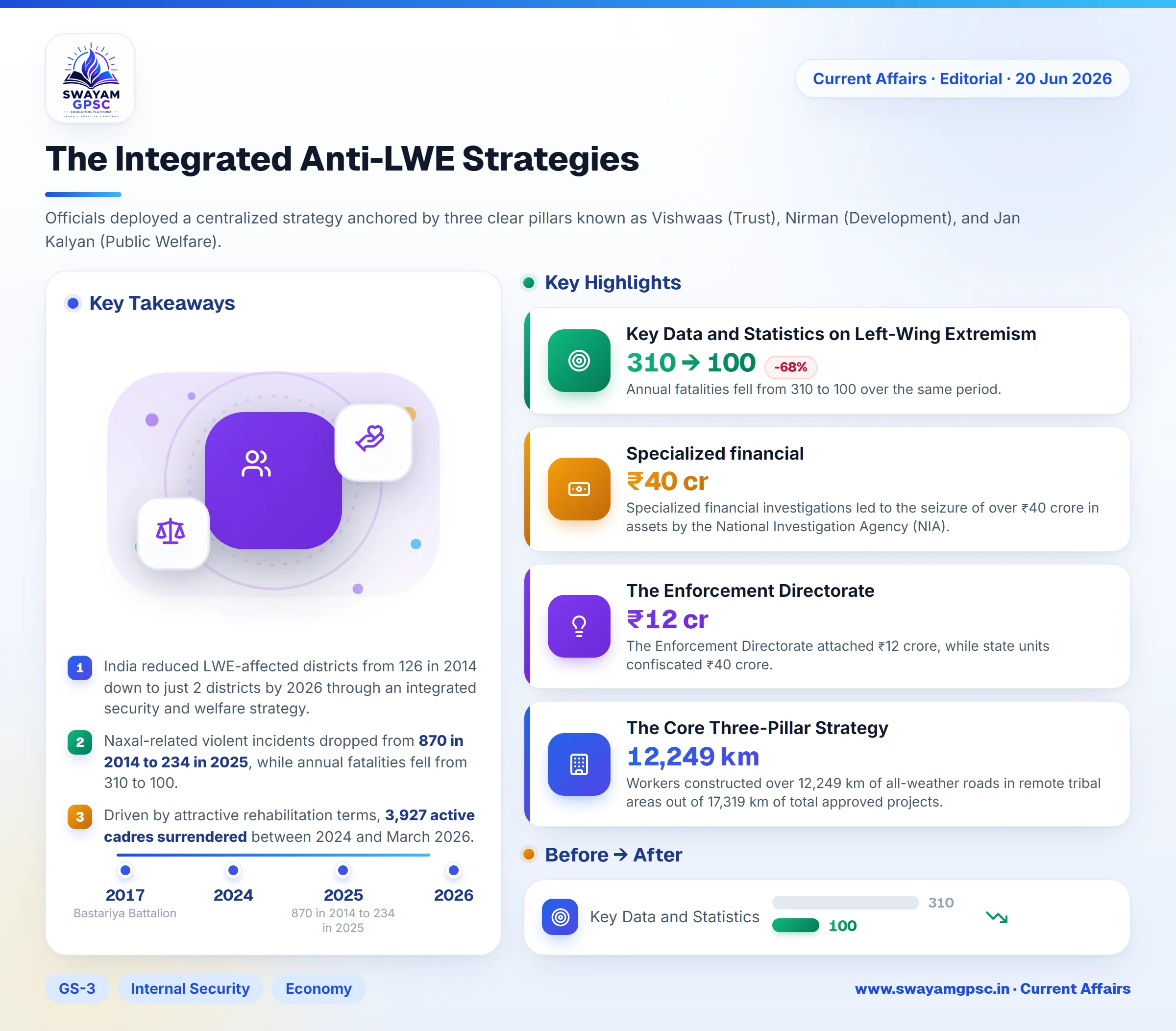
The Integrated Anti-LWE Strategies
#GS-3 #Internal Security #Economy #Infrastructure #Agriculture #Current Events #National #Governance & Social Justice #Poverty
Key takeaways
- India reduced LWE-affected districts from 126 in 2014 down to just 2 districts by 2026 through an integrated security and welfare strategy.
- Naxal-related violent incidents dropped from 870 in 2014 to 234 in 2025, while annual fatalities fell from 310 to 100.
- Driven by attractive rehabilitation terms, 3,927 active cadres surrendered between 2024 and March 2026.
- The National Investigation Agency seized over ₹40 crore in illegal assets from extremist networks to choke their financial backing.
- Authorities built 597 fortified police stations and constructed over 12,249 km of all-weather roads in remote tribal areas.
Why in News
- India reached a major internal security milestone by becoming effectively free from Left-Wing Extremism.
- This historic change turned the Red Corridor from an active conflict zone into a stable development region.
About The Integrated Anti-LWE Strategies
- The Ministry of Home Affairs moved past older approaches that only treated immediate symptoms of violence.
- Officials deployed a centralized strategy anchored by three clear pillars known as Vishwaas (Trust), Nirman (Development), and Jan Kalyan (Public Welfare).
Key Data and Statistics on Left-Wing Extremism
- The number of LWE-affected districts across India dropped from 126 districts in 2014 down to just 2 districts by 2026.
- The count of most affected districts fell from a peak of 35 down to absolute zero.
- Naxal-related violent incidents dropped from 870 in 2014 to 234 in 2025.
- Annual fatalities fell from 310 to 100 over the same period.
- Driven by attractive rehabilitation terms, 3,927 active cadres surrendered between 2024 and March 2026.
- Specialized financial investigations led to the seizure of over ₹40 crore in assets by the National Investigation Agency (NIA).
- The Enforcement Directorate attached ₹12 crore, while state units confiscated ₹40 crore.
The Core Three-Pillar Strategy
- The government built 597 fortified police stations in remote zones, up from just 66 before 2014.
- Authorities set up 408 new Central Armed Police Forces (CAPF) camps to maintain continuous area domination.
- Officials deployed 68 specialized night-landing helipads to help with rapid troop movement and medical evacuations.
- The state integrated elite central units like CoBRA with state forces like Chhattisgarh's District Reserve Guard and Andhra Pradesh's Greyhounds.
- Authorities deployed Unmanned Aerial Vehicles, satellite imagery, and AI-based tracking to monitor extremist hideouts.
- Security forces executed successful intelligence-led campaigns such as Operation Double Bull and Operation Black Forest.
- Workers constructed over 12,249 km of all-weather roads in remote tribal areas out of 17,319 km of total approved projects.
- Teams installed more than 9,600 mobile towers, ensuring that 96% of previously cut-off villages have reliable cellular connectivity.
- Financial inclusion deepened as authorities opened 1,804 new bank branches and installed 1,321 ATMs.
- The state deployed 74,720 banking correspondents and set up 6,025 post offices to connect tribal communities with formal banking.
- Officials constructed 179 Eklavya Model Residential Schools (EMRS), 46 Industrial Training Institutes, and 49 Skill Development Centres.
- These vocational hubs provided technical training to over 90,000 youth and women.
- Surrendered cadres receive immediate rehabilitation grants up to ₹5 lakh and a monthly stipend of ₹10,000 for 36 months.
- Families receive housing support under the Pradhan Mantri Awas Yojana.
- The government provided complete free education up to Class XII for the children of surrendered cadres.
- Agencies used the PM-JANMAN initiative and the Dharti Aaba Janjatiya Gram Utkarsh Abhiyan to bridge infrastructure gaps in tribal villages.
Case Study: Bastar's Structural Transformation
- A major turning point occurred in 2017 with the creation of the Bastariya Battalion, which recruited 1,143 local tribal youth from Bijapur, Sukma, and Dantewada.
- Workers laid down over 3,240 kilometers of roads and installed 889 mobile towers across the district.
- In May 2026, the state launched the Shaheed Veer Gunda Dhur Seva Dera initiative to convert 70 former CAPF camps into civic service centers.
Challenges
- Maintaining the vast network of new roads and mobile towers in rugged terrains requires consistent, multi-year state funding.
- Frontline forest communities can show varying levels of interest in modern vocational training, which requires targeted outreach.
- Security forces must maintain high vigilance along the borders of the remaining two affected districts to prevent scattered cadres from regrouping.
- Long-term peace requires state agencies to actively protect community land rights and prevent commercial entities from exploiting tribal resources.
Way Forward
- Scale up Chhattisgarh's camp-conversion model across all formerly affected states to turn old security camps into local civic utility nodes.
- Expeditiously complete and staff the remaining sanctioned Eklavya Model Residential Schools to anchor high-quality education in tribal belts.
- Mirror successful grassroots models by listing local tribal handicrafts and products directly on digital marketplaces to boost rural incomes.
- Scale up regional engagement platforms like the Bastar Olympics to build social integration and leadership opportunities among tribal youth.