Insulating India's Macroeconomy from Erratic Monsoon
#GS-1 #Physical Geography #Agricultural Resources #GS-3 #Climate Change #Economy #Agriculture #Infrastructure #Monsoon #Inflation
Key takeaways
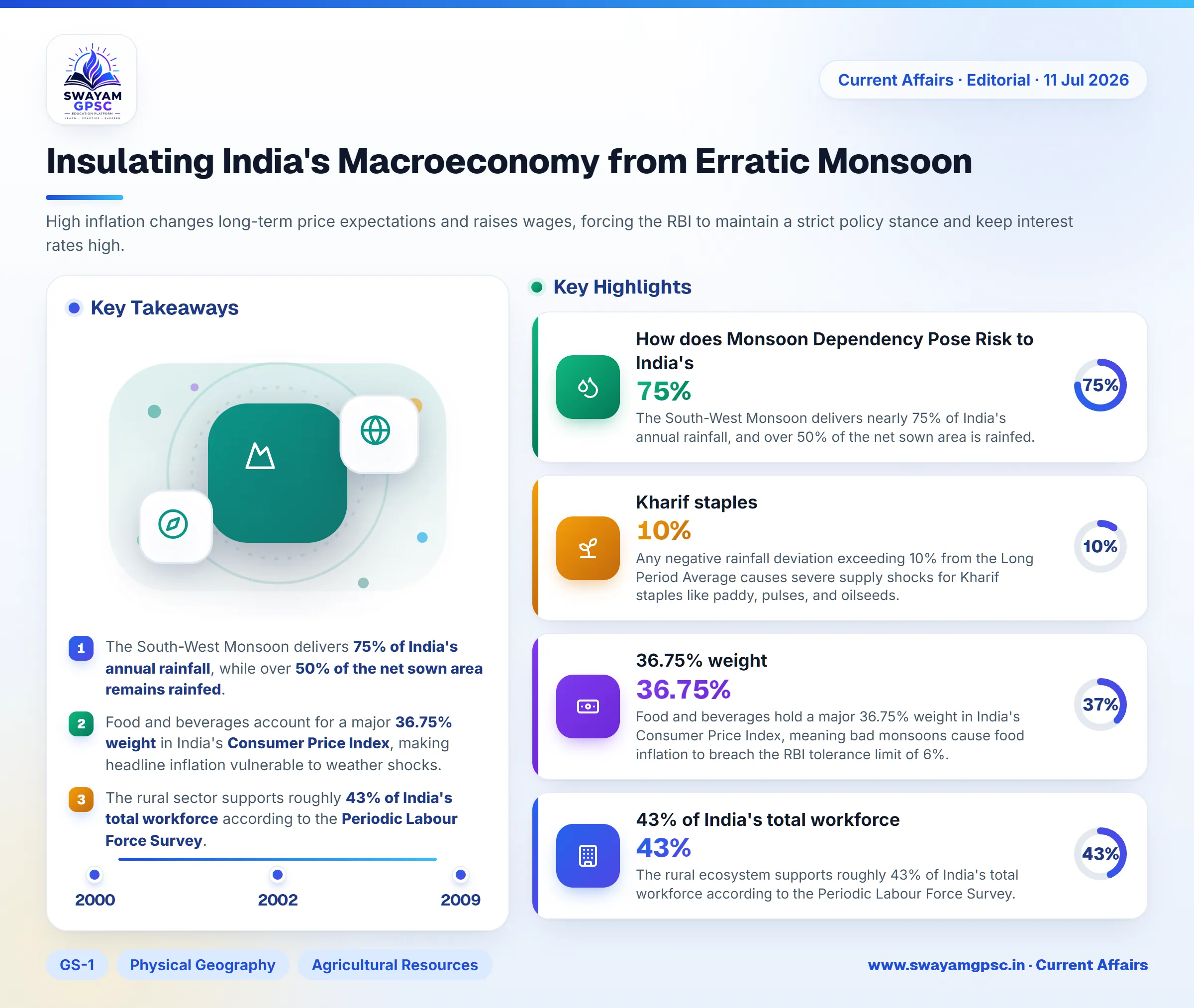
- The South-West Monsoon delivers 75% of India's annual rainfall, while over 50% of the net sown area remains rainfed.
- Food and beverages account for a major 36.75% weight in India's Consumer Price Index, making headline inflation vulnerable to weather shocks.
- The rural sector supports roughly 43% of India's total workforce according to the Periodic Labour Force Survey.
- Expanding Component-C of the PM-KUSUM Scheme aims to solarize 3.5 million agriculture pumps to boost rural resilience.
Why in News
- A recent editorial highlights that India relies heavily on rainfall for farming, leaving agricultural infrastructure vulnerable to weather shifts.
- True economic decoupling from rain remains an unachieved goal for the country, demanding urgent structural shifts toward micro-irrigation and water-resilient crops.
How does Monsoon Dependency Pose Risk to India's Macroeconomy Stability
- The South-West Monsoon delivers nearly 75% of India's annual rainfall, and over 50% of the net sown area is rainfed.
- Any negative rainfall deviation exceeding 10% from the Long Period Average causes severe supply shocks for Kharif staples like paddy, pulses, and oilseeds.
- Food and beverages hold a major 36.75% weight in India's Consumer Price Index, meaning bad monsoons cause food inflation to breach the RBI tolerance limit of 6%.
- Prolonged dry spells drive up input and fodder costs, leading to secondary price hikes in dairy, poultry, and industrial raw materials like cotton.
- High inflation changes long-term price expectations and raises wages, forcing the RBI to maintain a strict policy stance and keep interest rates high.
- The rural ecosystem supports roughly 43% of India's total workforce according to the Periodic Labour Force Survey.
- Crop failures act as a major negative income shock for rural workers, causing sharp drops in sales volumes for Fast-Moving Consumer Goods and tractors.
- Bad monsoons disrupt government budgets by reducing tax revenues while forcing massive spending on fertilizer and power subsidies.
- Governments respond to droughts by deferring capital expenditure meant for building long-term infrastructure.
- Production drops force the Directorate General of Foreign Trade to place export bans on wheat, non-basmati white rice, and sugar to protect domestic food security.
- India must import large quantities of pulses and edible oils during poor harvests, which widens the Current Account Deficit.
- Deficient rains impair rural debt repayment, driving up loan defaults in agricultural and microfinance portfolios and increasing banking sector Non-Performing Assets.
- Commercial banks and Non-Banking Financial Companies respond to these risks by tightening rural credit availability.
- Weak monsoons lower water levels in reservoirs, causing hydropower generation capacity to drop significantly.
- Surface-irrigated areas contract sharply during severe deficit years like 2000, 2002, and 2009.
- High temperatures during delayed rains force farmers to run millions of electric tube wells at once, creating power surges that worsen losses for distribution companies.
- Unpredictable weather discourages private investors from funding food processing, warehousing, and cold storage infrastructure.
- The rural economy remains trapped in low-productivity farming, which depresses India's long-term potential GDP growth.
What Strategic Measures are Required to Insulate India from the Shocks of an Erratic Monsoon
- Community-managed solar-powered smart micro-irrigation grids should be deployed across rainfed farming clusters.
- These networks use automated water meters connected to sub-surface drip grids via the Internet-of-Things.
- Farmers access pressurized water on a pay-per-use basis using mobile wallets, bypassing high upfront costs and saving groundwater.
- A virtual water export duty should be applied to crops like basmati rice and sugarcane grown in water-deficient regions.
- This policy factors groundwater costs into export pricing and shifts farming capital toward low-water, high-margin alternatives.
- The Ministry of Finance can issue sovereign Parametric Catastrophe Bonds and trade weather derivatives on international markets.
- These parametric instruments trigger automatic payouts to the government when independent satellites record predefined weather breaks like a 21-day dry spell.
- Government manufacturing can scale up biodegradable cellulose-based hydro-gel matrices for priority-sector crop seeds.
- These polymers absorb up to 400 times their dry weight in rainwater, forming moisture reservoirs around roots that keep crops alive for up to three weeks without rain.
- Component-C of the PM-KUSUM Scheme should be expanded to solarize 3.5 million grid-connected agriculture pumps.
- Farmers act as micro-power generators by selling surplus solar energy back to the grid, giving them a financial shield during crop failures.
- A decentralized network of grain silos and cold storages should be built at the village level through targeted subsidies to Primary Agricultural Credit Societies and Farmer Producer Organizations.
- Local groups can use a mobile logistics platform to rent empty storage space in real time.
- Banks can issue short-term credit using stored produce as collateral, preventing post-harvest gluts and stabilizing food prices.
Conclusion
- Monsoon dependency creates complex risks that link fiscal health with food inflation and financial stability.
- De-risking Indian growth requires shifting away from traditional relief models toward modern resilience strategies.
- Implementing precision irrigation, parametric derivatives, and solar crop diversification will protect rural demand and anchor long-term GDP growth.