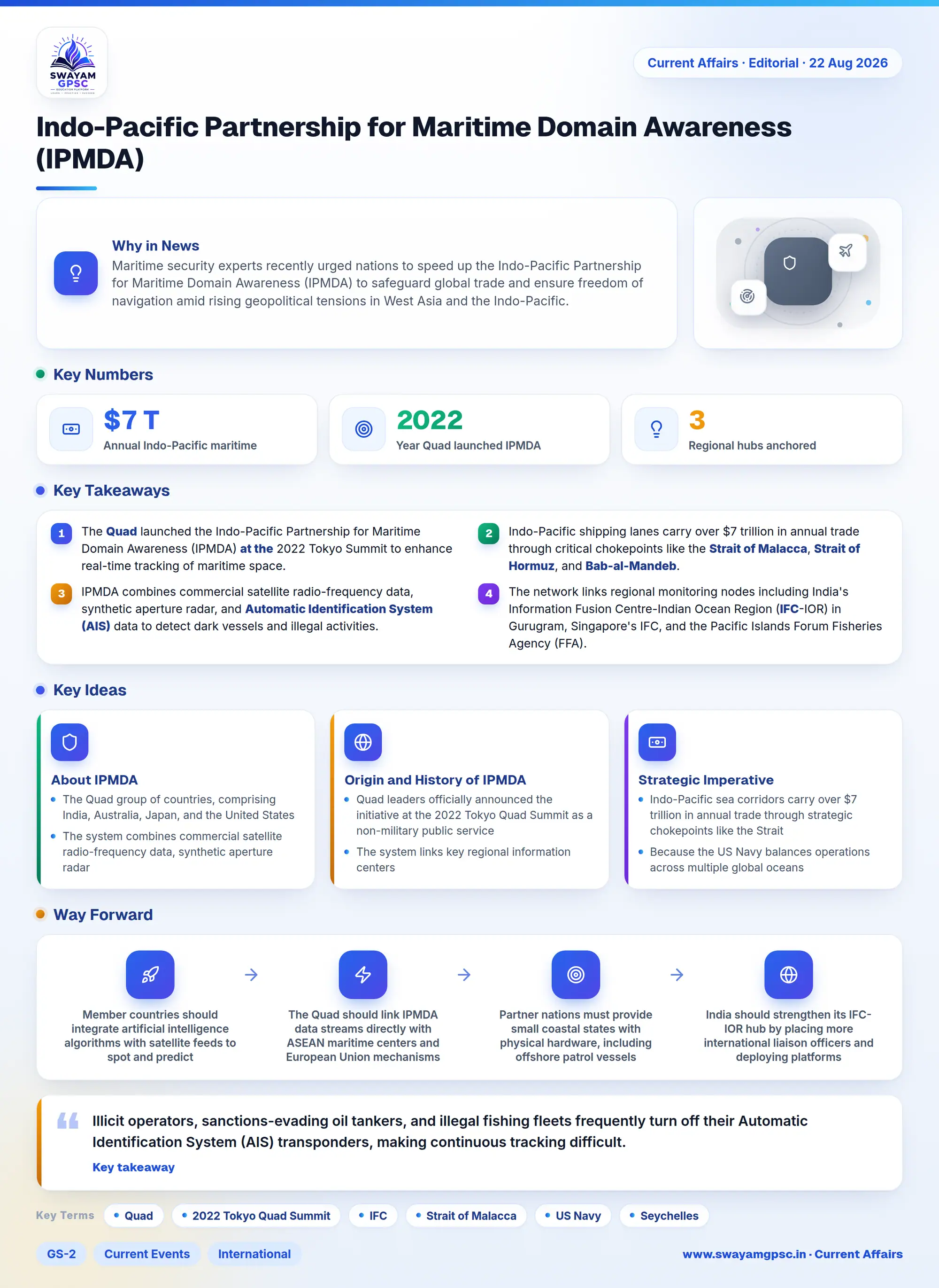
Indo-Pacific Partnership for Maritime Domain Awareness (IPMDA)
#GS-2 #Current Events #International #GS-3 #Science & Technology #Defence #Economy #Infrastructure #Indo-Pacific #IPMDA #Maritime Security
Key takeaways
- The Quad launched the Indo-Pacific Partnership for Maritime Domain Awareness (IPMDA) at the 2022 Tokyo Summit to enhance real-time tracking of maritime space.
- Indo-Pacific shipping lanes carry over $7 trillion in annual trade through critical chokepoints like the Strait of Malacca, Strait of Hormuz, and Bab-al-Mandeb.
- IPMDA combines commercial satellite radio-frequency data, synthetic aperture radar, and Automatic Identification System (AIS) data to detect dark vessels and illegal activities.
- The network links regional monitoring nodes including India's Information Fusion Centre-Indian Ocean Region (IFC-IOR) in Gurugram, Singapore's IFC, and the Pacific Islands Forum Fisheries Agency (FFA).
Why in News
- Maritime security experts recently urged nations to speed up the Indo-Pacific Partnership for Maritime Domain Awareness (IPMDA) to safeguard global trade and ensure freedom of navigation amid rising geopolitical tensions in West Asia and the Indo-Pacific.
About IPMDA
- The Quad group of countries, comprising India, Australia, Japan, and the United States, launched this technology-driven security initiative to provide a shared, real-time maritime picture across the Pacific Islands, Southeast Asia, and the Indian Ocean.
- The system combines commercial satellite radio-frequency data, synthetic aperture radar, and Automatic Identification System (AIS) signals to track dark vessels, stop illegal ocean activities, and safeguard critical sea routes.
Origin and History of IPMDA
- Quad leaders officially announced the initiative at the 2022 Tokyo Quad Summit as a non-military public service designed to improve regional ocean transparency.
- The system links key regional information centers, including India's Information Fusion Centre-Indian Ocean Region (IFC-IOR) in Gurugram, Singapore's IFC, and the Pacific Islands Forum Fisheries Agency (FFA) in the Solomon Islands.
- The initiative purchases unclassified commercial satellite data to track vessels that turn off standard transponders without facing security classification barriers.
- By 2026, the framework will expand under the Indo-Pacific Maritime Surveillance Collaboration (IPMSC) to deepen joint sensor integration, logistics training, and technological sharing between India and the US.
Strategic Imperative for the Indo-Pacific and USA
- Indo-Pacific sea corridors carry over $7 trillion in annual trade through strategic chokepoints like the Strait of Malacca, Strait of Hormuz, Bab-al-Mandeb, Sunda Strait, and Lombok Strait.
- Because the US Navy balances operations across multiple global oceans, Washington relies on regional partners like India to monitor the vast Indian Ocean.
- Transparent maritime tracking exposes state-affiliated militias and covert research vessels that carry out grey-zone pressure maneuvers below the level of open warfare.
- The initiative positions the Quad as a positive provider of security by offering free ocean tracking data to smaller coastal nations.
Challenges Facing IPMDA
- Illicit operators, sanctions-evading oil tankers, and illegal fishing fleets frequently turn off their Automatic Identification System (AIS) transponders, making continuous tracking difficult.
- Differences in national security classifications, incompatible communications systems, and older radar networks among partner nations delay real-time data sharing.
- Small island nations like the Seychelles, Maldives, Fiji, and Sri Lanka receive tracking information but lack patrol boats, aircraft, and fuel to intercept violators.
- Several ASEAN countries hesitate to fully participate in Quad-led initiatives because they want to remain neutral and avoid alienating China.
- Buying high-resolution commercial satellite data across vast ocean areas requires continuous, long-term funding from Quad members.
Way Forward
- Member countries should integrate artificial intelligence algorithms with satellite feeds to spot and predict suspicious dark-vessel movements automatically.
- The Quad should link IPMDA data streams directly with ASEAN maritime centers and European Union mechanisms like CRIMARIO to build an integrated monitoring grid.
- Partner nations must provide small coastal states with physical hardware, including offshore patrol vessels, surveillance drones, and boarding operational training.
- India should strengthen its IFC-IOR hub by placing more international liaison officers and deploying platforms equipped with SeaVision software.
- Regional leaders must establish clear legal standards under UNCLOS to prosecute illegal fishing, smuggling, and environmental dumping in international waters.
Conclusion
- By combining commercial space technology with regional institutions like India's IFC-IOR, the Quad helps close critical surveillance gaps while respecting national sovereignty.
- Strengthening the enforcement capabilities of smaller coastal nations and expanding international cooperation are essential steps to secure trade routes across the Indo-Pacific.