India-Uzbekistan Bilateral Relations and Security Cooperation
#GS-2 #Current Events #International #Groupings & Agreements Involving India and/or Affecting India's Interests #India and its Neighbourhood #International Relations #Defence & Security
Key takeaways
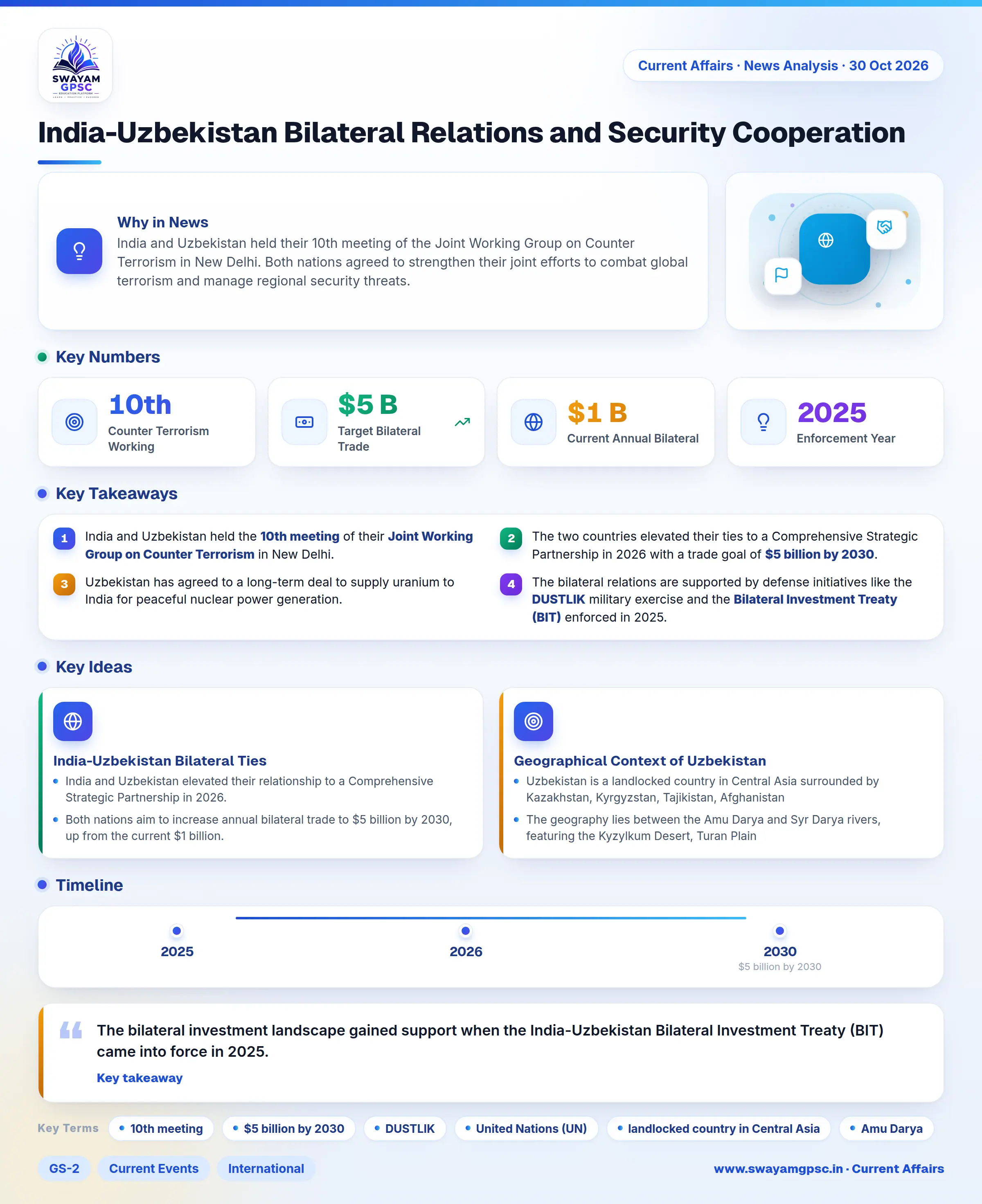
- India and Uzbekistan held the 10th meeting of their Joint Working Group on Counter Terrorism in New Delhi.
- The two countries elevated their ties to a Comprehensive Strategic Partnership in 2026 with a trade goal of $5 billion by 2030.
- Uzbekistan has agreed to a long-term deal to supply uranium to India for peaceful nuclear power generation.
- The bilateral relations are supported by defense initiatives like the DUSTLIK military exercise and the Bilateral Investment Treaty (BIT) enforced in 2025.
Why in News
- India and Uzbekistan held their 10th meeting of the Joint Working Group on Counter Terrorism in New Delhi.
- Both nations agreed to strengthen their joint efforts to combat global terrorism and manage regional security threats.
India-Uzbekistan Bilateral Ties
- India and Uzbekistan elevated their relationship to a Comprehensive Strategic Partnership in 2026.
- Both nations aim to increase annual bilateral trade to $5 billion by 2030, up from the current $1 billion.
- Uzbekistan agreed to a long-term arrangement to supply uranium to India for peaceful nuclear energy production.
- The two countries regularly execute the DUSTLIK joint military exercise to boost defense cooperation.
- Both countries coordinate through international bodies like the United Nations (UN), SCO-RATS, and the Eurasian Group (EAG).
- The bilateral investment landscape gained support when the India-Uzbekistan Bilateral Investment Treaty (BIT) came into force in 2025.
Geographical Context of Uzbekistan
- Uzbekistan is a landlocked country in Central Asia surrounded by Kazakhstan, Kyrgyzstan, Tajikistan, Afghanistan, and Turkmenistan.
- The geography lies between the Amu Darya and Syr Darya rivers, featuring the Kyzylkum Desert, Turan Plain, and Ustyurt Plateau in the west, and the Tien Shan and Gissar ranges in the east.
- The nation experiences an arid continental climate with hot summers, cold winters, and minimal rainfall.
- Important cultural and historical cities in the country include Tashkent, Samarkand, Bukhara, and Khiva.