India-UK Comprehensive Economic and Trade Agreement Comes Into Effect
#GS-3 #Economy #Growth #Employment #Current Events #International #Bilateral Relations #Trade Agreements
Why in News
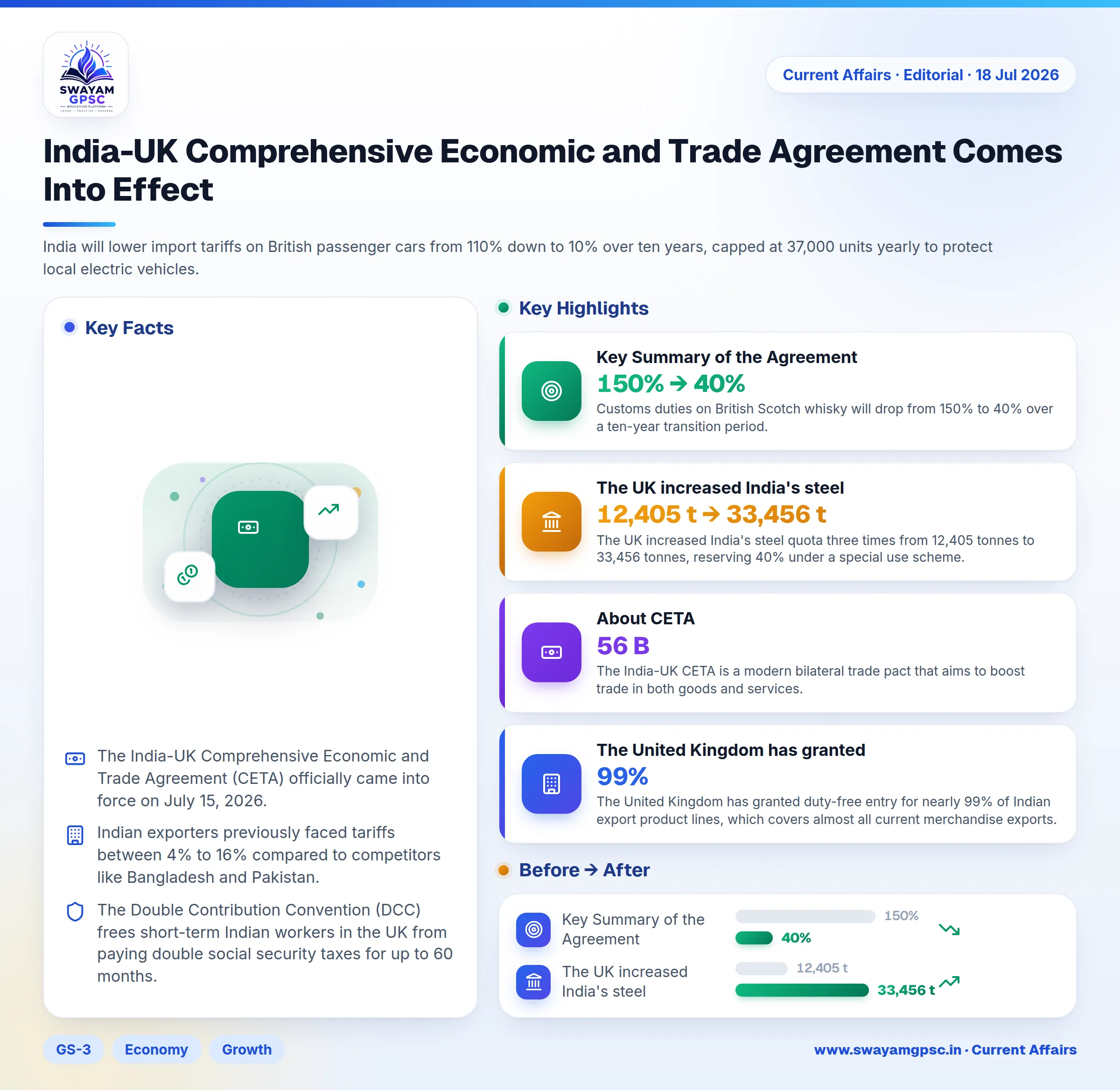
- The India-UK Comprehensive Economic and Trade Agreement (CETA) officially came into force on July 15, 2026.
About CETA
- The India-UK CETA is a modern bilateral trade pact that aims to boost trade in both goods and services. By removing tariff barriers, the deal plans to double total trade from $56 billion by 2030.
Key Summary of the Agreement
- The United Kingdom has granted duty-free entry for nearly 99% of Indian export product lines, which covers almost all current merchandise exports.
- Indian exporters previously faced tariffs between 4% to 16% compared to competitors like Bangladesh and Pakistan. This pact removes that price disadvantage completely.
- India will lower import tariffs on British passenger cars from 110% down to 10% over ten years, capped at 37,000 units yearly to protect local electric vehicles.
- Customs duties on British Scotch whisky will drop from 150% to 40% over a ten-year transition period.
- The Double Contribution Convention (DCC) frees short-term Indian workers in the UK from paying double social security taxes for up to 60 months.
- India secured market access across 12 major service sectors and 137 sub-sectors, covering almost all of its service export interests.
- Both countries agreed to sign Mutual Recognition Agreements (MRAs) within 12 months for professionals like nurses, accountants, and architects.
- The UK increased India's steel quota three times from 12,405 tonnes to 33,456 tonnes, reserving 40% under a special use scheme.
Opportunities for India
- Zero-duty access will boost production and job creation in key manufacturing hubs like Tiruppur garments and Agra footwear.
- Removing tariffs lets Indian generic medicine manufacturers bid directly in the UK's massive $30 billion annual health market.
- Stopping dual social security tax will save about 75,000 Indian workers and 900 companies roughly $600 million every year.
- Indian service providers can now legally bid for government contracts in the UK worth £90 billion ($122 billion).
- Clear digital service rules will encourage UK companies to turn their Indian offices into research, analytics, and cybersecurity hubs.
Opportunities for the United Kingdom
- Controlled quota access helps luxury British car makers sell large-engine vehicles into India's growing premium market.
- Cutting the 150% Scotch whisky tariff enables UK distilleries to reach more buyers among India's expanding middle class.
- British firms get a fair chance to participate in India's $114 billion public infrastructure procurement projects.
- The deal allows UK financial technology firms and educational institutions to open campuses and operate inside India easily.
Challenges
- Small Indian businesses often fail to benefit from trade deals because of complex paperwork and lack of awareness about rules.
- Indian farm and food exports face strict health standards in the UK, which can result in sudden product rejections at borders.
- Lowering import tariffs exposes local manufacturers to cheaper foreign products, which might reduce profit margins for domestic firms.
- Ongoing sea route conflicts in the Red Sea boost shipping costs and travel time, reducing benefits gained from reduced tariffs.
Way Forward
- The government must start outreach programs to help small businesses learn how to process digital trade certificates under CETA.
- Authorities should stick to the 12-month deadline to complete qualification agreements for nurses, architects, and accountants.
- Testing laboratories must be set up near major textile and agricultural hubs to clear goods before export.
- Indian steel exporters should actively use the newly expanded quota limits to capture a bigger market share in the UK.
Conclusion
- The India-UK CETA represents a major step forward for India's global trade relations by balancing domestic industry protection with export expansion. Its long-term success will depend on how effectively Indian businesses take advantage of these new market opportunities.