India's Strategy to Overcome Global Economic and Geopolitical Shocks
#GS-2 #GS-3 #Governance & Social Justice #Good Governance #Economy #Growth #Infrastructure #Taxation #Science & Technology #Artificial Intelligence #Energy #Current Events #National #International
Why in News
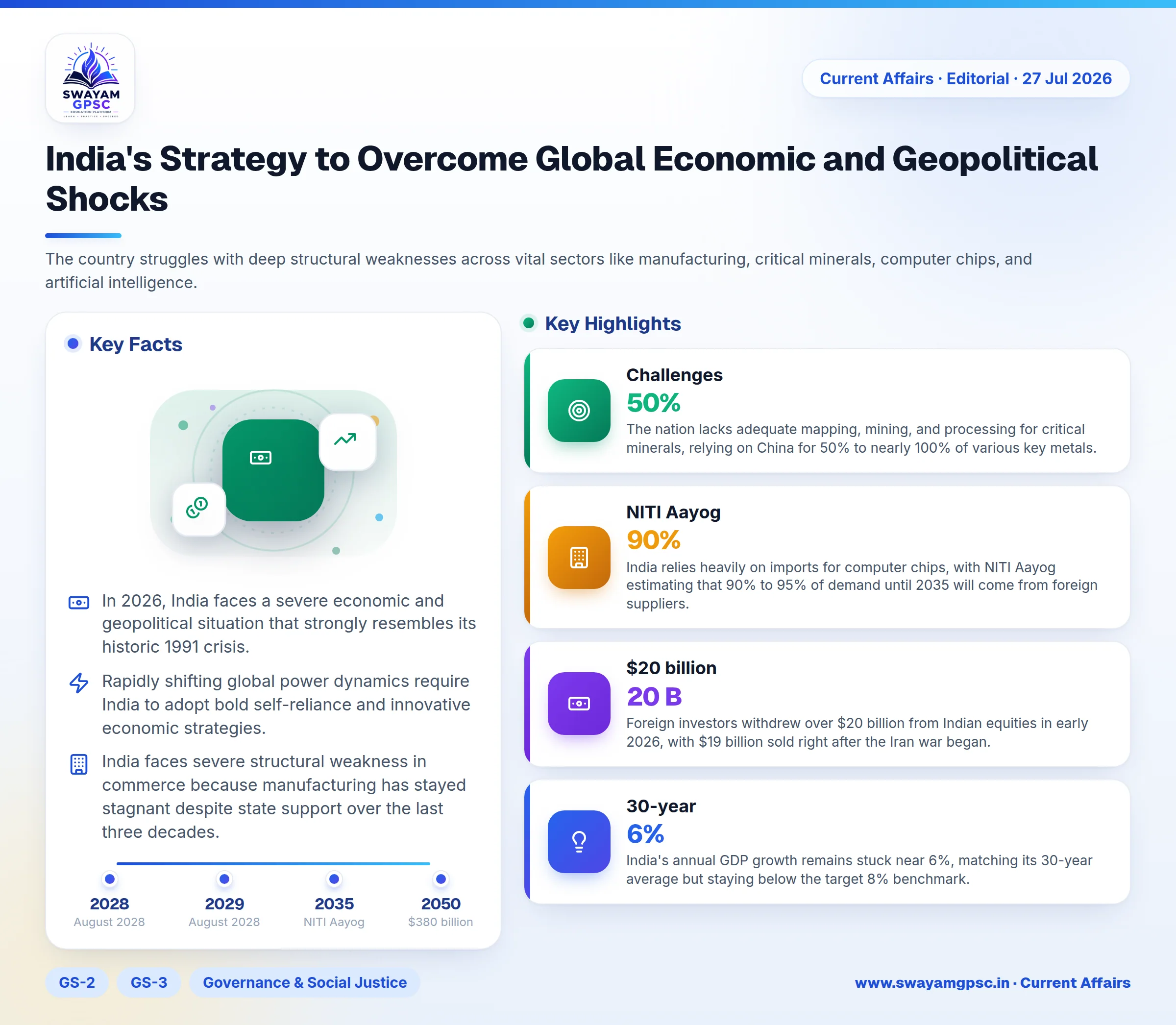
- In 2026, India faces a severe economic and geopolitical situation that strongly resembles its historic 1991 crisis.
- The country struggles with deep structural weaknesses across vital sectors like manufacturing, critical minerals, computer chips, and artificial intelligence.
- Rapidly shifting global power dynamics require India to adopt bold self-reliance and innovative economic strategies.
Challenges
- India faces severe structural weakness in commerce because manufacturing has stayed stagnant despite state support over the last three decades.
- The nation lacks adequate mapping, mining, and processing for critical minerals, relying on China for 50% to nearly 100% of various key metals.
- India relies heavily on imports for computer chips, with NITI Aayog estimating that 90% to 95% of demand until 2035 will come from foreign suppliers.
- Despite having strong tech talent, India lacks a major presence in the core value chain of foundational AI infrastructure and software.
- Frequent shifts in global monetary policy and rising trade conflicts trigger sudden capital flight from emerging markets like India.
- Foreign investors withdrew over $20 billion from Indian equities in early 2026, with $19 billion sold right after the Iran war began.
- Interest rate expectations set by the United States Federal Reserve cause repeated sell-offs by foreign institutions in Indian markets.
- The Indian Rupee dropped to an all-time low of 96.96 per US Dollar in May 2026, marking a near double-digit fall over recent fiscal cycles.
- High dollar demand from importers forced the Reserve Bank of India (RBI) to intervene heavily using spot markets and a $100+ billion net short forward book.
- India's annual GDP growth remains stuck near 6%, matching its 30-year average but staying below the target 8% benchmark.
- Policymakers struggle to reduce the central fiscal deficit toward 4.3% of GDP while trying to maintain essential public capital spending.
- Spikes in global fertiliser and natural gas prices force the government to spend more on subsidies, putting pressure on other public budgets.
- India imports almost 88% of its crude oil needs, leaving national energy supplies vulnerable to conflict along Middle Eastern sea routes.
- Geopolitical tensions in key supply regions have repeatedly pushed global Brent crude prices past $90 to $100 per barrel.
- Every sustained $10 per barrel rise in crude prices increases India's import bill by $13 billion to $14 billion and expands the current account deficit by 0.3% of GDP.
- Indian exports face rising trade friction as the United States pushes for reciprocal market access and tariff parity with regional competitors.
- The US plans to keep generic drug imports tariff-free for two years, followed by a 100% tariff in August 2028 and a 200% tariff in August 2029 unless manufacturing moves to America.
- India faces heavy risk from these proposed drug tariffs because the US is its largest export market, receiving $9.7 billion (37.7%) of India's $25.8 billion pharma exports in 2025.
- Indian companies supply 47% of all generic prescriptions in the United States, making India its largest source of affordable medicines.
- India runs a massive bilateral trade deficit of about $100 billion with China.
- Despite domestic initiatives like the Production-Linked Incentive (PLI) scheme and the China Plus One Strategy, India still relies on Chinese suppliers for active pharmaceutical ingredients and electronic components.
- In 1991, China's economy at $380 billion was close to India's $270 billion, but by 2026, China reached $20 trillion against India's $4 trillion, creating a gap projected to reach $24 trillion by 2050.
Way Forward
- India can set up a state-backed reinsurance facility to protect shipping lines, energy importers, and mineral suppliers operating in high-risk conflict zones.
- The government can use a part of its foreign exchange reserves as an insurance pool to shield national importers from sudden freight spikes and war-risk premiums.
- India can expand its Central Bank Digital Currency (CBDC) or e-Rupee into a programmable system for direct cross-border trade settlements with partner countries.
- Smart contracts built into the digital rupee can automate bilateral trade using local currencies or tokenised gold, avoiding foreign exchange volatility and Western sanctions.
- The government can introduce dynamic carbon-pricing mechanisms to match foreign border taxes like the EU's CBAM, keeping carbon tax revenue inside India for green R&D.
- Carbon tax revenues can be reinvested into export industries to help heavy sectors like steel, cement, and chemicals switch to green hydrogen.
- India can build autonomous micro-grids powered by renewable energy in major manufacturing clusters to prevent disruptions from extreme weather or main grid failures.
- Export-oriented zones should be required to install solar-storage units so that heatwaves and power cuts do not halt precision engineering lines.
- The government can raise capital while meeting its 4.3% of GDP fiscal deficit target by monetising state assets through Infrastructure Investment Trusts (InvITs).
- Converting physical fuel and fertiliser subsidies into direct digital cash transfers will cut leakages and protect infrastructure spending during price shocks.
- India must enforce strict, time-bound Phased Manufacturing Programs (PMP) with mandatory domestic value addition for critical inputs to secure technology transfers.
- The government should set firm deadlines requiring tech, telecom, and auto firms to move their key component supply chains away from Chinese sources.
Conclusion
- The economic crisis of 2026 resembles 1991 but is structurally deeper across critical minerals, computer chips, artificial intelligence, and manufacturing.
- India can secure long-term economic growth by combining sovereign risk insurance, digital rupee trade swaps, carbon tax buffers, and decentralised renewable energy grids.