Strengthening India-Japan Strategic Ties: Bilateral Cooperation and Way Forward
#GS-2 #International #Current Events #International Treaties & Agreements #Effect of Policies & Politics of Countries on India's Interests
Key takeaways
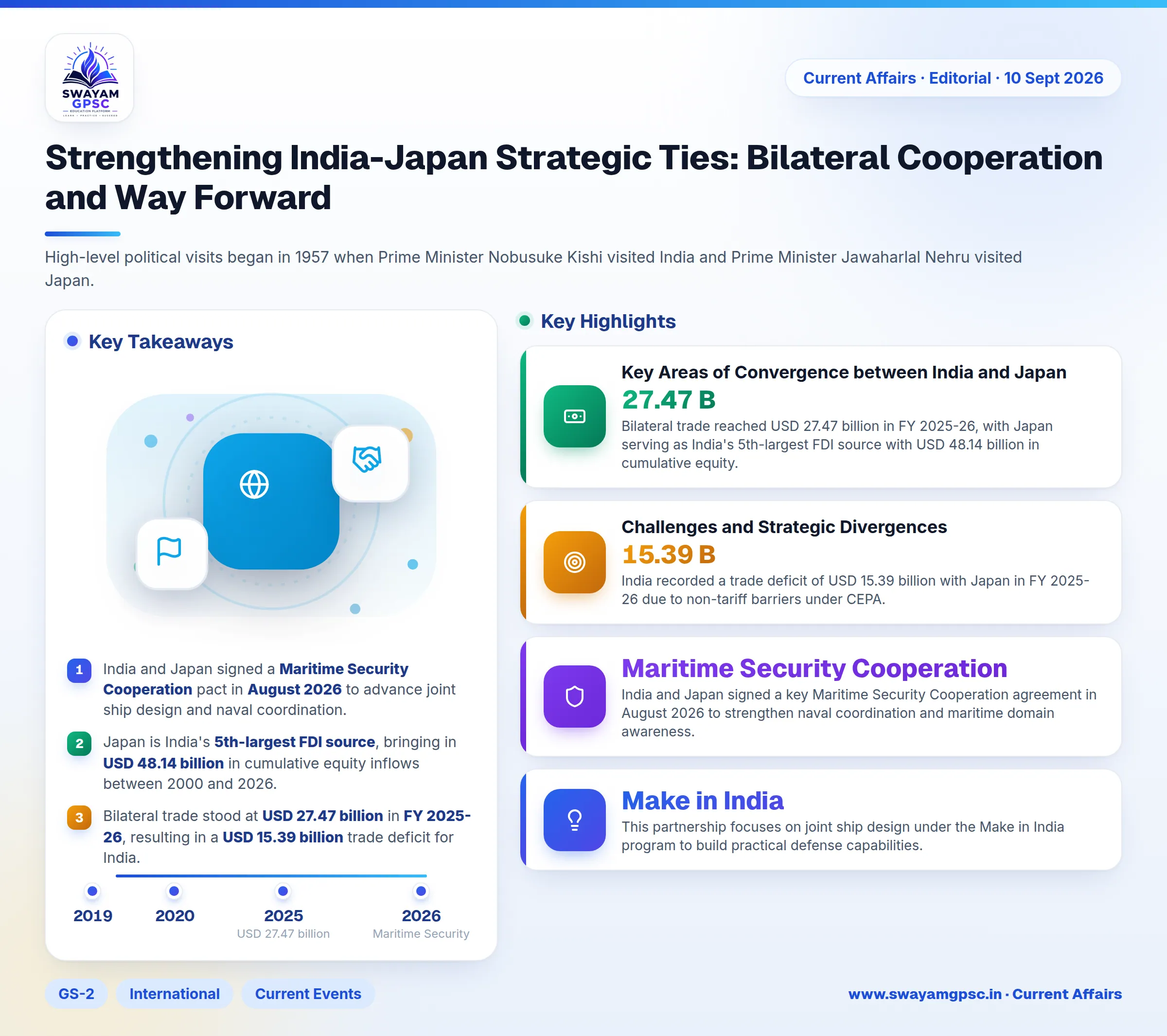
- India and Japan signed a Maritime Security Cooperation pact in August 2026 to advance joint ship design and naval coordination.
- Japan is India's 5th-largest FDI source, bringing in USD 48.14 billion in cumulative equity inflows between 2000 and 2026.
- Bilateral trade stood at USD 27.47 billion in FY 2025-26, resulting in a USD 15.39 billion trade deficit for India.
- The 2025 Action Plan for Human Resource Exchange aims to facilitate the movement of 500,000 people over five years.
Why in News
- India and Japan signed a key Maritime Security Cooperation agreement in August 2026 to strengthen naval coordination and maritime domain awareness.
- This partnership focuses on joint ship design under the Make in India program to build practical defense capabilities.
- The cooperation targets regional stability, clean energy transition, and maritime security in the Indo-Pacific area.
- Despite strategic progress, both nations still face execution delays, trade deficits, and foreign policy differences.
Phase I: Diplomatic Foundation and Development Cooperation (1952-1980)
- India and Japan officially established diplomatic relations on 28th April, 1952 after signing a bilateral peace treaty.
- High-level political visits began in 1957 when Prime Minister Nobusuke Kishi visited India and Prime Minister Jawaharlal Nehru visited Japan.
- In 1958, India became the first country to receive Official Development Assistance (ODA) loans from Japan.
- Early economic relations relied on concessional financing and technical assistance, while Cold War alignments restricted deeper security ties.
- India pursued non-alignment and maintained ties with the Soviet Union, whereas Japan maintained a defense alliance with the United States.
- Cultural connections based on Buddhism, historic visits by Rabindranath Tagore, and ties with Subhas Chandra Bose sustained goodwill.
Phase II: Industrial Expansion and Strategic Constraints (1981-1999)
- Commercial relations expanded rapidly as Japanese technology and manufacturing strategies entered the Indian market.
- The 1982 joint venture between Maruti Udyog Limited and Suzuki Motor Corporation transformed India's automotive sector.
- Japanese firms introduced practices such as Kaizen and Just-in-Time manufacturing into Indian industrial systems.
- Japan offered essential financial support to India during the 1991 balance-of-payments crisis.
- Following India's 1991 economic reforms, Japanese enterprises expanded across the automobile, electronics, and machinery sectors.
- Japan froze new grant aid and yen loans after India conducted the Pokhran-II nuclear tests in 1998.
- This period highlighted a divide between India's national security needs and Japan's commitment to nuclear non-proliferation.
Phase III: Global Partnership and Institutionalisation (2000-2013)
- Japanese Prime Minister Yoshiro Mori visited India in 2000, establishing the Global Partnership between India and Japan.
- Prime Minister Atal Bihari Vajpayee visited Japan in 2001 to sign the Japan-India Joint Declaration.
- In 2006, both countries upgraded their relationship to a Strategic and Global Partnership and instituted annual leader summits.
- The Joint Declaration on Security Cooperation was signed in 2008, making Japan India's third formal security partner.
- The India-Japan Comprehensive Economic Partnership Agreement (CEPA) came into force in August 2011.
- Japanese development assistance funded major infrastructure including the Delhi Metro and the Delhi-Mumbai Industrial Corridor.
Phase IV: Special Strategic and Indo-Pacific Partnership (2014-2021)
- The relationship was elevated to a Special Strategic and Global Partnership in 2014 to deepen defense and Indo-Pacific cooperation.
- India's Act East Policy, 2014 aligned with Japan's Free and Open Indo-Pacific vision, leading to Japan joining the Malabar exercise in 2015.
- The India-Japan Civil Nuclear Cooperation Agreement was signed in 2016 and operationalized in 2017.
- The 2+2 Foreign and Defence Ministers' Dialogue launched in 2019, followed by the Acquisition and Cross-Servicing Agreement (ACSA) in 2020.
- Both nations jointly launched the Asia-Africa Growth Corridor to promote regional connectivity.
Phase V: Economic-Security and Technology Partnership (2022-Present)
- Bilateral relations expanded to focus on resilient supply chains, critical technology, clean energy, and workforce mobility.
- Key platforms include the India-Japan Digital Partnership 2.0 and the Semiconductor Supply Chain Partnership.
- Joint military exercises now include Dharma Guardian, JIMEX, Shinyuu Maitri, and Veer Guardian.
- The Mumbai-Ahmedabad High-Speed Rail project utilizes Japanese Shinkansen technology to upgrade Indian rail transport.
Key Areas of Convergence between India and Japan
- Both nations support a rules-based Indo-Pacific order under international law such as UNCLOS, working closely through the Quad.
- Bilateral trade reached USD 27.47 billion in FY 2025-26, with Japan serving as India's 5th-largest FDI source with USD 48.14 billion in cumulative equity.
- Japanese assistance funds major transit networks, including high-speed rail and urban metro systems across several Indian cities.
- India and Japan participate in the Supply Chain Resilience Initiative alongside Australia to secure critical inputs like semiconductors.
- Space agencies ISRO and JAXA are collaborating on the Lunar Polar Exploration Mission (LUPEX) to explore lunar water resources.
- The India-Japan Clean Energy Partnership supports green hydrogen, solar power, and clean ammonia initiatives in states like Odisha.
- Both countries work through the G4 grouping to advocate for comprehensive reform of the UN Security Council.
Challenges and Strategic Divergences
- India maintains strategic autonomy and views the Quad as a non-military platform, whereas Japan integrates it into formal security alliances.
- Japan imposed sanctions on Russia over the Ukraine conflict, while India preserved its strategic relationship and economic ties with Moscow.
- India recorded a trade deficit of USD 15.39 billion with Japan in FY 2025-26 due to non-tariff barriers under CEPA.
- Japan joined major agreements like CPTPP and RCEP, whereas India withdrew from RCEP in 2019 to protect domestic sectors.
- Defense technology transfers remain slow, as seen in the prolonged and unresolved negotiations over the US-2 amphibious aircraft.
Way Forward
- Establish an India-Japan Strategic Futures Council to handle long-term planning and scenario-based strategic policy alignment.
- Create a Joint Defence Innovation and Procurement Fund to support co-development and defense production under Make in India.
- Set up dedicated Trusted Manufacturing Zones for electronics, batteries, and precision machinery with plug-and-play facilities.
- Develop a joint circular economy mechanism to recycle e-waste and recover critical minerals such as lithium and cobalt.
- Launch a Yen-Rupee Strategic Finance Architecture using specialized hybrid bonds to fund large infrastructure projects.
- Adopt a Talent Passport system to facilitate smooth professional mobility for skilled Indian workers moving to Japan.
- Deploy a Smart Agri-Tech Sandbox using Japanese IoT sensors and AI mapping to build climate-resilient farming techniques.
Conclusion
- The India-Japan strategic partnership has matured into a multi-faceted alliance focused on security, infrastructure, and economic security.
- Future growth depends on resolving trade deficits, accelerating defense hardware co-production, and ensuring timely project execution.