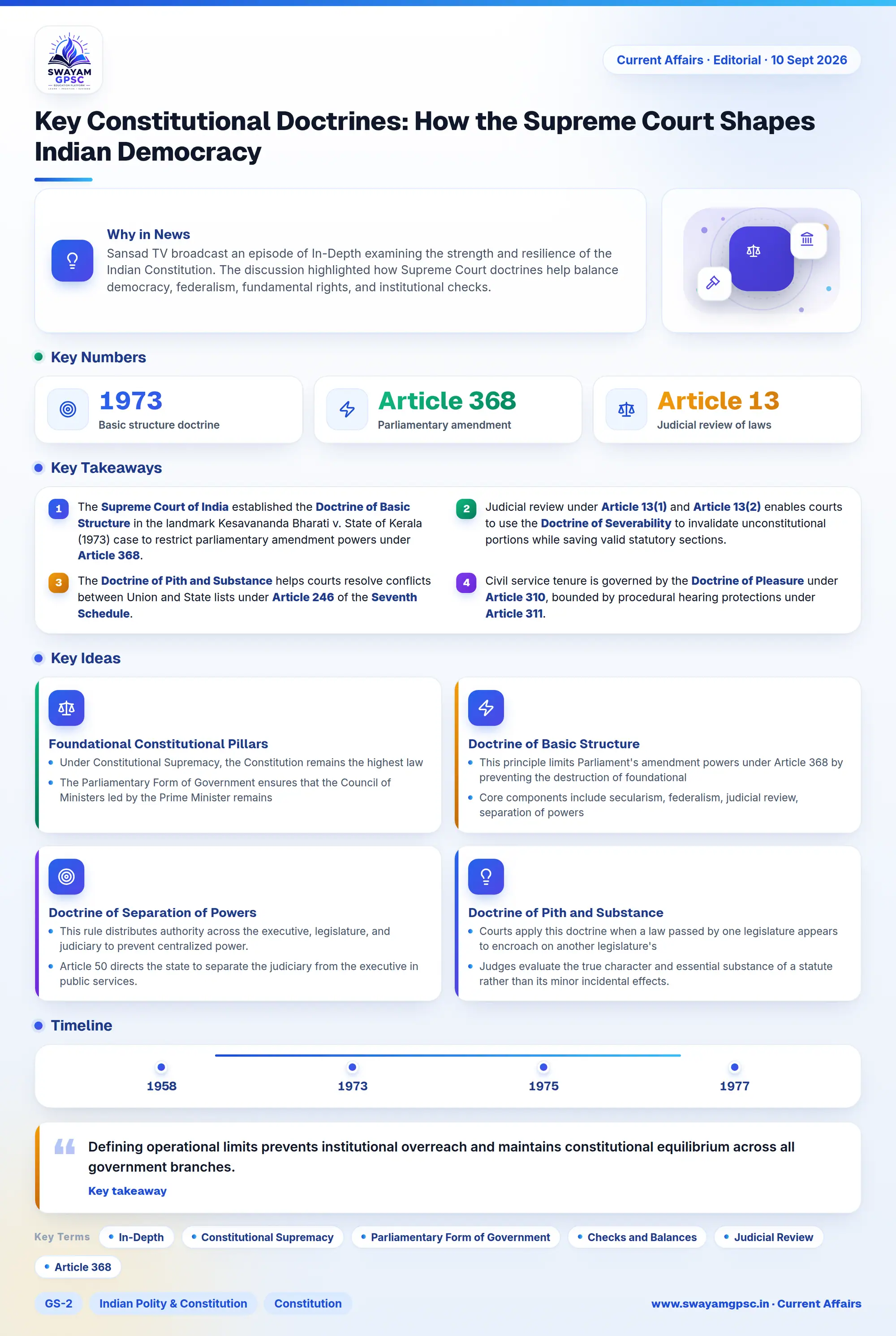
Key Constitutional Doctrines: How the Supreme Court Shapes Indian Democracy
#GS-2 #Indian Polity & Constitution #Constitution #Judiciary #Federalism #Supreme Court Doctrines #Basic Structure
Key takeaways
- The Supreme Court of India established the Doctrine of Basic Structure in the landmark Kesavananda Bharati v. State of Kerala (1973) case to restrict parliamentary amendment powers under Article 368.
- Judicial review under Article 13(1) and Article 13(2) enables courts to use the Doctrine of Severability to invalidate unconstitutional portions while saving valid statutory sections.
- The Doctrine of Pith and Substance helps courts resolve conflicts between Union and State lists under Article 246 of the Seventh Schedule.
- Civil service tenure is governed by the Doctrine of Pleasure under Article 310, bounded by procedural hearing protections under Article 311.
Why in News
- Sansad TV broadcast an episode of In-Depth examining the strength and resilience of the Indian Constitution.
- The discussion highlighted how Supreme Court doctrines help balance democracy, federalism, fundamental rights, and institutional checks.
- Superior courts formulate constitutional doctrines to resolve ambiguities and evaluate legislative competence.
- These judicial rules serve as guardrails that allow the Constitution to adapt while protecting its fundamental integrity.
Foundational Constitutional Pillars
- Under Constitutional Supremacy, the Constitution remains the highest law, binding all branches of government to its limits.
- The Parliamentary Form of Government ensures that the Council of Ministers led by the Prime Minister remains accountable to the Lok Sabha.
- A system of Checks and Balances prevents any single organ from concentrating unchecked authority.
- Through Judicial Review, the Supreme Court evaluates legislative acts and executive orders to ensure constitutional compliance.
Doctrine of Basic Structure
- This principle limits Parliament's amendment powers under Article 368 by preventing the destruction of foundational features.
- Core components include secularism, federalism, judicial review, separation of powers, and the democratic republican structure.
- The Supreme Court introduced this doctrine in Kesavananda Bharati v. State of Kerala (1973).
- In Indira Nehru Gandhi v. Raj Narain (1975), the court struck down the 39th Constitutional Amendment Act for removing prime ministerial election disputes from judicial review.
Doctrine of Separation of Powers
- This rule distributes authority across the executive, legislature, and judiciary to prevent centralized power.
- Article 50 directs the state to separate the judiciary from the executive in public services.
- In Ram Jawaya Kapur v. State of Punjab (1955), the court ruled that the Constitution mandates functional differentiation rather than rigid separation.
- The Supreme Court reaffirmed separation of powers as an essential part of the basic structure in the Indira Nehru Gandhi (1975) case.
Doctrine of Pith and Substance
- Courts apply this doctrine when a law passed by one legislature appears to encroach on another legislature's jurisdiction.
- Judges evaluate the true character and essential substance of a statute rather than its minor incidental effects.
- This doctrine links directly to legislative powers under Article 246 and Article 254.
- In Prafulla Kumar Mukherjee v. Bank of Commerce (1946), a provincial moneylending law remained valid even though it incidentally touched central promissory notes.
Doctrine of Incidental or Ancillary Powers
- This concept complements pith and substance by granting implicit authority to legislate on matters connected to a primary subject.
- Constitutional entries under provisions like Article 4 and Article 169 demonstrate how secondary powers support main laws.
- In State of Rajasthan v. G. Chawla (1958), the Supreme Court held that legislative entries must be interpreted broadly to cover ancillary powers.
Doctrine of Severability
- Courts remove only the unconstitutional parts of a law while saving the remaining valid provisions.
- Article 13(1) and Article 13(2) declare laws invalid only to the extent of their inconsistency with Fundamental Rights.
- In A.K. Gopalan v. State of Madras (1950), the court invalidated Section 14 of the Preventive Detention Act while preserving the rest.
- In State of Bombay v. F.N. Balsara (1951), specific invalid sections of the Bombay Prohibition Act were removed to save the broader statute.
Doctrine of Eclipse
- Pre-constitutional laws violating Fundamental Rights do not become completely void but remain dormant for citizens.
- If a relevant constitutional limitation is removed, the dormant law regains full operation under Article 13(1).
- The Supreme Court established this concept in Bhikaji Narain Dhakras v. State of Madhya Pradesh (1955) regarding state transport services.
Doctrine of Territorial Nexus
- State legislatures cannot pass laws operating outside their territory unless a clear connection exists between the state and the subject matter.
- This requirement is grounded in Article 245, which defines the territorial limits of state legislation.
- In A.H. Wadia v. Commissioner of Income Tax (1948) and State of Bombay v. R.M.D. Chamarbaugwala (1957), prize competitions printed outside Bombay were taxed legally due to business connections inside the state.
Doctrine of Colorable Legislation
- This principle prevents a legislature from doing indirectly what it is constitutionally forbidden to do directly.
- Courts apply this test under Article 246 to stop legislatures from disguising unauthorized laws under permitted entries.
- In K.C. Gajapati Narayan Deo v. State of Orissa (1953) and R.S. Joshi v. Ajit Mills (1977), the court clarified that this doctrine checks legislative competence rather than motive.
Doctrine of Pleasure
- Adapted from English common law, this concept states that civil servants hold office during the pleasure of the executive.
- Article 155 covers Governors, Article 310 governs civil service tenure, and Article 311 guarantees a fair hearing before dismissal.
- In State of Bihar v. Abdul Majid (1954), the court noted that India did not adopt English feudal rules completely.
- In Union of India v. Tulsiram Patel (1985), the Supreme Court grounded this principle in public interest and constitutional necessity.
Doctrine of Harmonious Construction
- When two legal provisions appear contradictory, courts interpret them together so that both remain functional.
- In Shankari Prasad v. Union of India (1951), judges applied this rule to resolve internal constitutional conflicts.
- In In Re: Kerala Education Bill (1958), the Supreme Court balanced Fundamental Rights with Directive Principles of State Policy.
- In CIT v. Hindustan Bulk Carriers (2003), the court outlined five core guidelines for harmonious interpretation.
Significance for Democratic Governance
- Defining operational limits prevents institutional overreach and maintains constitutional equilibrium across all government branches.
- Judicial tests like severability and basic structure safeguard individual rights against arbitrary legislative acts.
- Doctrines such as pith and substance and harmonious construction preserve federal flexibility during jurisdictional disputes.
Conclusion
- Supreme Court doctrines demonstrate how the Indian Constitution functions as a dynamic and adaptive instrument.
- These principles provide a practical framework that enables democratic institutions to handle current challenges while protecting foundational values.