UNCCD COP17: Advancing Global Drought Resilience and Land Restoration
#GS-3 #Environment #Climate Change #Sustainable Development #Economy #Agriculture #Current Events #International #National
Key takeaways
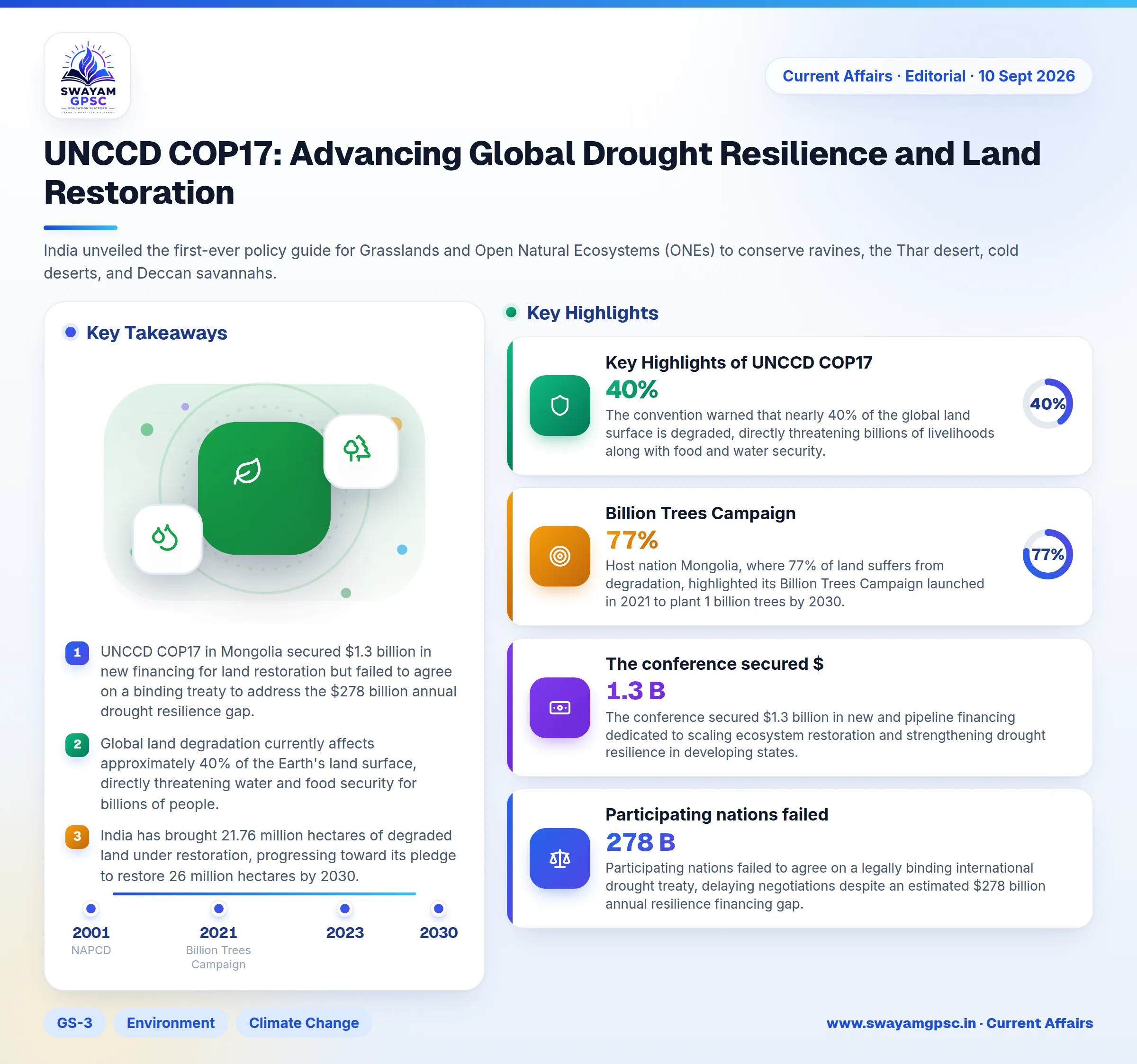
- UNCCD COP17 in Mongolia secured $1.3 billion in new financing for land restoration but failed to agree on a binding treaty to address the $278 billion annual drought resilience gap.
- Global land degradation currently affects approximately 40% of the Earth's land surface, directly threatening water and food security for billions of people.
- India has brought 21.76 million hectares of degraded land under restoration, progressing toward its pledge to restore 26 million hectares by 2030.
- To combat desertification, India relies on initiatives like the Aravalli Green Wall Project and Mission Amrit Sarovar, which targets rejuvenating 75 water bodies per district.
Why in News
- The 17th Conference of the Parties (COP17) to the United Nations Convention to Combat Desertification (UNCCD) concluded in Ulaanbaatar, Mongolia.
- Held under the theme Restoring Land, Restoring Hope, the summit focused on rangeland conservation, drought financing, and community-led restoration amid a deadlock over a binding global drought treaty.
About UNCCD and COP17 Focus
- Established after the 1992 Rio Earth Summit, the UNCCD is the only legally binding international agreement connecting environment and development to sustainable land management.
- COP17 coincided with the UN International Year of Rangelands and Pastoralists, placing pastoral communities and fragile open ecosystems at the core of the global Land Degradation Neutrality (LDN) agenda.
Key Highlights of UNCCD COP17
- The convention warned that nearly 40% of the global land surface is degraded, directly threatening billions of livelihoods along with food and water security.
- Host nation Mongolia, where 77% of land suffers from degradation, highlighted its Billion Trees Campaign launched in 2021 to plant 1 billion trees by 2030.
- Delegates launched an AI-powered Drought Resilience Index as the first global technical diagnostic tool using artificial intelligence to track national preparedness and drive proactive mitigation.
- The UNCCD and Luxembourg co-launched the Drought Resilience Investment Facility as the first catalytic financing platform to de-risk investments and mobilize commercial funds for water security and climate-resilient agriculture.
- The conference secured $1.3 billion in new and pipeline financing dedicated to scaling ecosystem restoration and strengthening drought resilience in developing states.
- Participating nations failed to agree on a legally binding international drought treaty, delaying negotiations despite an estimated $278 billion annual resilience financing gap.
- Parties formally decided that drought will become a permanent, standalone agenda item starting from COP18 onwards.
India's Stance and Interventions at COP17
- India unveiled the first-ever policy guide for Grasslands and Open Natural Ecosystems (ONEs) to conserve ravines, the Thar desert, cold deserts, and Deccan savannahs.
- India reported bringing 21.76 million hectares of degraded land under restoration, progressing steadily toward its Bonn Challenge pledge of restoring 26 million hectares by 2030.
- India advocated recognizing pastoralists as frontline ecological stewards and highlighted traditional conservation models like the Orans of Rajasthan.
- Indian delegates reiterated calls for predictable international climate finance while detailing domestic market instruments like Sovereign Green Bonds and the Green Credit Programme.
India's Domestic Initiatives to Combat Desertification
- Formulated in 2001 and updated in 2023, the National Action Plan to Combat Desertification (NAPCD) serves as the main umbrella framework converging land restoration programs across ministries.
- The watershed component of PMKSY integrates ridge-to-valley watershed treatments, runoff harvesting, and moisture conservation to build local drought resistance.
- ISRO uses remote sensing and Geographic Information System (GIS) analytics in its Desertification and Land Degradation Atlas to monitor shifting land degradation patterns across districts.
- The Aravalli Green Wall Project creates an afforestation corridor across Haryana, Rajasthan, Gujarat, and Delhi to stop the eastward expansion of the Thar desert.
- Mission Amrit Sarovar focuses on excavating and rejuvenating at least 75 water bodies per district to recharge shallow groundwater aquifers and ensure local water security.
- The Soil Health Card Scheme provides farmers with soil nutrient test profiles to optimize chemical fertilizer application and prevent chemical land degradation.
Challenges
- A massive $278 billion annual financing deficit severely hampers proactive drought preparedness across developing nations.
- Disagreements between developed and developing countries over binding financial commitments continue to block a global drought treaty.
- Tree-planting campaigns often plant non-native monocultures in natural grasslands, which damages local hydrology and endemic wildlife.
- National drought management systems remain largely reactive, deploying post-disaster compensation rather than executing anticipatory risk reduction.
Way Forward
- Governments should align power subsidies, irrigation allocations, and Minimum Support Prices (MSP) with local agro-climatic conditions to halt water-intensive crop cultivation in dry regions.
- Authorities should adopt forecast-based trigger financing by linking satellite soil moisture data directly to emergency relief funds before crop failures occur.
- Policymakers must legally protect community grazing routes, pastoral commons, and sacred groves within formal revenue and land-use records.
- Countries need to transition from reactive disaster relief to proactive water stewardship by expanding micro-irrigation, rainwater harvesting, and soil organic carbon.
Conclusion
- The outcomes of UNCCD COP17 highlight that while technology tools and catalytic financing platforms are emerging, they cannot replace a legally binding global drought treaty.
- India can achieve its Land Degradation Neutrality targets by 2030 by combining science-based landscape restoration with the protection of traditional grazing commons.