India's Strategy for Energy Security amid Global Sanctions
#GS-2 #Governance & Social Justice #Current Events #National #International #GS-3 #Economy #Infrastructure #Energy
Key takeaways
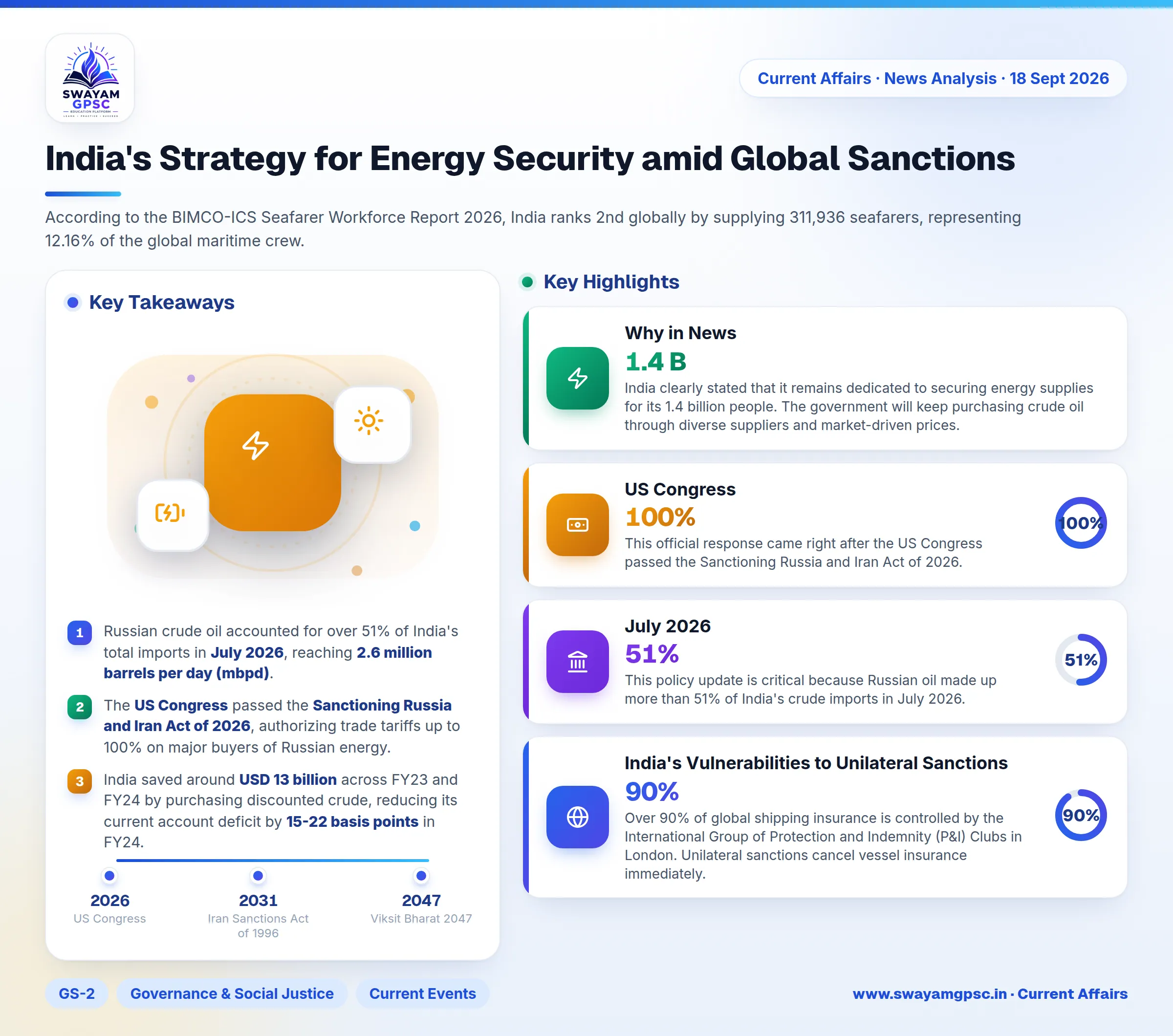
- Russian crude oil accounted for over 51% of India's total imports in July 2026, reaching 2.6 million barrels per day (mbpd).
- The US Congress passed the Sanctioning Russia and Iran Act of 2026, authorizing trade tariffs up to 100% on major buyers of Russian energy.
- India saved around USD 13 billion across FY23 and FY24 by purchasing discounted crude, reducing its current account deficit by 15-22 basis points in FY24.
- Indian refiners earned USD 16 billion in windfall profits from discounted crude, driving refined petroleum exports to USD 60 billion in FY25.
- India ranks 2nd globally by supplying 311,936 seafarers (12.16% of the global workforce), making its maritime personnel vulnerable to shadow fleet sanctions.
Why in News
- India clearly stated that it remains dedicated to securing energy supplies for its 1.4 billion people. The government will keep purchasing crude oil through diverse suppliers and market-driven prices.
- This official response came right after the US Congress passed the Sanctioning Russia and Iran Act of 2026. This law permits the US to place up to 100% trade tariffs on major buyers of Russian petroleum.
- This policy update is critical because Russian oil made up more than 51% of India's crude imports in July 2026. Because of this, experts urge setting up a central Sanctions War Room to shield the national economy from single-country sanctions.
Summary of Energy Vulnerabilities
- The passage of the Sanctioning Russia and Iran Act of 2026 targets buyers of Russian oil. This legislation exposes India to secondary sanctions, heavy tariffs, and operational disruptions across banking, shipping, and insurance sectors.
- To protect its domestic growth, India must build economic strength through supplier diversification, expanded Strategic Petroleum Reserves, local maritime insurance, alternative financial channels, and a faster clean energy transition.
India's Vulnerabilities to Unilateral Sanctions
- Global trade relies heavily on the US dollar, which passes through Western clearinghouses and the SWIFT messaging network. Because banks fear losing access to US financial licenses, both Indian and foreign banks practice defensive over-compliance. They routinely block valid transactions in alternative currencies like Special Rupee Vostro Accounts (SRVA) or UAE Dirhams.
- Over 90% of global shipping insurance is controlled by the International Group of Protection and Indemnity (P&I) Clubs in London. Unilateral sanctions cancel vessel insurance immediately. Without state-backed coverage, oil tankers carrying Indian cargo risk bans at key global chokepoints like the Danish Straits or the Bosphorus.
- Secondary sanctions under US laws like CAATSA create constant uncertainty. This collateral threat halts vital defense procurements like the S-400 missile system and delays key connectivity links like Iran's Chabahar Port and the INSTC corridor.
- According to the BIMCO-ICS Seafarer Workforce Report 2026, India ranks 2nd globally by supplying 311,936 seafarers, representing 12.16% of the global maritime crew. When authorities blacklist non-compliant shadow fleet tankers, Indian sailors face sudden vessel seizures, unpaid wages, and legal abandonment in foreign ports.
- Sanction impacts hit multiple sectors simultaneously, including commodity markets, shipping routes, insurers, and banks. However, India manages these areas in separate silos: the Ministry of External Affairs handles diplomacy, the RBI controls banking, and the Ministry of Ports, Shipping and Waterways oversees vessels. This lack of coordination prevents early warning systems for businesses.
Key Provisions of the Sanctioning Russia and Iran Act of 2026
- The new legislation aims to cut off Russia's energy revenue. It directly targets the shadow fleet of tankers that move Russian oil outside the price cap set by the G7.
- The bill grants the US administration power to impose trade tariffs up to 100% on exports from key buyers of Russian energy. This measure directly impacts nations like India and China.
- These rules operate with wide extraterritorial authority. They penalize the entire transaction chain by restricting non-US banks, shipping insurers, and fleet managers from the US financial system if they assist Russian oil sales.
- Beyond targeting Russia, the law increases enforcement against Iran's military and oil trade. It extends the main provisions of the Iran Sanctions Act of 1996 for five more years through 2031.
- The bill gives the US President discretionary power to waive tariffs if doing so serves US national security interests. This clause offers a small opening for diplomatic negotiation.
Significance of Russian Oil to India
- Large price discounts turned Russia into India's top crude oil supplier. Deliveries touched a record 2.6 million barrels per day (mbpd) in July 2026.
- India imports more than 85% of its raw crude requirements. Lower-priced Russian oil helped fulfill the primary pillars of energy security by keeping local fuel prices stable and controlling domestic inflation.
- Purchasing discounted Russian crude saved India nearly USD 13 billion across FY23 and FY24. These savings reduced India's Current Account Deficit (CAD) by 15-22 basis points in FY24, which protected the Rupee from sharp falls.
- Indian refiners generated roughly USD 16 billion in windfall profits by processing Russian Urals crude. Refined fuel exports reached USD 60 billion in FY25, which unexpectedly supplied fuel to Western nations that banned Russian crude directly.
- India's purchasing decisions demonstrated its strategic autonomy. The nation complied strictly with UNSC sanctions while declining to follow non-UN unilateral measures that threatened the wellbeing of its 1.4 billion citizens.
Way Forward
- India should establish an Economic Security and Sanctions Office inside the Cabinet Secretariat or the National Security Council Secretariat (NSCS). Formally placing this office under the Government of India (Allocation of Business) Rules, 1961 will give it power to issue clear inter-agency directives.
- The government must speed up the creation of an domestic P&I Club and expand the Bharat Maritime Insurance Pool. These steps will secure insurance cover for vital energy shipments during global crises. India should also offer incentives for companies to purchase Indian-flagged crude and gas vessels.
- India must expand non-dollar trade settling mechanisms and link the RBI's central bank digital currency with foreign partners. Joining initiatives like Project Nexus for instant cross-border payments and building alternative trade channels with BRICS members will reduce relying on Western clearing systems.
- The Ministry of Petroleum should fast-track Phase II of the Strategic Petroleum Reserve (SPR) program at Chandikhol and Padur. Expanding these underground storage facilities will protect the economy against unexpected supply blockades.
- India can lower its exposure to global oil shocks by accelerating green energy projects. Boosting the National Green Hydrogen Mission, meeting E20 biofuel blending goals, and installing large-scale battery storage will permanently trim fossil fuel demand.
- The government needs to maintain multi-vector diplomacy while spreading crude import reliance across alternative producers in the US, Brazil, Canada, and Africa. Securing long-term agreements with OPEC+ members alongside gas pipelines will stabilize long-term energy supplies.
Conclusion
- In a modern world where global finance is used as a strategic tool, foreign policy alone cannot preserve national interests. As India works toward Viksit Bharat 2047, economic self-reliance must stand alongside military strength. Building home-grown financial payment tools, sovereign shipping insurance, and a central economic security office will protect India's national growth from external sanctions.