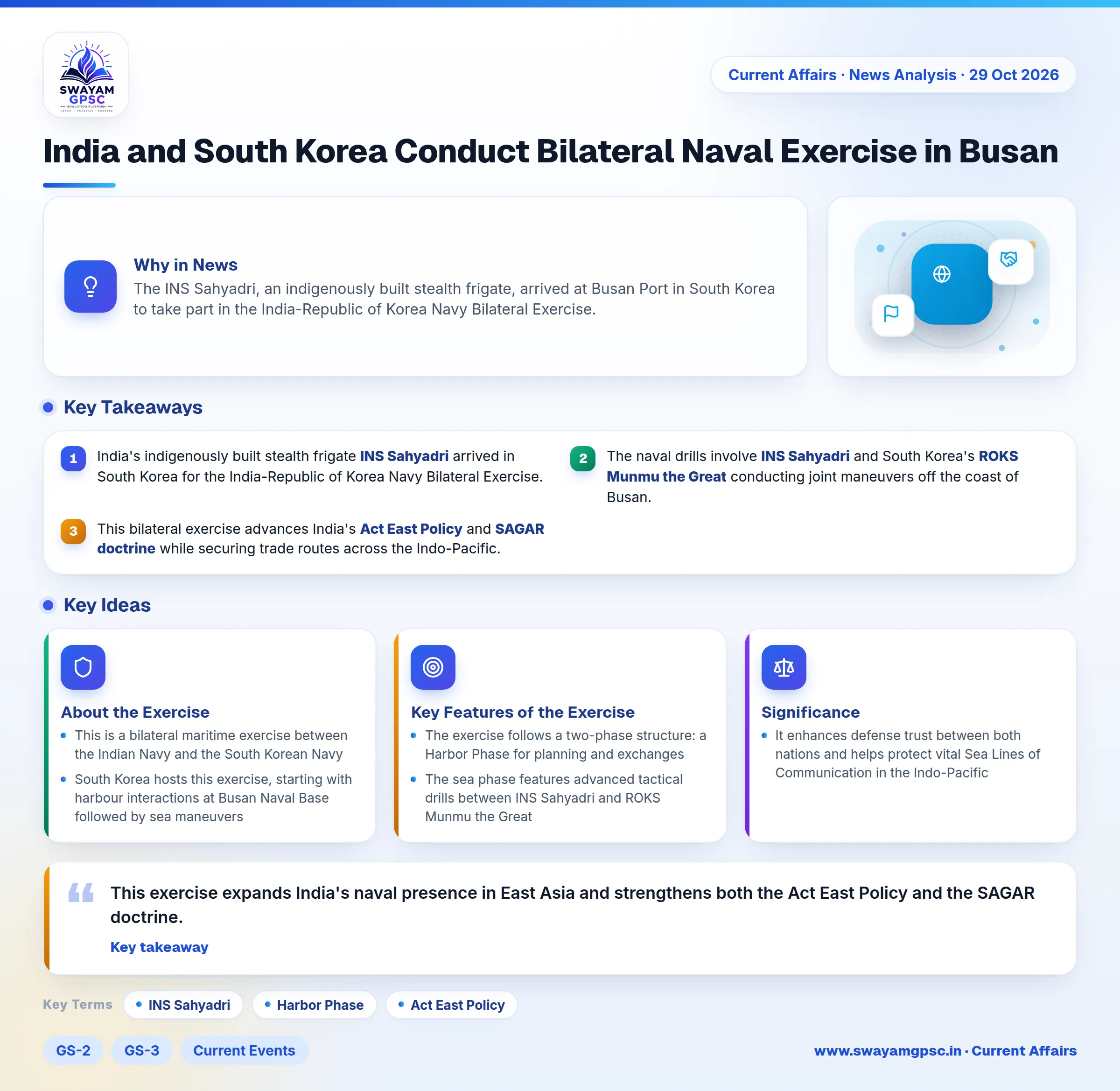
India and South Korea Conduct Bilateral Naval Exercise in Busan
#GS-2 #GS-3 #Current Events #International #Defence #Bilateral Relations #Prelims
Key takeaways
- India's indigenously built stealth frigate INS Sahyadri arrived in South Korea for the India-Republic of Korea Navy Bilateral Exercise.
- The naval drills involve INS Sahyadri and South Korea's ROKS Munmu the Great conducting joint maneuvers off the coast of Busan.
- This bilateral exercise advances India's Act East Policy and SAGAR doctrine while securing trade routes across the Indo-Pacific.
Why in News
- The INS Sahyadri, an indigenously built stealth frigate, arrived at Busan Port in South Korea to take part in the India-Republic of Korea Navy Bilateral Exercise.
About the Exercise
- This is a bilateral maritime exercise between the Indian Navy and the South Korean Navy, featuring both harbour activities and tactical sea drills.
- South Korea hosts this exercise, starting with harbour interactions at Busan Naval Base followed by sea maneuvers in adjacent waters.
- The exercise involves naval forces from two member nations, namely India and the Republic of Korea.
- The main objective is to deepen naval ties, share best practices, and build tactical coordination for a free and open Indo-Pacific region.
Key Features of the Exercise
- The exercise follows a two-phase structure: a Harbor Phase for planning and exchanges, followed by an intensive Sea Phase.
- The sea phase features advanced tactical drills between INS Sahyadri and ROKS Munmu the Great, including helicopter cross-deck landings and seamanship exercises.
- Both navies share domain knowledge, damage control practices, and maritime domain awareness protocols through interactive exchanges.
- The deployment highlights India's defense manufacturing capacity by sending the Mazagon Dock-built INS Sahyadri into East Asian waters.
Significance
- This exercise expands India's naval presence in East Asia and strengthens both the Act East Policy and the SAGAR doctrine.
- It enhances defense trust between both nations and helps protect vital Sea Lines of Communication in the Indo-Pacific region.