India's Solar Expansion Enters a New Phase of Growth
#GS-2 #GS-3 #Governance & Social Justice #Economy #Infrastructure #Energy #Science & Technology #Environment #Climate Change #Sustainable Development #Current Events #National #Government Policies & Interventions #Solar Energy #Renewable Energy
Key takeaways
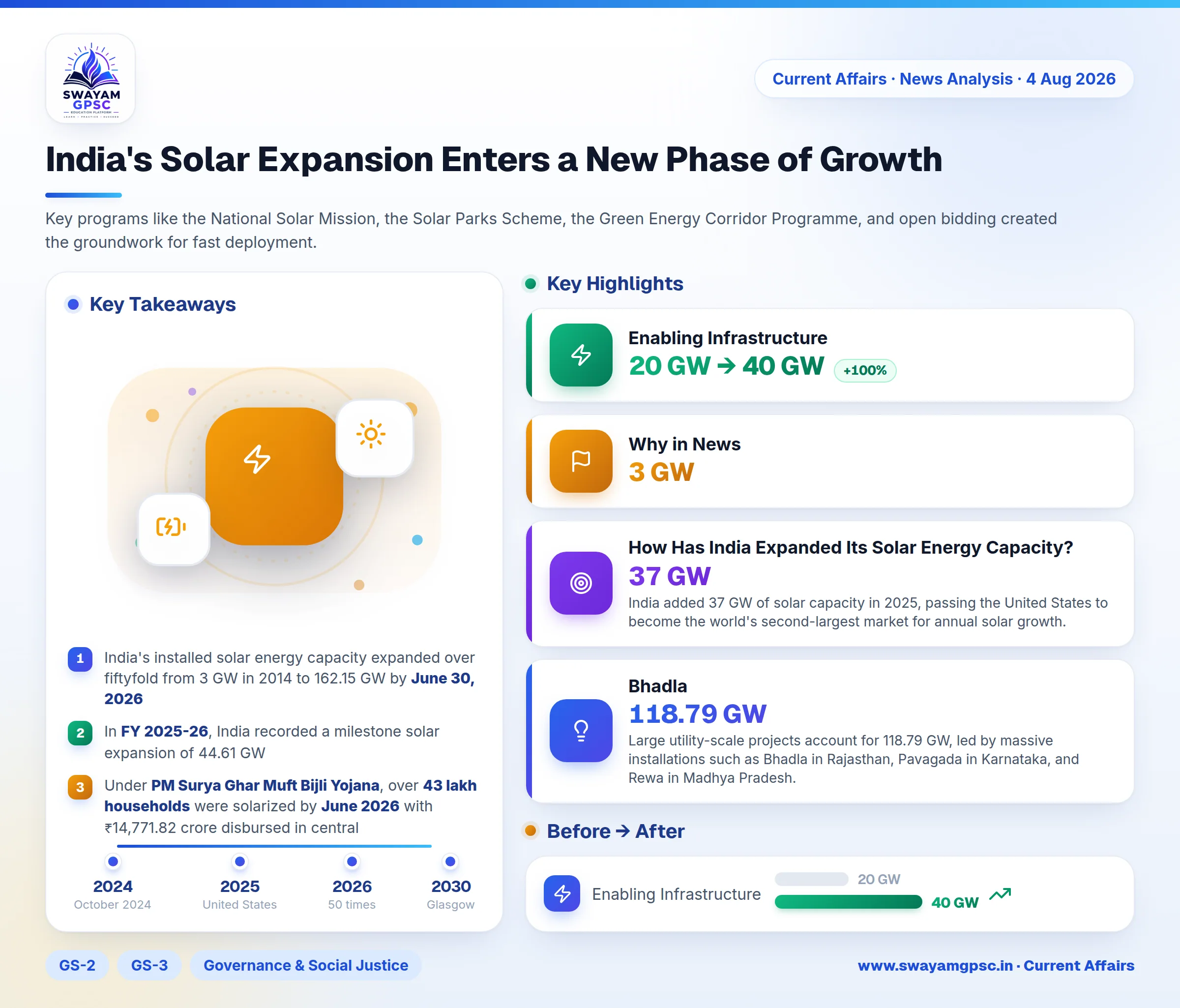
- India's installed solar energy capacity expanded over fiftyfold from 3 GW in 2014 to 162.15 GW by June 30, 2026, becoming the largest component of the country's clean energy mix.
- In FY 2025-26, India recorded a milestone solar expansion of 44.61 GW, while domestic solar module manufacturing capacity reached 172 GW by March 2026.
- Under PM Surya Ghar Muft Bijli Yojana, over 43 lakh households were solarized by June 2026 with ₹14,771.82 crore disbursed in central support, resulting in zero power bills for 7.7 lakh families.
- The PM-KUSUM scheme benefited 21.77 lakh farmers by delivering 11.49 lakh off-grid pumps and solarizing 15.89 lakh pumps through feeder installations.
- The newly introduced Pradhan Mantri Surya Sarovar Yojana (PM-SSY) targets 5,000 MW of floating solar power paired with energy storage to overcome land scarcity and enhance grid reliability.
Why in News
- India expanded its total installed solar power capacity over 50 times, growing from 3 GW in 2014 to 162.15 GW by June 30, 2026, making solar the biggest part of its clean energy total.
- Favourable policies, infrastructure development, local manufacturing growth, and active public participation have driven this rapid expansion.
- Giant solar parks, home rooftop setups, and solar water pumps accelerated deployment, while the new Pradhan Mantri Surya Sarovar Yojana (PM-SSY) offers the newest policy support.
How Has India Expanded Its Solar Energy Capacity?
- India added 37 GW of solar capacity in 2025, passing the United States to become the world's second-largest market for annual solar growth.
- Key programs like the National Solar Mission, the Solar Parks Scheme, the Green Energy Corridor Programme, and open bidding created the groundwork for fast deployment.
- Six major states - Rajasthan, Gujarat, Karnataka, Tamil Nadu, Andhra Pradesh, and Maharashtra - generate the largest share of the national solar output.
- Large utility-scale projects account for 118.79 GW, led by massive installations such as Bhadla in Rajasthan, Pavagada in Karnataka, and Rewa in Madhya Pradesh.
- Rooftop solar power systems connected to the main grid supply 27.88 GW, while hybrid energy storage setups and off-grid units power remote areas.
- The country added a record 44.61 GW of solar power in FY 2025-26, nearly doubling the 23.83 GW brought online in FY 2024-25.
- Domestic solar module manufacturing capabilities expanded from 2.3 GW in 2014 to almost 172 GW by March 2026.
- Total non-fossil fuel power generation reached 283.46 GW, which includes 274.68 GW derived directly from renewable energy sources.
- During FY 2025-26, India achieved its highest annual surge in clean energy capability by adding 55.29 GW of non-fossil capacity.
- On 29th July 2025, clean energy met 51.5% of total national power demand, setting a historical peak for renewable power usage.
Creating Vision: Climate Commitments and Long-Term Targets
- At COP26 in Glasgow, India announced its Panchamrit pledges to reach 500 GW of non-fossil energy capacity by 2030 and net-zero emissions by 2070.
- Mission LiFE reinforces these national climate goals by nudging citizens toward eco-friendly daily choices and sustainable resource consumption.
Creating Demand: National Missions and Renewable Purchase Obligations
- The National Solar Mission kicked off long-term expansion by setting target milestones and building steady consumer demand for green power.
- Mandated Renewable Purchase Obligations (RPO) require electricity distribution utilities to buy a fixed percentage of clean electricity, assuring stable market demand for developers.
- The official policy schedule fixes the target clean power share at 35.95% for 2026-27, with binding rules set through 2029-30.
- Programs like PM Surya Ghar Muft Bijli Yojana and PM-KUSUM broaden participation by helping residential consumers and farmers generate solar power.
Lowering Costs: Competitive Bidding and Tariff Discovery
- Electricity costs dropped rapidly over the last decade because solar developers actively bid against each other using an e-Reverse Auction system.
- The Solar Energy Corporation of India (SECI) helped lower solar power tariffs from around ₹18 per unit in 2010 to a record low of ₹2.44 per unit at Bhadla Solar Park in 2017.
- In 2025, India produced utility-scale solar energy at USD 35 per MWh, staying far below the global average cost of USD 44 per MWh.
Enabling Infrastructure
- The Solar Parks Scheme supplies developers with pre-cleared land and grid links, scaling its target from 20 GW to 40 GW in 2017 and approving 54 solar parks totaling 39,188 MW by February 2026.
- Gujarat leads state park development with 12,150 MW across 7 parks, followed by Rajasthan with 10,726 MW across 11 parks and Madhya Pradesh with 4,208 MW across 9 parks.
- Prominent utility projects like the 2,245 MW Bhadla Solar Park in Rajasthan, Pavagada in Karnataka, and Rewa in Madhya Pradesh show how shared facilities lower costs.
- The Green Energy Corridor Programme moves clean electricity to load centers, having successfully integrated 24,567.8 MW into the power grid by February 2026 while targeting 44 GW across 10 states.
Supporting Manufacturing
- The Production Linked Incentive (PLI) Scheme launched with ₹4,500 crore in 2021 and grew by ₹19,500 crore in 2022 to boost local solar module production and curb imports.
- By October 2024, the PLI initiative had drawn about ₹35,000 crore in private investments and created around 10,000 direct jobs.
- Established in 2019, the Approved List of Models and Manufacturers (ALMM) guarantees that public projects only purchase high-quality, domestically manufactured solar equipment.
How Is India Strengthening Domestic Solar Energy Architecture?
- Unveiled in February 2024 with a budget of ₹75,021 crore, PM Surya Ghar Muft Bijli Yojana offers direct financial grants and collateral-free loans for rooftop solar systems.
- Over 43 lakh households adopted solar energy by June 2026, with the Central Government releasing ₹14,771.82 crore in financial support by December 2025.
- Thanks to rooftop panels, over 7.7 lakh families recorded zero utility charges on their monthly power statements by December 2025.
- The World Bank approved extra funding support to accelerate the rollout of home rooftop solar units across Indian cities and towns.
- Started in 2019, PM-KUSUM promotes small off-grid solar generators, standalone irrigation pumps, and solar powering of farm power lines.
- Farm workers gain dependable daytime water supplies, lower their diesel bills, and earn extra income by selling leftover electricity back to local power companies.
- The government allocated ₹34,422 crore in financial aid to build 34,800 MW of rural solar capacity through 2026-27.
- Installations reached 11.49 lakh off-grid pumps, solarized 15.89 lakh pumps at the grid feeder level, and built 1,726 MW of local solar systems on farm ground.
- Nationwide, over 21.77 lakh farmers have improved their irrigation and lowered energy costs using PM-KUSUM.
- Distributed solar accounted for 16.3 GW or 36% of all new solar power installed in FY 2025-26, split between 7.6 GW from PM-KUSUM and 8.7 GW from home rooftops.
How Is India Strengthening Global Solar Cooperation?
- Created by India and France at COP21 in 2015, the International Solar Alliance (ISA) drives global solar installation, technology sharing, and skill training.
- Member nations like Germany, Italy, Greece, Argentina, Bhutan, Luxembourg, and the Maldives collaborate through the ISA platform to expand solar adoption.
- First suggested by India in 2018, One Sun One World One Grid (OSOWOG) strives to link national power grids across borders to share green energy worldwide.
- India and the United Kingdom launched the combined GGI-OSOWOG project at COP26 in 2021, backed by Australia, France, the United States, and the ISA.
- Unified power grids allow international green energy sales, balance peak demand across different time zones, and boost world energy resilience.
- By sharing technological knowledge and training programs through the ISA, India guides renewable development across nations in the Global South.
- Under its G20 leadership term, India rallied member countries to commit to tripling world renewable power capacity by 2030.
Way Forward
- India has entered an advanced solar growth phase backed by immense scale, low production costs, local factory output, and active public adoption.
- The newly launched Pradhan Mantri Surya Sarovar Yojana (PM-SSY) resolves land shortage and grid storage issues by pairing floating solar panels with battery storage units across 5,000 MW of projects.
- Combining home rooftop systems, PM-KUSUM, utility solar parks, the Green Energy Corridor Programme, and global partnerships will keep solar power at the core of India's net-zero 2070 target.