India Semiconductor Mission 2.0 and the Drive for Technological Self-Reliance
#GS-2 #GS-3 #Governance & Social Justice #Economy #Science & Technology #Current Events #Good Governance #Infrastructure #ICT #National #Semiconductors #India Semiconductor Mission
Why in News
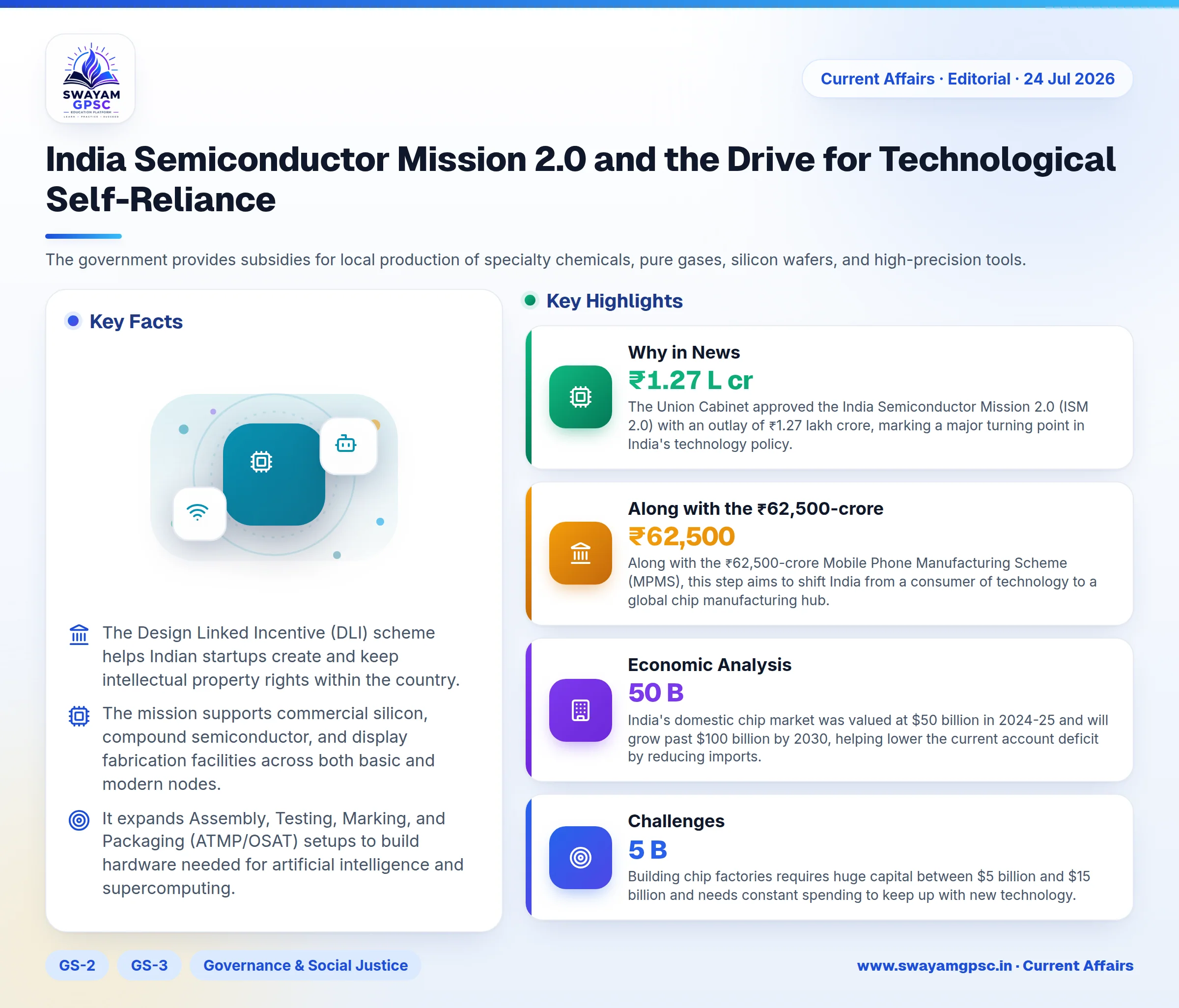
- The Union Cabinet approved the India Semiconductor Mission 2.0 (ISM 2.0) with an outlay of ₹1.27 lakh crore, marking a major turning point in India's technology policy.
- Along with the ₹62,500-crore Mobile Phone Manufacturing Scheme (MPMS), this step aims to shift India from a consumer of technology to a global chip manufacturing hub.
Overview of India's Silicon Ambition
- India's semiconductor drive through Semicon 2.0 focuses on self-reliance in chip design, manufacturing, raw equipment, and research to protect supply chains and build a strong domestic tech base.
The Six Pillars of ISM 2.0
- The Design Linked Incentive (DLI) scheme helps Indian startups create and keep intellectual property rights within the country.
- The mission supports commercial silicon, compound semiconductor, and display fabrication facilities across both basic and modern nodes.
- It expands Assembly, Testing, Marking, and Packaging (ATMP/OSAT) setups to build hardware needed for artificial intelligence and supercomputing.
- The government provides subsidies for local production of specialty chemicals, pure gases, silicon wafers, and high-precision tools.
- It funds research into advanced semiconductor technologies, including sub-7nm processing, 3D chiplets, and optical silicon chips.
- Colleges and industries will work together to train skilled process engineers, materials scientists, and VLSI designers.
Rationale and Need for Self-Reliance
- Supply chain interruptions during the pandemic showed how foreign dependence can stop manufacturing in cars, electronics, and medical equipment.
- Relying heavily on a few places like Taiwan, South Korea, China, Japan, and the US creates economic risks during conflicts.
- National infrastructure like satellites, defense weapons, 5G/6G networks, and AI run on chips, so importing them creates security risks.
- The ₹62,500-crore mobile manufacturing scheme creates immediate demand for locally produced semiconductor chips.
Economic Analysis
- India's domestic chip market was valued at $50 billion in 2024-25 and will grow past $100 billion by 2030, helping lower the current account deficit by reducing imports.
- Building this ecosystem creates specialized jobs for chip designers, chemical technicians, and materials engineers.
- Manufacturing chips locally lowers production costs for electric vehicles, 5G/6G networks, and data centers.
Geopolitical and Strategic Analysis
- Global chip production sits mainly in East Asia, so establishing a local manufacturing hub protects India from war or shipping breakdowns.
- Chips control vital hardware for AI, space satellites, and defense, so relying on foreign factories makes the country vulnerable during crises.
- This mission supports global technology agreements like the US-India iCET and partnerships with Japan, the EU, and Singapore.
Technological and Industrial Analysis
- India's current plan focuses on mature nodes from 28nm to 110nm for cars and devices, with plans to build sub-7nm chips later.
- Advanced chip packaging gives a cost-effective way to boost hardware performance without needing expensive sub-2nm factories right away.
Challenges
- Building chip factories requires huge capital between $5 billion and $15 billion and needs constant spending to keep up with new technology.
- Factories need uninterrupted power and millions of liters of pure water daily, as even a minor power flicker ruins entire production batches.
- India lacks local suppliers for raw specialty chemicals, specialized metals, and chip manufacturing machinery.
- Many Indian chip engineers work abroad because the country lacked advanced foundries and research labs in the past.
Way Forward
- State governments should build ready-to-use industrial parks with dedicated water treatment plants and dual-line power setups.
- Initial efforts should target niche areas like Silicon Carbide and Gallium Nitride along with older nodes that need lower investment and have high local demand.
- Setting up the India Semiconductor Research Centre (ISRC) based on Belgium's imec or Taiwan's ITRI will link research labs with commercial factories.
- Expanding the Design Linked Incentive (DLI) scheme will give startups easier access to design software, chip trials, and investment funds.
Conclusion
- The India Semiconductor Mission 2.0 is an essential program to secure digital independence and turn India into a strong global technology hub.
- While government grants help start the process, long-term success depends on efficient administration, reliable utilities, and strong local innovation.