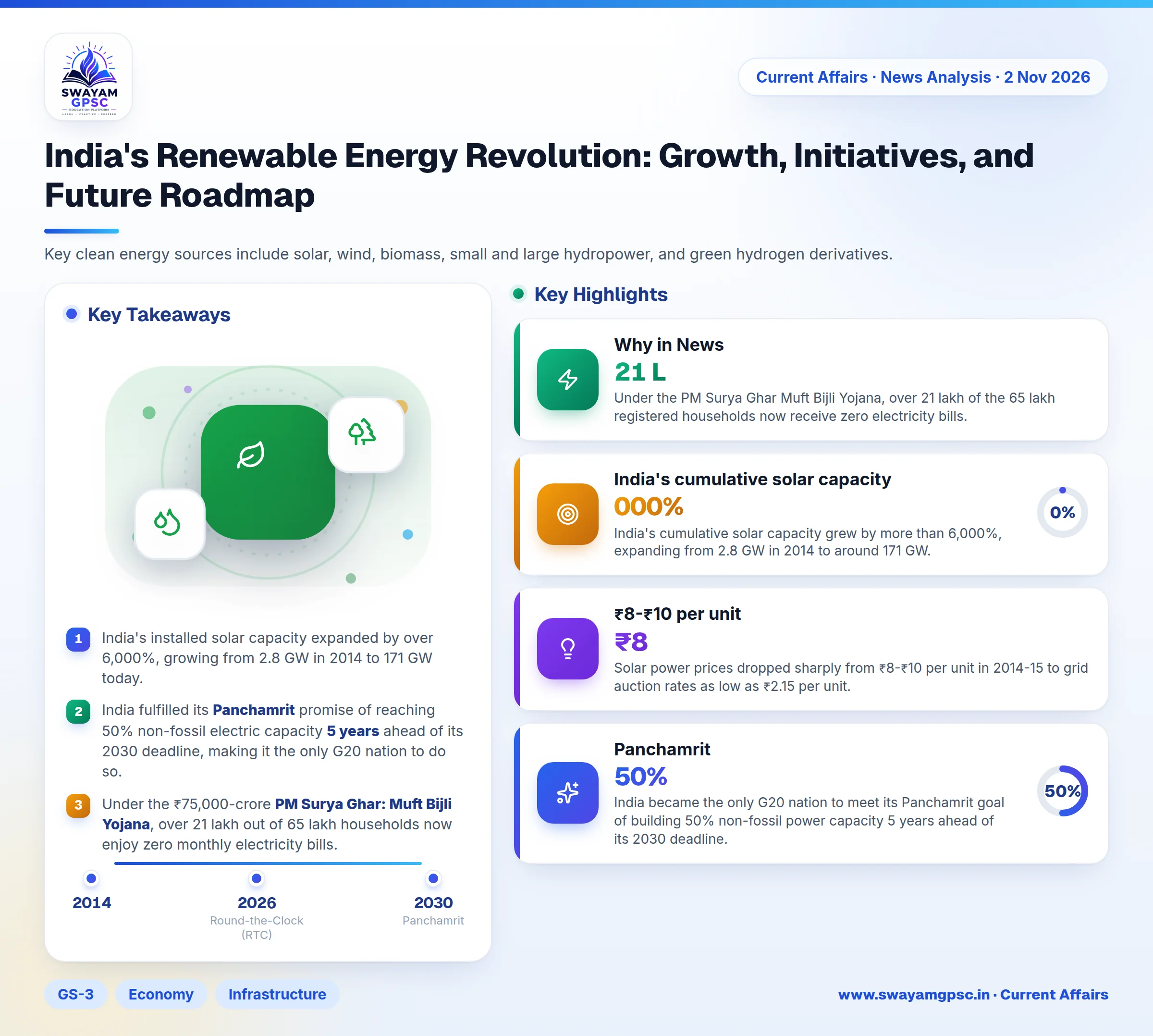
India's Renewable Energy Revolution: Growth, Initiatives, and Future Roadmap
#GS-3 #Economy #Infrastructure #Energy #Environment #Climate Change #Sustainable Development #Current Events #National
Key takeaways
- India's installed solar capacity expanded by over 6,000%, growing from 2.8 GW in 2014 to 171 GW today.
- India fulfilled its Panchamrit promise of reaching 50% non-fossil electric capacity 5 years ahead of its 2030 deadline, making it the only G20 nation to do so.
- Under the ₹75,000-crore PM Surya Ghar: Muft Bijli Yojana, over 21 lakh out of 65 lakh households now enjoy zero monthly electricity bills.
- The Central Electricity Authority (CEA) estimates that India will need 236 GWh of battery storage by 2031-32 to balance grid supply.
- India's domestic solar manufacturing capacity has reached 225 GW for solar modules and 45 GW for solar cells under PLI incentives.
Why in News
- The Union Minister for New and Renewable Energy recently shared key updates on India's clean energy growth.
- India is shifting from large centralized power projects to a decentralized, people-led solar energy model.
- Under the PM Surya Ghar Muft Bijli Yojana, over 21 lakh of the 65 lakh registered households now receive zero electricity bills.
What is Renewable Energy?
- Renewable energy comes from natural, non-fossil sources that refill faster than people consume them.
- Key clean energy sources include solar, wind, biomass, small and large hydropower, and green hydrogen derivatives.
Key Data and Statistics
- India's cumulative solar capacity grew by more than 6,000%, expanding from 2.8 GW in 2014 to around 171 GW.
- Solar power prices dropped sharply from ₹8-₹10 per unit in 2014-15 to grid auction rates as low as ₹2.15 per unit.
- India became the only G20 nation to meet its Panchamrit goal of building 50% non-fossil power capacity 5 years ahead of its 2030 deadline.
- Through the PM Surya Ghar: Muft Bijli Yojana, more than 21 lakh out of 65 lakh solar rooftop homes now pay zero electricity bills.
- The PM-KUSUM program has successfully deployed more than 30 lakh standalone solar pumps for farmers.
Evolution of Renewable Energy in India
- Phase I (Pre-2014 Foundation): Clean energy depended mainly on wind power and small hydro projects, while utility solar remained small with high setup costs of around 2.8 GW.
- Phase II (2014-2020 Scale-Up): The government raised the National Solar Mission target to 100 GW, introduced reverse competitive bidding, and built mega-solar parks across dry lands.
- Phase III (2021-2025 Manufacturing): Post-COP26 Panchamrit targets aimed for 500 GW of non-fossil energy by 2030, backed by Production Linked Incentive (PLI) schemes and the National Green Hydrogen Mission.
- Phase IV (2026+ Storage and Integration): Focus is shifting to Round-the-Clock (RTC) power using Battery Energy Storage Systems (BESS), rooftop solar under PM Surya Ghar, and smart power grids.
Key Government Initiatives
- PM Surya Ghar: Muft Bijli Yojana: This ₹75,000-crore scheme supports rooftop solar for 1 crore homes, offering up to 300 units of free monthly power and net-metering earnings.
- PM-KUSUM Scheme: This initiative helps remove diesel from farms by funding standalone solar pumps and solarizing rural agricultural power feeders.
- PLI Schemes for Solar PV: Domestic production capacity expanded to over 225 GW for solar modules and roughly 45 GW for solar cells, lowering reliance on imports.
- Green Energy Corridors (GEC Phase III): A Cabinet-approved ₹50,000-crore project that adds transmission lines to carry 50 GWh of clean and stored power to major industrial hubs.
Challenges
- Grid Intermittency and High Storage Costs: Solar and wind power depend on the weather, requiring costly Battery Energy Storage Systems (BESS) and pumped hydro to balance evening power demand.
- Central Electricity Authority (CEA) projections indicate that India will need 236 GWh of battery storage capacity by 2031-32 to keep the grid stable.
- Supply Chain Vulnerabilities: Domestic plants assemble final solar modules, but India still imports raw materials like polysilicon ingots and wafers.
- Price changes in global polysilicon and critical minerals create financial uncertainty for local solar cell manufacturers.
- Financial Stress Among State DISCOMs: Heavy debts, delayed subsidy payouts, and renegotiated contracts in state distribution companies slow down power purchase agreements.
- Delays in DISCOM payments and slow approvals for rooftop net-metering hold back commercial solar adoption.
- Land Acquisition and Transmission Bottlenecks: Building large solar parks requires vast continuous land areas and new inter-state power lines.
- Setting up power lines across western desert zones like the Khavda hybrid park faces land acquisition delays and environmental clearances.
Way Forward
- Accelerate Domestic Manufacturing: Direct PLI funds into raw material facilities like polysilicon, ingot, and wafer units, alongside electrolyser factories for the National Green Hydrogen Mission.
- Scale Up Storage Systems: Combine Viability Gap Funding for large lithium and sodium-ion batteries with pumped storage hydro projects to guarantee continuous power supply.
- Modernize State Utilities (DISCOMs): Fast-track smart prepaid meter installations and simplify power purchase agreements to reduce financial losses at state utilities.
- Expand Global Cooperation: Leverage the International Solar Alliance (ISA) and the $200-million Africa Solar Facility to share Indian technical skills and off-grid solar equipment with developing nations.
Conclusion
- India's clean energy transition has successfully shifted from large government projects into a citizen-driven movement for energy independence.
- To maintain this growth, India must pair clean power generation with cheap battery storage, modern grid lines, and domestic wafer manufacturing.
- By combining strong industrial policies with international leadership through the International Solar Alliance (ISA), India provides a reliable clean-energy model for developing countries.