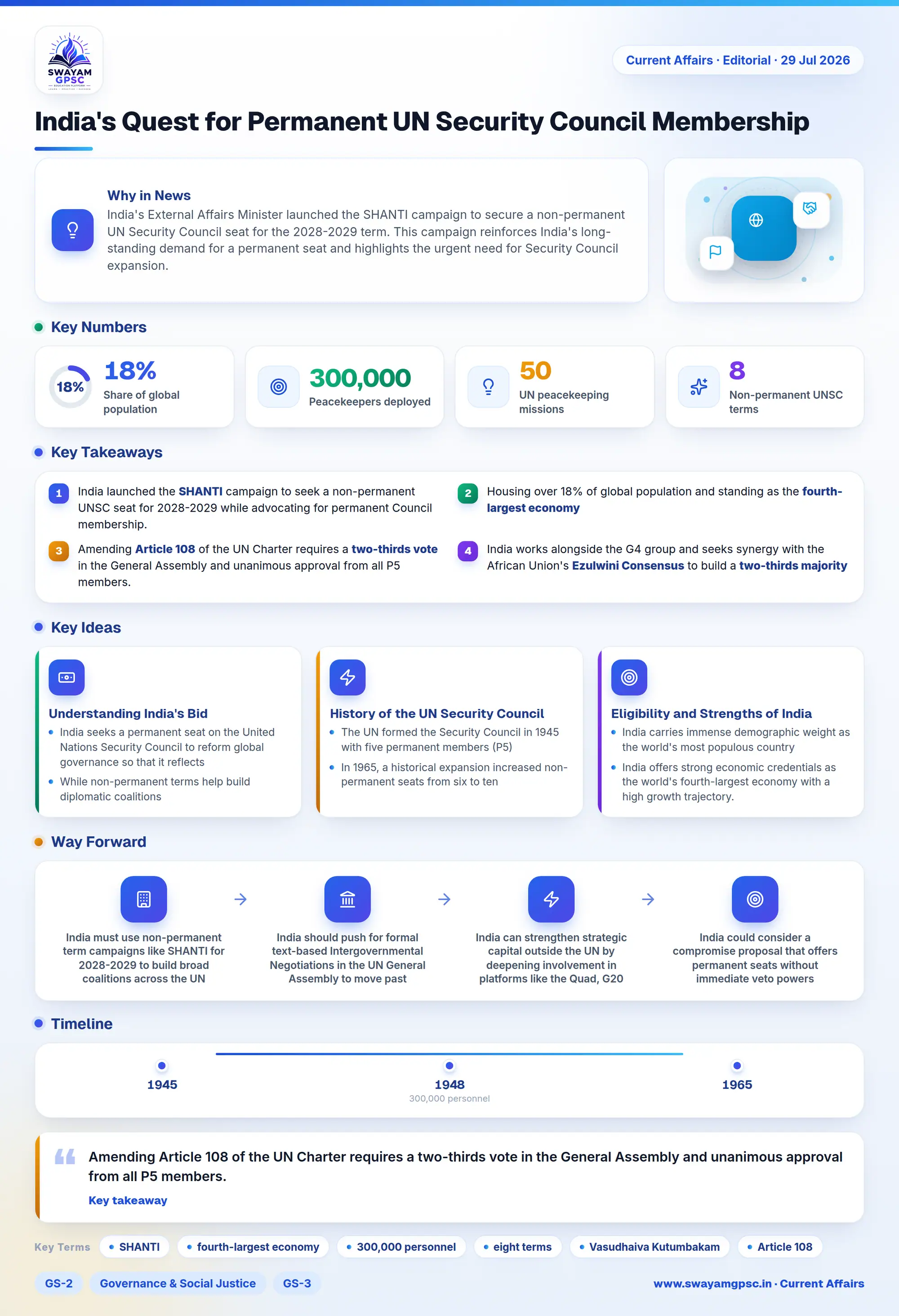
India's Quest for Permanent UN Security Council Membership
#GS-2 #Governance & Social Justice #GS-3 #Current Events #International #UNSC Reforms #G4 Nations #UN Peacekeeping
Key takeaways
- India launched the SHANTI campaign to seek a non-permanent UNSC seat for 2028-2029 while advocating for permanent Council membership.
- Housing over 18% of global population and standing as the fourth-largest economy, India has contributed nearly 300,000 personnel to UN Peacekeeping since 1948.
- Amending Article 108 of the UN Charter requires a two-thirds vote in the General Assembly and unanimous approval from all P5 members.
- India works alongside the G4 group and seeks synergy with the African Union's Ezulwini Consensus to build a two-thirds majority for structural UN reforms.
Why in News
- India's External Affairs Minister launched the SHANTI campaign to secure a non-permanent UN Security Council seat for the 2028-2029 term.
- This campaign reinforces India's long-standing demand for a permanent seat and highlights the urgent need for Security Council expansion.
Understanding India's Bid for Permanent UNSC Membership
- India seeks a permanent seat on the United Nations Security Council to reform global governance so that it reflects current economic and geopolitical realities.
- While non-permanent terms help build diplomatic coalitions, a permanent seat gives India a lasting veto-backed voice on global security and sanctions.
History of the UN Security Council
- The UN formed the Security Council in 1945 with five permanent members (P5), giving exclusive veto power to the victory nations of World War II.
- In 1965, a historical expansion increased non-permanent seats from six to ten, raising total Council membership to 15 while leaving P5 veto power unchanged.
- India, Brazil, Germany, and Japan established the G4 grouping in 2005 to support each other's bids for permanent seats and promote African representation.
- Rivalries among the P5 nations frequently paralyze the Security Council during international crises, creating a severe crisis of legitimacy.
Eligibility and Strengths of India for Permanent Membership
- India carries immense demographic weight as the world's most populous country, housing over 18% of the human population.
- India offers strong economic credentials as the world's fourth-largest economy with a high growth trajectory.
- India has made unmatched contributions to UN Peacekeeping, deploying nearly 300,000 personnel across roughly 50 missions since 1948.
- India holds a proven institutional track record, having served eight terms as an elected non-permanent member of the Security Council.
- India serves as a prominent voice for the Global South while promoting universal civilisational values like Vasudhaiva Kutumbakam.
Challenges
- Amending Article 108 of the UN Charter requires a two-thirds vote in the General Assembly and unanimous approval from all P5 members.
- China consistently uses its position as the sole Asian P5 member to block India from entering the permanent ranks.
- The Uniting for Consensus group, also known as the Coffee Club and led by Italy alongside Pakistan, actively opposes new permanent seats.
- Existing permanent members remain hesitant to share veto privileges or dilute their exclusive decision-making authority.
- Disagreements within regional groups over candidate selection create diplomatic friction for representation from Asia, Africa, and Latin America.
Way Forward
- India must use non-permanent term campaigns like SHANTI for 2028-2029 to build broad coalitions across the UN General Assembly.
- India should push for formal text-based Intergovernmental Negotiations in the UN General Assembly to move past open-ended discussions.
- India can strengthen strategic capital outside the UN by deepening involvement in platforms like the Quad, G20, BRICS, and the International Solar Alliance.
- India could consider a compromise proposal that offers permanent seats without immediate veto powers during a transitional phase.
- Aligning the G4 strategy with the African Union's Ezulwini Consensus can help gather the required two-thirds majority in the General Assembly.
Conclusion
- India fulfills virtually every strategic and moral requirement for permanent UNSC membership, yet procedural barriers and P5 self-interest hold it back.
- A UN Security Council that leaves out over 18% of global humanity cannot maintain long-term global legitimacy.
- Reforming the Security Council is essential to ensure multilateralism remains fair and capable of handling modern threats to international peace.