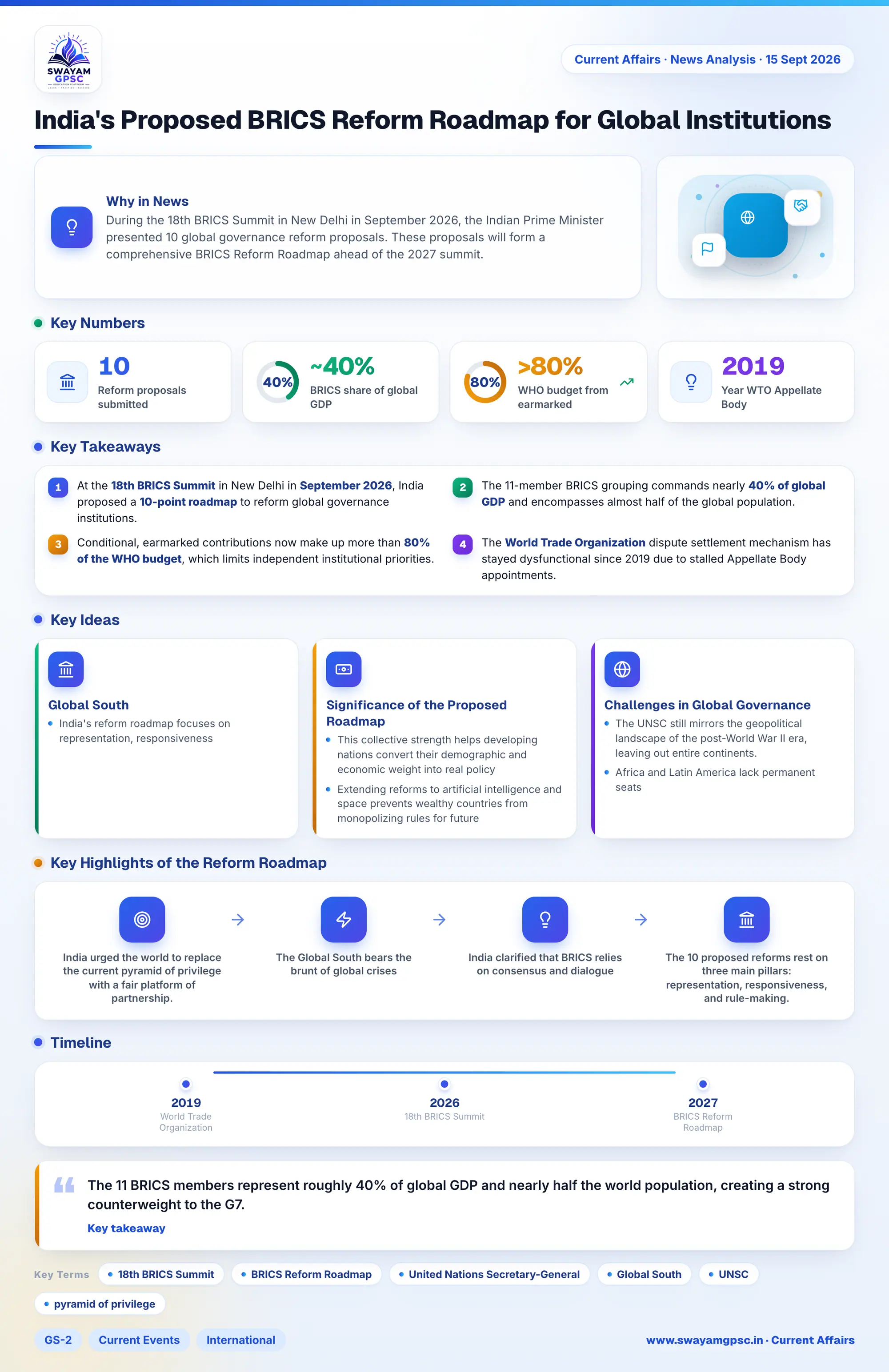
India's Proposed BRICS Reform Roadmap for Global Institutions
#GS-2 #Current Events #International #Important International Institutions #BRICS #UNSC Reform #Bretton Woods Institutions #Global South #Multilateralism
Key takeaways
- At the 18th BRICS Summit in New Delhi in September 2026, India proposed a 10-point roadmap to reform global governance institutions.
- The 11-member BRICS grouping commands nearly 40% of global GDP and encompasses almost half of the global population.
- Conditional, earmarked contributions now make up more than 80% of the WHO budget, which limits independent institutional priorities.
- The World Trade Organization dispute settlement mechanism has stayed dysfunctional since 2019 due to stalled Appellate Body appointments.
Why in News
- During the 18th BRICS Summit in New Delhi in September 2026, the Indian Prime Minister presented 10 global governance reform proposals.
- These proposals will form a comprehensive BRICS Reform Roadmap ahead of the 2027 summit.
- The United Nations Secretary-General also warned that distorted power balances have made the UN Security Council non-operational.
Summary
- India's reform roadmap focuses on representation, responsiveness, and inclusive rule-making to give the Global South a decisive voice.
- The framework targets problems like UNSC exclusion, financial inequality, the crippled WTO, and technological rule-making barriers.
Key Highlights of the Reform Roadmap
- India urged the world to replace the current pyramid of privilege with a fair platform of partnership.
- The Global South bears the brunt of global crises, but powerful nations still exclude it from critical decisions.
- India clarified that BRICS relies on consensus and dialogue, rather than acting as a hostile bloc against any nation.
- The 10 proposed reforms rest on three main pillars: representation, responsiveness, and rule-making.
- Reforming the UN Security Council (UNSC) requires text-based negotiations with a strict timeline and concrete outcomes.
- Leadership posts and voting shares in the IMF and World Bank must reflect the current economic weight of developing countries.
- Global organizations must speed up relief delivery and ensure support reaches the ground during emergencies.
- India proposed creating a Seafarers Emergency Support Network to connect maritime agencies and rescue stranded sailors quickly.
- Developing nations need an equal voice in regulating Artificial Intelligence (AI), cyberspace, space exploration, biotechnology, and critical minerals.
- BRICS plans to train young diplomats from the Global South in international law and negotiation strategies.
- India suggested using the BRICS Troika and a secure digital portal to track summit commitments and deadlines systematically.
Significance of the Proposed Roadmap
- The 11 BRICS members represent roughly 40% of global GDP and nearly half the world population, creating a strong counterweight to the G7.
- This collective strength helps developing nations convert their demographic and economic weight into real policy influence.
- Extending reforms to artificial intelligence and space prevents wealthy countries from monopolizing rules for future technologies.
- As BRICS marks its 20th anniversary, the bloc is shifting from merely criticizing Western institutions to building workable governance alternatives.
Challenges in Global Governance Institutions
- The UNSC still mirrors the geopolitical landscape of the post-World War II era, leaving out entire continents.
- Africa and Latin America lack permanent seats, prompting pushback from the G4 nations and backers of the Sirte Declaration and Ezulwini Consensus.
- An unwritten convention reserves the World Bank presidency for an American and the IMF leadership for a European.
- Frequent use of the veto by the Permanent Five (P5) paralyzes the UNSC during major conflicts, including wars in Ukraine and Gaza.
- Selective enforcement of global rules weakens trust, as seen in the uneven application of the Nuclear Non-Proliferation Treaty (NPT).
- International agencies increasingly depend on donor-directed funds, with over 80% of the WHO budget tied to donor conditions.
- The dispute settlement mechanism of the World Trade Organization remains broken because the US has blocked Appellate Body appointments since 2019.
- Unilateral actions like the EU Carbon Border Adjustment Mechanism (CBAM) and the US Inflation Reduction Act (IRA) hurt developing economies.
- Weaponizing financial tools like the SWIFT messaging system and freezing sovereign reserves damages neutrality and drives de-dollarization.
- Exclusive Western forums like the G7 Hiroshima AI Process sideline developing nations from technological governance.
- Rivalries among developing countries stall progress, as the Uniting for Consensus coalition works to block regional contenders from gaining permanent seats.
- Sudden policy reversals, such as the US withdrawal from the Paris Agreement, destabilize funding bodies like the Green Climate Fund and Loss and Damage Fund (LDF).
- Boycotts and withdrawals by major funders, including the US and Israeli departures from UNESCO, starve educational and cultural programs of resources.
Way Forward
- The UN General Assembly must start time-bound, text-based talks to add both permanent and non-permanent members to the UNSC.
- The IMF and World Bank must revise quotas to reflect the true gross domestic product of emerging powers.
- International financial institutions must abandon geographical monopolies and pick leaders through open, merit-based selection processes.
- Nations should restore the WTO dispute settlement mechanism by filling Appellate Body vacancies and defending Special and Differential Treatment (S&DT).
- Groups like BRICS, the African Union, and the G20 must unite to advocate for fair trade, institutional reforms, and climate justice.
- Developing nations must use BRICS tech-diplomacy platforms to help write universal United Nations standards for artificial intelligence, space, and minerals.
Conclusion
- The BRICS Reform Roadmap seeks to build a more equitable, responsive, and representative international order.
- This framework enables the Global South to move from rule-takers to rule-shapers, turning an elite system into a true partnership.