India’s Poor Monsoon and Preparedness
#GS-3 #Economy #Agriculture #Infrastructure #Environment #Climate Change #Current Events #National
Key takeaways
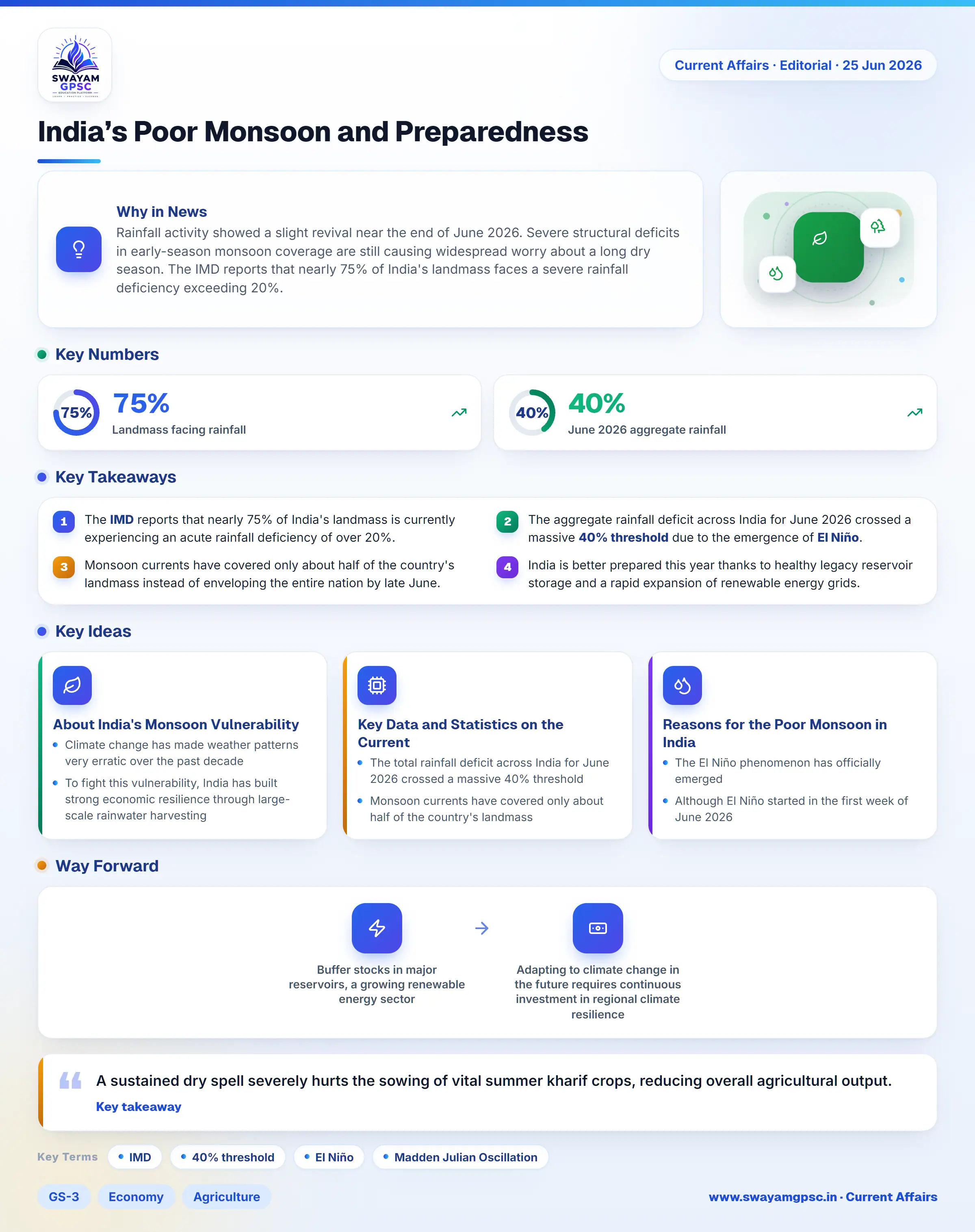
- The IMD reports that nearly 75% of India's landmass is currently experiencing an acute rainfall deficiency of over 20%.
- The aggregate rainfall deficit across India for June 2026 crossed a massive 40% threshold due to the emergence of El Niño.
- Monsoon currents have covered only about half of the country's landmass instead of enveloping the entire nation by late June.
- India is better prepared this year thanks to healthy legacy reservoir storage and a rapid expansion of renewable energy grids.
Why in News
- Rainfall activity showed a slight revival near the end of June 2026. Severe structural deficits in early-season monsoon coverage are still causing widespread worry about a long dry season.
- The IMD reports that nearly 75% of India's landmass faces a severe rainfall deficiency exceeding 20%.
About India's Monsoon Vulnerability and Resilience
- Climate change has made weather patterns very erratic over the past decade, causing huge regional and local variations in rainfall distribution.
- To fight this vulnerability, India has built strong economic resilience through large-scale rainwater harvesting projects and better groundwater management in rural areas.
- The country has also shifted quickly toward renewable energy grids to reduce dependence on traditional power sources.
Key Data and Statistics on the Current Poor Monsoon
- The total rainfall deficit across India for June 2026 crossed a massive 40% threshold, which experts believe cannot be bridged before July.
- Monsoon currents have covered only about half of the country's landmass, whereas normal timelines show the rain should cover almost the entire nation by late June.
- Roughly 75% of India's total land area currently suffers from an acute rainfall deficit of 20% or more.
Reasons for the Poor Monsoon in India
- The El Niño phenomenon has officially emerged, bringing abnormal warming to the equatorial Pacific Ocean and suppressing multi-month rainfall activity.
- Although El Niño started in the first week of June 2026, its full disruptive atmospheric block takes over a month to reach the subcontinent, adding pressure for July and August.
- An unfavourable phase of the Madden Julian Oscillation placed a rain-suppressing wind and cloud system directly over India during most of June, pushing rain clouds far away.
- Regional low-pressure atmospheric systems formed over the ocean lacked the thermal and structural strength needed to drive continuous rain over the land.
- Early-season maritime wind currents lacked the momentum to push the monsoon grid past central India, leaving half the landmass dry.
Implications of a Poor Monsoon on India
- A sustained dry spell severely hurts the sowing of vital summer kharif crops, reducing overall agricultural output.
- Lower crop yields directly compress farm incomes because many people depend on agriculture, which slows down rural retail consumption.
- Reduced crop harvests can trigger structural food price inflation, forcing the government to use buffer stocks or place export curbs.
- A weak monsoon stops underground aquifers from recharging naturally, which dries up local wells and lowers drinking water supplies.
- Low water levels in major rivers reduce the operating capacity of hydroelectric plants, adding extra stress to the national power grid.
India’s Preparedness to Handle a Poor Monsoon
- Exceptionally high rainfall over the previous two consecutive years filled major industrial and agricultural reservoirs, leaving them with healthy buffer storage.
- The rapid growth of solar and wind energy installations over the past ten years reduced the power grid's reliance on hydro turbines, saving reservoir water for drinking and farming.
- Public works under rural employment schemes focused heavily on building check dams, installing rainwater harvesting systems, and improving water conservation.
- Official scientific data shows a clear turnaround and improvement in regional groundwater tables because of systematic watershed management.
- Timely and digitized weather forecasts from the IMD helped farmers change their kharif crop timelines and make good use of early pre-monsoon showers.
Way Forward
- Buffer stocks in major reservoirs, a growing renewable energy sector, and wide water harvesting networks provide a vital safety cushion for the country.
- Adapting to climate change in the future requires continuous investment in regional climate resilience and smart agricultural forecasting to protect the domestic economy from erratic weather.