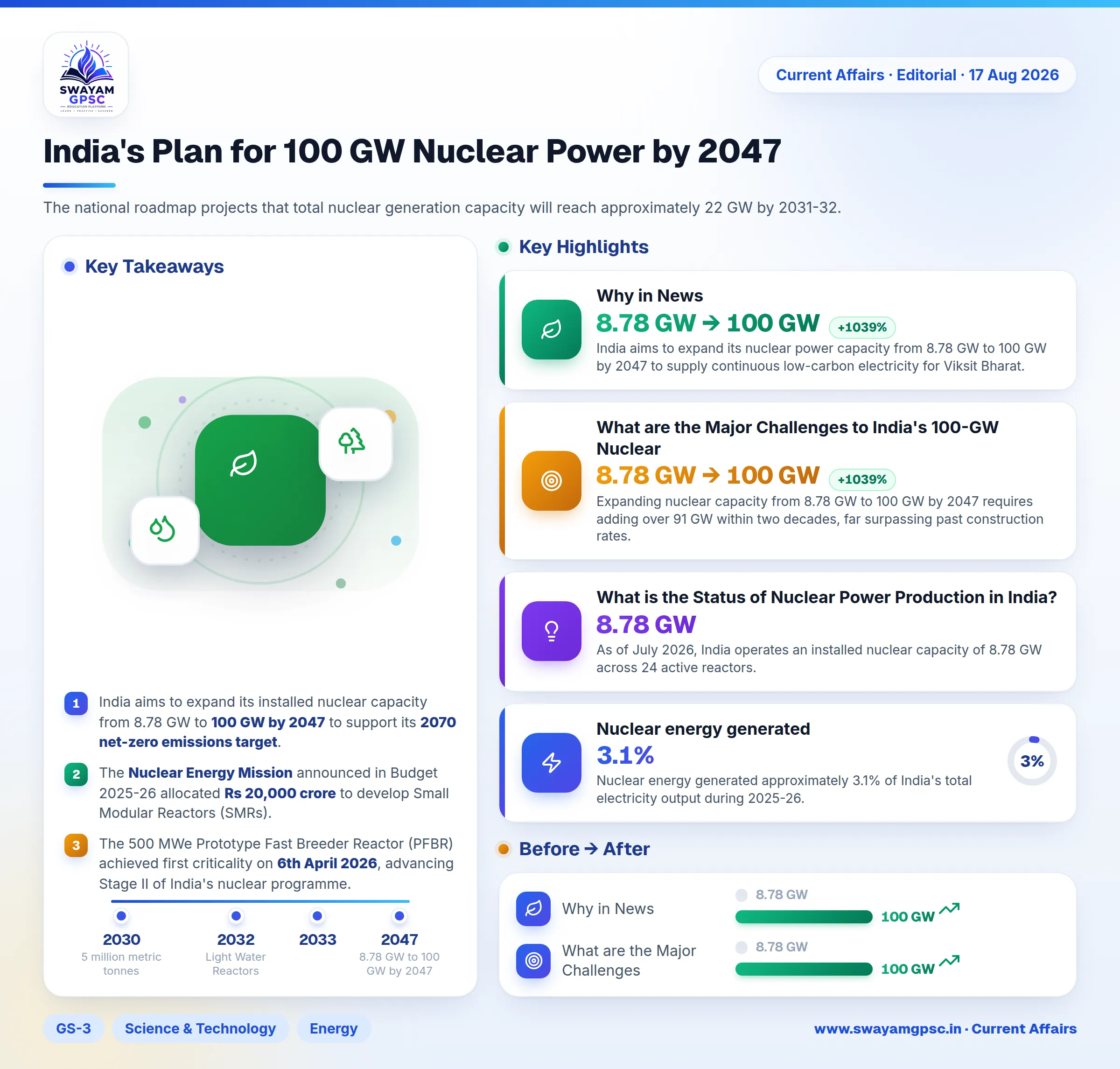
India's Plan for 100 GW Nuclear Power by 2047
#GS-3 #Science & Technology #Energy #Economy #Infrastructure #Environment #Climate Change #Current Events #National
Key takeaways
- India aims to expand its installed nuclear capacity from 8.78 GW to 100 GW by 2047 to support its 2070 net-zero emissions target.
- The Nuclear Energy Mission announced in Budget 2025-26 allocated Rs 20,000 crore to develop Small Modular Reactors (SMRs).
- The 500 MWe Prototype Fast Breeder Reactor (PFBR) achieved first criticality on 6th April 2026, advancing Stage II of India's nuclear programme.
- A 100 GW nuclear fleet will require over 20,000 tonnes of imported uranium annually, highlighting the need for secure fuel reserves.
Why in News
- India aims to expand its nuclear power capacity from 8.78 GW to 100 GW by 2047 to supply continuous low-carbon electricity for Viksit Bharat.
- Expanding nuclear power capacity directly supports India's commitment to achieve net-zero emissions by 2070.
- The enactment of the SHANTI Act 2025 and growing private sector involvement have intensified national policy discussions on nuclear expansion.
- The Prototype Fast Breeder Reactor (PFBR) reached its first criticality in April 2026, raising important questions about managing foreign uranium dependencies.
What is the Status of Nuclear Power Production in India?
- As of July 2026, India operates an installed nuclear capacity of 8.78 GW across 24 active reactors.
- Nuclear energy generated approximately 3.1% of India's total electricity output during 2025-26.
- The national roadmap projects that total nuclear generation capacity will reach approximately 22 GW by 2031-32.
- Beyond 2032, the Nuclear Power Corporation of India Limited (NPCIL) plans to add 32 GW using indigenous Pressurised Heavy Water Reactors (PHWRs) and Light Water Reactors (LWRs).
- India targets adding an initial 1 GW of Fast Breeder Reactors through two 500 MW units.
- State PSUs, private companies, and joint ventures are expected to add around 45 GW of nuclear capacity.
- The overall national target sets a long-term goal of 100 GW total nuclear capacity by 2047.
- The government announced the Nuclear Energy Mission in Union Budget 2025-26 to drive national capacity expansion.
- The budget allocated Rs 20,000 crore under the mission for research, design, and deployment of Small Modular Reactors (SMRs).
- The mission targets operationalising at least five indigenously designed SMRs by 2033.
- The government is actively developing the 200/220 MWe Bharat Small Modular Reactor and the 55 MWe SMR-55.
- The Bhabha Atomic Research Centre is developing a high-temperature gas-cooled reactor designed specifically for hydrogen production.
Why does India Need to Expand Nuclear Power Production?
- Rapid industrialisation, urbanisation, data centres, electric transport, and green hydrogen production will sharply increase national electricity demand.
- The Central Electricity Authority (CEA) projects peak electricity demand to increase from 250 GW in 2024-25 to 459 GW by 2035-36.
- India reached 274 GW of installed renewable capacity by March 2026, including 150 GW of solar and 56 GW of wind energy.
- Non-fossil sources produced only 29.2% of total electricity generation in 2025-26 despite large installed capacity.
- The CEA estimates that India will require 174 GW/888 GWh of energy storage by 2035-36 to balance variable solar and wind power.
- Nuclear power plants run continuously between refuelling cycles, providing reliable baseload power and reducing storage requirements.
- The CEA projects that India will still need around 315 GW of coal capacity in 2035-36 unless clean baseload sources expand rapidly.
- Replacing coal generation with nuclear power cuts greenhouse emissions and reduces congestion on the national railway network.
- Achieving net-zero by 2070 requires electrifying industrial production and transport using low-carbon electricity.
- Nuclear power has low average lifecycle emissions of 5.5 grams of CO2-equivalent per kWh, covering mining, construction, and operation.
- Clean nuclear power can decarbonise heavy industries, electric transport, steel making, building cooling, and water desalination.
- Nuclear energy strengthens national energy security by reducing vulnerability to volatile oil imports and maritime supply routes.
- High energy density allows utilities to stockpile nuclear fuel easily for several years, unlike bulky coal or liquefied natural gas.
- Natural uranium forms a small share of total nuclear power costs, and domestic PHWRs do not need expensive enriched fuel.
- High-tech facilities like semiconductor fabs, data centres, and artificial intelligence infrastructure demand uninterrupted power supply.
- Deploying Small Modular Reactors near industrial hubs or former coal plants provides continuous local power without grid strain.
- The National Green Hydrogen Mission aims to produce 5 million metric tonnes of clean hydrogen annually by 2030.
- Advanced nuclear reactors supply stable electricity and high-temperature heat to improve electrolyser efficiency for hydrogen production.
- The Bhabha Atomic Research Centre (BARC) is building a 5 MWth gas-cooled reactor focused on clean hydrogen generation.
- Constructing standardized 700 MWe PHWRs in fleet mode creates steady orders for major domestic manufacturing firms like Larsen & Toubro and BHEL.
- Expanding domestic nuclear manufacturing generates valuable technological spillovers in advanced metallurgy, precision engineering, and robotics.
- India's nuclear establishments currently support healthcare, medical sterilization, food irradiation, crop breeding, and industrial testing.
- Expanding nuclear facilities will increase the national supply of critical radioisotopes and train specialized technical personnel.
India's Three-Stage Nuclear Power Programme
- Dr. Homi J. Bhabha designed India's three-stage nuclear strategy to overcome limited domestic uranium and utilize abundant thorium resources.
- Stage I uses Pressurised Heavy Water Reactors (PHWRs) fuelled by natural uranium, with heavy water serving as moderator and coolant.
- Reprocessing spent fuel from PHWRs yields fissile Plutonium-239, which serves as fuel for the second stage.
- Stage II relies on Fast Breeder Reactors (FBRs) that convert fertile Uranium-238 into fissile Plutonium-239, producing more fuel than they consume.
- India's 500 MWe PFBR at Kalpakkam uses mixed oxide fuel and reached its first criticality on 6th April 2026.
- Stage III aims to utilize fertile Thorium-232, which must absorb neutrons in a reactor to transform into fissile Uranium-233.
- Thorium cannot replace imported uranium immediately because its utilization depends on the commercial expansion of breeder reactors.
What Advantages does Nuclear Power Offer India over Crude Oil Dependence?
- Nuclear fuel requires very small physical storage volume due to high energy density, unlike massive petroleum imports.
- Power companies can easily store several years of nuclear fuel reserves, whereas oil storage requires vast and costly facilities.
- Uranium raw material represents a minor part of generation costs, keeping nuclear power prices insulated from commodity price spikes.
- Existing fuel stocks give nuclear power plants strong resistance against global trade disruptions and supply shocks.
- Nuclear fuel conversion and processing facilities can be concentrated and secured far more easily than widespread oil refineries.
- Standardized nuclear fuel assemblies ensure predictable fuel management, unlike varying imported crude oil grades.
What are the Major Challenges to India's 100-GW Nuclear Power Target?
- Expanding nuclear capacity from 8.78 GW to 100 GW by 2047 requires adding over 91 GW within two decades, far surpassing past construction rates.
- Nuclear projects face prolonged timelines due to sequential site selection, land acquisition, safety approvals, and grid connection tests.
- Although the 500 MWe PFBR achieved criticality in April 2026, it still requires lengthy power-ascension tests before commercial operation.
- Reaching 100 GW will require immense financial investments estimated at Rs 15 lakh crore, requiring substantial private sector funding.
- Nuclear projects have suffered severe cost escalations, with Kudankulam Units 3 and 4 rising by 73% and RAPP 7 and 8 increasing by 86%.
- High initial construction costs result in elevated nuclear tariffs, making state discoms hesitate to sign long-term Power Purchase Agreements.
- Operating a 100 GW nuclear fleet could require over 20,000 tonnes of imported uranium annually, compared to 1,884 tonnes used in 2025.
- Relying on a small group of foreign uranium suppliers exposes India to risks from geopolitical conflicts, economic sanctions, and transit bottlenecks.
- Domestic uranium mining faces constraints from low ore quality, high processing costs, environmental concerns, and local community protests.
- Importing Light Water Reactors creates persistent reliance on foreign vendors for specialized fuel assemblies and technological components.
- Geopolitical disruptions such as the Russia-Ukraine war have caused equipment delivery delays for the Kudankulam nuclear project.
- A 100 GW nuclear fleet will generate large volumes of radioactive waste, but India lacks an operational deep geological repository.
How to Strengthen India's Nuclear Energy Ecosystem to Achieve 100 GW Target?
- India should prioritize fleet-mode construction of standardized 700 MWe PHWRs to lower procurement costs and shorten construction timelines.
- Funding for the PFBR, fast breeder reactors, and thorium fuel research must be ring-fenced to ensure steady technological progress.
- The government should establish an independent nuclear safety regulator with a dedicated budget drawn from the Consolidated Fund of India.
- Policy makers should develop innovative financing structures using sovereign green bonds, public-private joint ventures, and milestone-linked funding.
- India must create a comprehensive national strategy covering spent-fuel handling, waste immobilisation, and deep geological waste repositories.
- Project authorities must build local trust by sharing radiation data, emergency plans, and environmental monitoring results with nearby communities.
- The government and technical institutions must coordinate to train nuclear engineers, precision welders, reactor physicists, and safety inspectors.
- Nuclear energy must complement renewable expansion, energy storage systems, and green hydrogen projects to build a balanced power grid.
Conclusion
- Nuclear power offers India a reliable source of clean baseload electricity to power Viksit Bharat and reach net-zero emissions by 2070.
- Achieving long-term energy independence requires securing diverse uranium supplies, mastering the closed fuel cycle, and expanding thorium utilization.