India's Path to Blue Skies: Clean Air Initiatives and Policy Action
#GS-2 #GS-3 #Governance & Social Justice #Environment #Government Policies & Interventions #Climate Change #Pollution #Air Quality Index #NCAP
Key takeaways
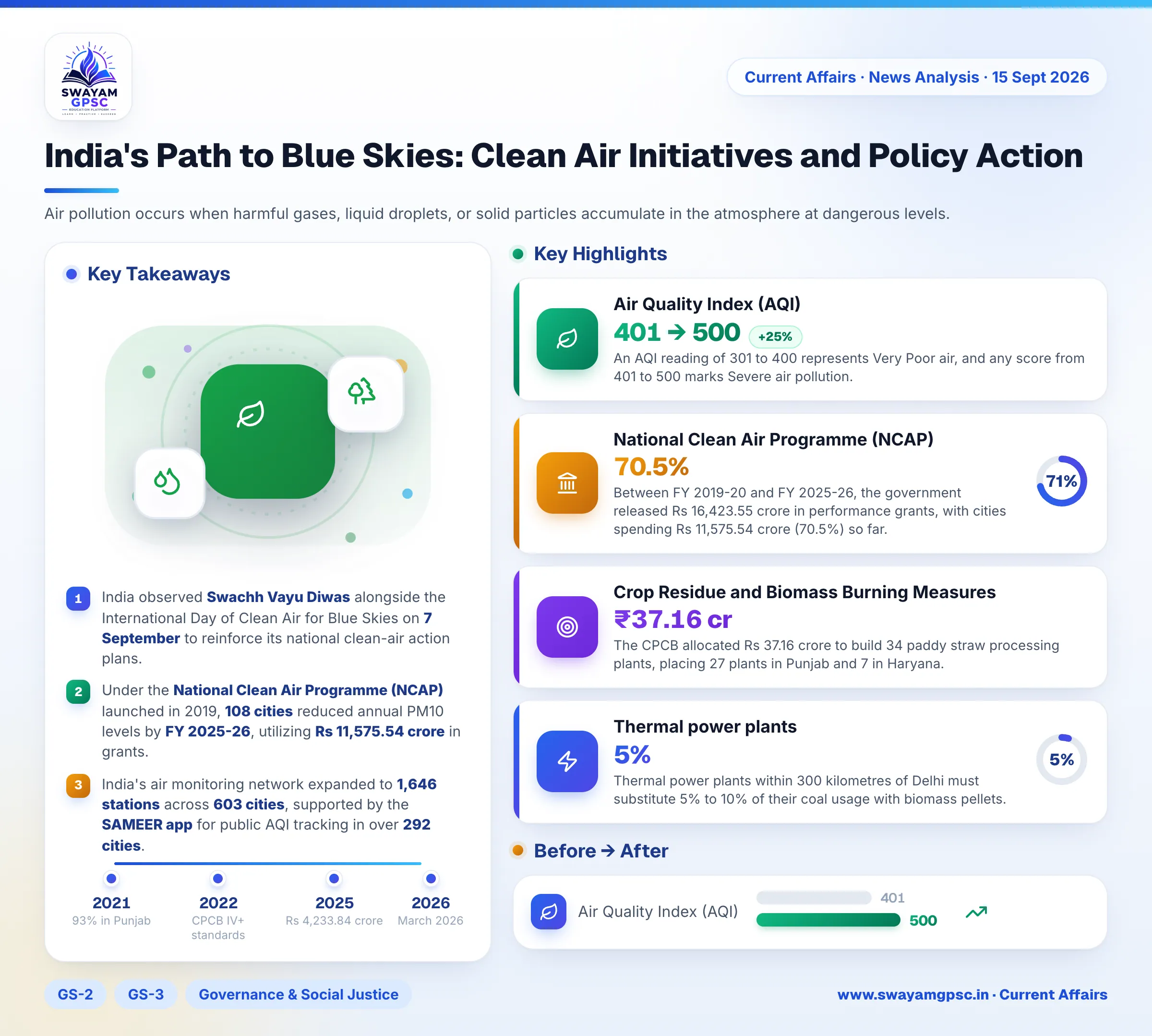
- India observed Swachh Vayu Diwas alongside the International Day of Clean Air for Blue Skies on 7 September to reinforce its national clean-air action plans.
- Under the National Clean Air Programme (NCAP) launched in 2019, 108 cities reduced annual PM10 levels by FY 2025-26, utilizing Rs 11,575.54 crore in grants.
- India's air monitoring network expanded to 1,646 stations across 603 cities, supported by the SAMEER app for public AQI tracking in over 292 cities.
- Targeted farm machinery distribution of over 3.53 lakh units led to a 93% drop in stubble burning in Punjab and 91% drop in Haryana in 2025 compared to 2021.
- Nationwide environmental drives achieved massive scale, with 262.4 crore saplings planted under the Ek Ped Maa Ke Naam campaign by December 2025.
Why in News
- The world observed the International Day of Clean Air for Blue Skies on 7 September to raise awareness and encourage global action against air pollution.
- The United Nations General Assembly established this annual event in 2019 to emphasize international commitments toward improving air quality.
- India celebrates this day as Swachh Vayu Diwas to align its national pollution control goals with international efforts.
What is Air Pollution
- Air pollution occurs when harmful gases, liquid droplets, or solid particles accumulate in the atmosphere at dangerous levels.
- These pollutants originate from natural events as well as human activities like vehicle transport, manufacturing, construction, and open burning.
- Clean air remains essential for maintaining human health, protecting ecosystems, and sustaining economic prosperity.
- Particulate Matter consists of tiny solid or liquid particles floating in the air that pose severe health risks.
- The category PM10 includes all coarse particles with a diameter measuring 10 micrometres or less.
- The category PM2.5 consists of fine particles measuring 2.5 micrometres or less that can enter deep into the human lungs and blood circulation.
- Because of their tiny size, PM2.5 particles cause severe heart and lung diseases, making particle reduction a vital public health goal.
Air Pollution Monitoring Systems
- The Continuous Ambient Air Quality Monitoring System (CAAQMS) provides real-time automated tracking of major air pollutants including PM2.5, PM10, SO2, NOx, CO, O3, and NH3.
- The Ambient Air Quality Monitoring System (AAQMS) uses both manual 24-hour sample testing and automated continuous measurements to track air quality.
- The Online Continuous Emission Monitoring System (OCEMS) requires highly polluting industrial plants to send real-time emission data straight to regulatory authorities.
National Air Quality Monitoring Programme (NAMP)
- The Central Pollution Control Board (CPCB) started the NAMP initiative to track air quality trends, identify policy violations, and evaluate public health risks.
- As of March 2026, the country operates 1,646 monitoring stations spread across 603 cities in 28 States and 7 Union Territories.
- This tracking network uses manual sampling stations alongside real-time continuous monitoring stations.
- Citizens can check real-time air quality data for over 292 cities using the SAMEER mobile app and report local pollution complaints.
Air Quality Index (AQI)
- The Air Quality Index (AQI) transforms complex chemical data into a simple color-coded scale to inform the public about air safety.
- Calculations for the AQI monitor eight key pollutants: PM2.5, PM10, Nitrogen Dioxide, Sulphur Dioxide, Carbon Monoxide, Ozone, Ammonia, and Lead.
- An AQI score between 0 and 50 indicates Good air, while 51 to 100 represents Satisfactory conditions.
- An AQI level between 101 and 200 means Moderate pollution, whereas 201 to 300 signals Poor air quality.
- An AQI reading of 301 to 400 represents Very Poor air, and any score from 401 to 500 marks Severe air pollution.
National Clean Air Programme (NCAP)
- The Ministry launched the National Clean Air Programme (NCAP) in 2019 as a targeted initiative covering 130 cities.
- This program drives source-specific pollution control plans created through cooperation between central ministries, state leaders, and local city bodies.
- A total of 24 States and UTs together with 130 target cities have finalized customized clean-air strategies.
- Between FY 2019-20 and FY 2025-26, the government released Rs 16,423.55 crore in performance grants, with cities spending Rs 11,575.54 crore (70.5%) so far.
- During FY 2025-26, 108 cities successfully lowered their annual average PM10 levels compared to 2017-18 baseline levels.
Digital Tracking of Air Quality Improvement
- The PRANA Portal functions as an official dashboard to monitor the financial spending and physical progress of NCAP targets across non-attainment cities.
Swachh Vayu Survekshan
- The Ministry of Environment, Forest and Climate Change (MoEFCC) created the Swachh Vayu Survekshan ranking system in 2022-23 to assess 130 NCAP cities annually.
- This initiative encourages friendly competition, creative technology adoption, and active implementation of clean air plans among municipal authorities.
- The 2026 assessment expanded to local ward levels, reviewing anti-pollution efforts in more than 7,400 wards nationwide.
- In the Swachh Vayu Survekshan 2026 rankings, Lucknow won first place in Category 1, Rourkela topped Category 2, and Kalinganagar led Category 3.
Vehicular Emissions Mitigation Measures
- India mandated cleaner BS-VI fuel and vehicle standards nationwide starting in April 2020 to cut exhaust emissions.
- The government accelerates electric vehicle adoption using dedicated funding programs such as the PM E-DRIVE scheme and PM E-Bus Sewa.
- The Ministry of Power issued official rules to expand charging infrastructure across highways and urban areas.
- The Vehicle Scrapping Policy relies on Registered Vehicle Scrapping Facilities (RVSFs) and Automated Testing Stations (ATS) to clear old vehicles off roads.
- Authorities are upgrading the Pollution Under Control (PUC) certification framework to enforce strict vehicular compliance.
- City plans focus on clearing traffic bottlenecks and promoting public transit, while the PARIVARTAN program replaces older NCR commercial fleets with cleaner BS-VI, CNG, or electric vehicles.
- The Commission for Air Quality Management (CAQM) ruled that only BS-VI, CNG, and electric buses can enter Delhi starting 1 November 2026.
- Regulators directed delivery platforms, commercial aggregators, and e-commerce companies to switch their fleets to zero-emission vehicles.
- Authorities across Delhi and surrounding NCR districts are transitioning passenger and freight transport to electric L5 three-wheelers.
Industrial Emissions Mitigation Measures
- The government established mandatory environmental limits for factory emissions under the Environment Protection Rules, 1986.
- The Central Pollution Control Board (CPCB) classified 419 industrial sectors into categories based on their pollution severity.
- All units across 17 highly polluting sectors must install OCEMS devices connected to CPCB monitoring servers.
- Factory operations across Delhi-NCR must run exclusively on approved clean fuels while maintaining air pollution control equipment.
- The CAQM capped industrial particulate matter emissions at 50 mg/Nm3 starting 1 October 2026.
- State regulators must enforce strict pollution limits and penalize non-compliant manufacturing units in industrial zones.
- The Comprehensive Environmental Pollution Index (CEPI) targets specialized cleanup plans for Critically Polluted Areas (CPAs) and Severely Polluted Areas (SPAs).
- In 2022, new CPCB IV+ standards came into effect for power generators up to 800 kW using diesel, petrol, or mixed fuel.
Road Dust and Construction Pollution Measures
- The CPCB published strict guidelines to prevent airborne dust and handle Construction and Demolition (C&D) waste responsibly.
- Large building sites exceeding 20,000 square metres must install anti-smog guns and suppression systems.
- Road management entities created 70 Dust Control and Management Cells (DCMCs) across NCR under CAQM oversight.
- Building projects covering over 500 square metres in Delhi-NCR must maintain continuous digital dust monitoring.
Open Waste Burning Control Measures
- The nation enforces detailed waste collection and treatment frameworks, including revised Solid Waste Management Rules and updated rules for plastic, hazardous, e-waste, battery, and biomedical waste.
- Mandatory Extended Producer Responsibility (EPR) frameworks compel manufacturers to collect and recycle plastic packaging, spent batteries, old tyres, and waste oil.
- India banned 12 high-litter single-use plastic items like straws, plastic cutlery, and thermocol decorations starting 1 July 2022.
Crop Residue and Biomass Burning Measures
- The CPCB allocated Rs 37.16 crore to build 34 paddy straw processing plants, placing 27 plants in Punjab and 7 in Haryana.
- Thermal power plants within 300 kilometres of Delhi must substitute 5% to 10% of their coal usage with biomass pellets.
- The Agriculture Ministry provided Rs 4,233.84 crore between 2018-19 and 2025-26 to distribute 3.53 lakh farm machines and set up 43,535 Custom Hiring Centres.
- Coordinated farm support reduced stubble burning incidents by 93% in Punjab and 91% in Haryana during 2025 compared to 2021 figures.
Afforestation and Green Cover Expansion
- The Green India Mission disbursed Rs 1,019.26 crore to states up to March 2026 to expand forest cover and increase carbon storage.
- The CAMPA authority restored ecological balance by completing compensatory afforestation on over 3.20 lakh hectares between FY 2020-21 and FY 2024-25.
- Under the Nagar Van Yojana, authorities released Rs 557.62 crore by 31 March 2026 to establish 626 urban forests on the way to a goal of 1,000 green sites by 2026-27.
- The Aravalli Green Wall Initiative aims to rehabilitate 6.31 million hectares across four states, establishing 435 plant nurseries and restoring 36,025 hectares in 2025.
- The popular Ek Ped Maa Ke Naam tree planting campaign achieved 262.4 crore planted saplings by December 2025.
Institutions Driving Clean Air Goals
- The Central Pollution Control Board (CPCB) operates as a statutory body created under the Water Act of 1974 while deriving its air management authority from the Air Act of 1981.
- The CPCB leads national monitoring networks, establishes emission standards, conducts research, and guides state pollution boards.
- The Commission for Air Quality Management (CAQM) functions under a 2021 Parliamentary Act as an overarching regulatory authority for the Delhi-NCR airshed.
- The CAQM coordinates inter-state policy actions across Delhi, Haryana, Rajasthan, and Uttar Pradesh to tackle regional air pollution.
- The Graded Response Action Plan (GRAP) acts as an emergency policy framework that triggers progressively stricter anti-pollution rules as air quality degrades in Delhi-NCR.
- GRAP consists of four distinct levels: Stage I (Poor, AQI 201-300), Stage II (Very Poor, AQI 301-400), Stage III (Severe, AQI 401-450), and Stage IV (Severe+, AQI above 450).
- State Pollution Control Boards (SPCBs) enforce environmental laws locally by inspecting factories, granting operating consents, and monitoring industrial discharges.
- The duties of SPCBs now cover managing industrial effluent, ambient noise levels, hazardous material disposal, and electronic waste.
Digital Reforms in Environmental Regulation
- Parliament amended the Air Act of 1981 and Water Act of 1974 to streamline consent procedures and modernize regulatory compliance.
- The government notified updated Air Consent Guidelines on 29 January 2025 and corresponding Water Consent Guidelines on 30 January 2025.
- The CPCB built the Unified Consent and Authorization Management System (UCAMS) as an online portal for processing all factory permit applications.
- The UCAMS platform delivers end-to-end digital processing for consent approvals, rejections, and renewals to ensure administrative transparency.
Way Forward
- Securing clean air across India requires long-term commitment, scientific planning, and collaborative governance across all state boundaries.
- Expanding programs like NCAP, strengthening digital monitoring networks, promoting clean vehicle technology, and restoring ecosystems will build environmental resilience.